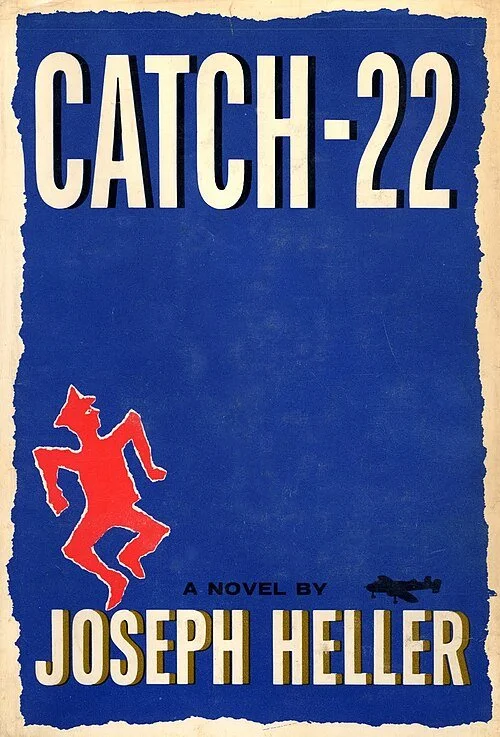
Banned Book of the Month - Catch-22 by Joseph Heller
Photo from Wikipedia.
Author:
Joseph Heller was born May 1, 1923, in New York to Russian-Jewish immigrant parents. He enlisted in the U.S. Army Air Corps at the age of 19 and served in the Mediterranean, flying 60 missions from the island of Corsica. After the war, he used the G.I. Bill to earn degrees from New York University and Columbia University before working as an English teacher and an advertising copywriter. He is best known for his 1961 satirical novel, Catch-22, which used absurdist and dark humor to harshly criticize military bureaucracy and wartime logic. The title, Catch-22, became a famously known paradox used in the English language. Heller spent the rest of his career addressing issues in a similar satirical sense with more novels, including Something Happened (1974) and Good as Gold (1979), getting nominated for the Nobel Prize in Literature twice.
Summary:
Catch-22 is a satirical World War II novel that follows the protagonist, Captain John Yossarian, a U.S. bomber stationed on the island of Pianosa. Yossarian and his friends are forced to endure a life controlled by bureaucracy and violence, as their superior officers only see them as inhuman resources to fight the war. The group is thrown into deadly combat situations and fiery bombing runs without a second thought, and it is bizarrely more important for them to catch quality aerial photographs of the explosions than to actually destroy their targets. The superior officers value photogenic, aesthetically pleasing bombing patterns over military strategy and human lives.
Yossarian and his friends face emotionless bureaucrats, incompetent generals, and psychopathic officers—people all only working for their own good. One particular mess officer, Milo Minderbinder, even runs a global black-market group that works with the enemy to bomb its own base for profit. Throughout the story, Yossarian witnesses many of his fellow soldiers, Nately, McWatt, and Snowden all die in horrible ways. Snowden bleeds to death from a leg wound and internal injuries in the back of a plane after being poorly advised to sit in the fuselage during a bombing raid. Nately is killed in a mid-air plane crash during a mission flight. McWatt, overcome with guilt and horror after accidentally killing a fellow airman, commits suicide by deliberately flying his aircraft into a mountain. Yossarian’s roommate, Orr, is also declared dead after he crashed his plane into the Mediterranean Sea.
During the war, Yossarian wants nothing more than to stay alive and go home. He knows that insane pilots are not allowed to fly, and therefore can be excused from the island and military base if they request an insanity evaluation. However, the military traps him using the paradoxical “Catch-22” rule: a pilot who asks to be excused from dangerous missions is showing a rational concern for his safety, which proves he is in fact sane, and must keep flying the aircrafts.
Towards the end of the book, Yossarian receives a corrupt deal from his commanding officers, Colonels Cathcart and Korn, where they offer to send him home with an honorable discharge, a promotion, and a medal for the “saving” of Cathcart’s life. The catch: in exchange, Yossarian must publicly praise the colonels, express support for their policies, and be a loyal man to the military so they can use him as a propaganda tool. Yossarian accepting this deal would mean compromising his morals and betraying the memory of his dead comrades who were lost in the very war his colonels wanted him to praise. He realizes that taking the easy way out is a trap and refuses the corrupt bargain. He also discovers that Orr, his former tentmate, had in fact survived his plane crash and had planned it in order to escape the military. Before his presumed death, Orr had continuously been crashing his plane in the sea but had survived. It turned out that he was practicing his plane crashes so he could easily disappear once he faked his death. He paddled a rubber life raft to neutral Sweden and was able to live in peace there. Hearing this inspires Yossarian to do the same, and instead of taking the officers’ deal, he deserts his combat missions and runs away to Sweden as well, finally escaping the psychotic military system.
Why It’s Banned:
While this book is not universally banned, it has faced many removals and school curriculum bans due to profane language, sexual content, violence, and anti-authoritarian views. The novel contains lots of crude language, offensive expressions, and explicit dialogue that many local school boards and libraries have deemed inappropriate for younger teens and children. Critics have also repeatedly flagged the book for its demeaning and derogatory descriptions of women, including scenes depicting physical abuse and violence towards them. There is also lots of violence in the story in general, as it portrays realities of World War II combat like brutal injuries, death, and psychological trauma. Since the book harshly criticizes military bureaucracy, blind patriotism, and the absurdity of war, it has often faced increased pushback during times of political sensitivity, such as the Vietnam War era. Catch-22 can be found at Pauline Haass Public Library, Menomonee Falls Public Library, and Pewaukee Public Library.