Book Review: Looking for Alaska by John Green
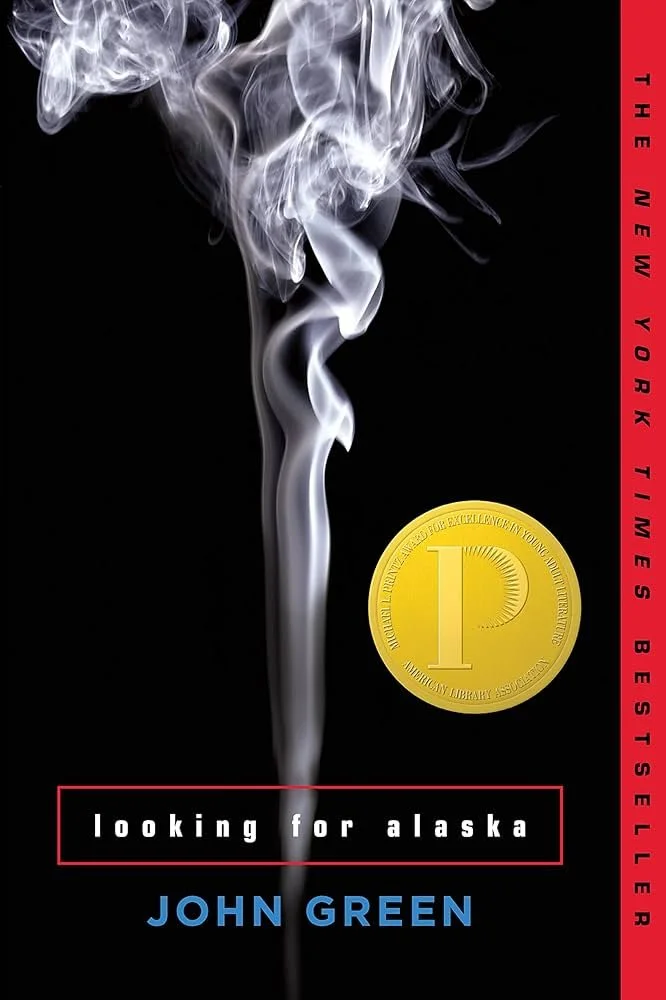
Image from Amazon.
Mollie Westfahl
“How will we ever get out of this labyrinth of suffering?”
This is the driving question of John Green’s first novel. Over 20 years since its publication, it remains one of the most banned books in the U.S. However, this book cannot be judged or defined by a singular short scene. There are a couple hundred more pages to read and learn from—and there’s a lot to be learned because Looking for Alaska is a book about how to make life worth living.
Miles Halter is intrigued by famous last words. He becomes fixated on the final words of the French writer, François Rabelais, “I go to seek a Great Perhaps.” So, in searching for his own Great Perhaps, Miles enrolls in boarding school, where he meets Alaska Young. Alaska is mysterious to Miles, even as they grow closer. Alaska is intense, she’s strong-willed and even reckless. She and Miles’s roommate, Chip, pull off grand pranks on classmates and teachers. But Alaska is also charming and friendly, with a love of reading. It’s Alaska that introduces Miles to the last words of Simón Bolívar, “How will I ever get out of this labyrinth?” where they interpret the labyrinth not as life or death, but the pain that we carry throughout our lives.
I recommend Looking for Alaska to anyone who enjoys books with raw emotions, deep philosophical questions, and coming-of-age stories. It shares similar themes with The Perks of Being a Wallflower, We Were Liars, If I Stay, and 13 Reasons Why. Of course, if you’ve liked other John Green books like Paper Towns, The Fault in Our Stars, and Turtles All the Way Down, Green’s writing style really shines through in this book.
A Banned Book
Despite being highly critically acclaimed, Looking for Alaska is consistently among the most banned books. According to PEN America, it was banned 147 times between 2021 and 2025, making it the most-banned book of that period. Often, the reason for the banning is “sexually explicit content.” It also contains characters drinking, smoking, and swearing, not the most school-friendly actions. Personally, I think it’s fine if the book comes with a warning, but I don’t think any of this warrants a banning. The sex scene isn’t dirty and obscene—it’s used to show contrast between physical and emotional intimacy. The smoking and drinking aren’t encouraged or glorified; rather, they’re shown as unhealthy ways to cope. Banning this book takes away important lessons of self-discovery and complex relationships.
Escaping the Labyrinth
Exactly halfway through the book, a sudden tragedy transforms Alaska’s life. After a seemingly random breakdown, Alaska drives off in the middle of the night. For the sake of finding closure, Miles and Chip try to figure out more details of Alaska’s departure. Despite all the information they uncover, Green never explicitly reveals Alaska’s final intentions. He wanted to teach us that, despite being filled with pain and suffering, life can still be filled with hope and love through forgiveness. Alaska lived a difficult life that certainly fit the description of a “labyrinth of suffering,” and she was never able to forgive herself after her mother’s passing. But by the end of the book, Miles finds the strength to forgive himself and Alaska, thus making his time in the labyrinth bearable.
So how do we escape this labyrinth of suffering? I see Miles’s Great Perhaps as a solution to Alaska’s Labyrinth of Suffering. Pain is inevitable, but I believe finding meaning in your life is essential to prevent getting suffocated by the hopelessness that often comes with suffering. Of course, there is no definitive answer, and I encourage you to read Looking for Alaska and discover your own way out of the Labyrinth.