Cutting Credits, Changing Culture: What Hamilton Stands to Lose
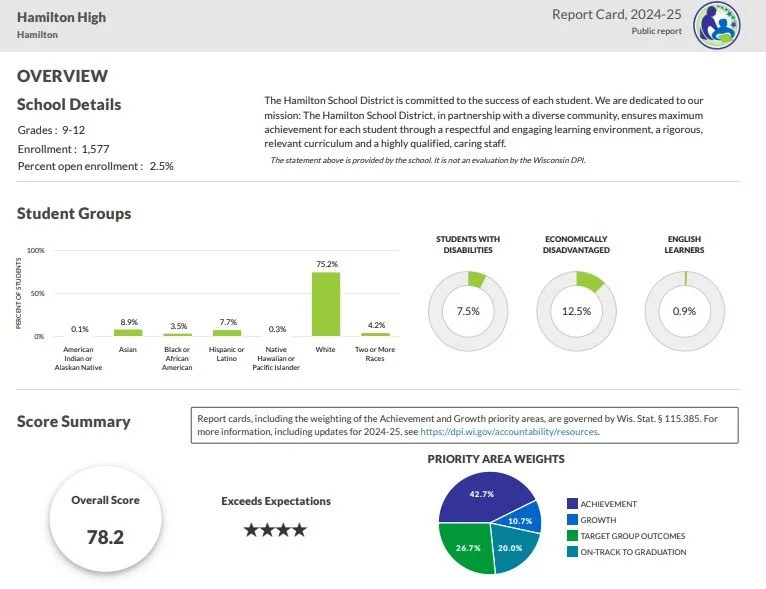
Image of the State Report Card for Hamilton High School from WI DPI.
In the coming 2026-2027 school year, there have been discussions within the Hamilton administrative team about a potential change in graduation requirements. In an interview with Hamilton High School Principal, Mr. Bauer, we met to discuss the possibility of this change and his belief that this recommendation will improve Hamilton. The plan, should it move forward, is that the number of credits needed to graduate with a full diploma would decrease from the current 28 to 25. The requirement for 16 total core credits, consisting of English, Math, Science, Social Studies, Physical Education, and Personal Finance, will remain, with the elective credits required to graduate being lowered. Mr. Bauer adds that students who would like to take “full advantage of the opportunities we offer” will still have the opportunity to earn more credits despite the lowered mandatory credits.
There is some important background to review to best understand the rationale behind this change. In addition to the standard diploma, there is another available diploma to graduating high school students called the basic diploma. According to the Wisconsin Department of Public Instruction (DPI), a basic high school diploma needs 15.5 credits, consisting of 4 ELA credits, 3 Math credits, 3 Science credits, 3 Social Studies credits, 1.5 Physical Education credits, 0.5 Health credits, and 0.5 Personal Financial Literacy credits. This is the minimum requirement needed to graduate. Hamilton’s basic diploma is the same, but rather than 0.5 Personal Financial Literacy credits, Hamilton students earn a full credit due to block scheduling. It is important to note that only 1-3% of HHS students earn this basic diploma, although some of the students who only earn the 15-credit basic diploma rather than the 28-credit full diploma still accumulate credits somewhere between 15 and 28 credits.
However, while many two-year technical colleges do accept this basic diploma, according to Mr. Bauer, most four-year colleges and universities do not accept a basic diploma. Because a full diploma offers more opportunities for graduates, the Wisconsin State Superintendent encourages students to pursue an additional 8.5 credits for a total of 24 credits (the minimum credit requirement for a full diploma as determined by the state). The full diploma at Hamilton currently requires 28 credits. It requires the same number of core credits as the basic diploma, but more elective credits (from any category). Mr. Bauer stated that he believes “the vast majority of graduates end up with more than 28 credits.”
This prospective change is due in part to the fact that Hamilton has exceeded the minimum 24-credit requirement (required by the Wisconsin Department of Public Instruction) for a full diploma. Each school gets to set its own credit requirements to graduate, but that requirement has to be equal to or above the state minimum. The change is also due in part to the fact that Mr. Bauer researched other school districts’ requirements. He disclosed that his research revealed that, as of the past two school years, eight of the nine high schools in Waukesha County with higher DPI State Report Card scores compared to Hamilton High School have a minimum credit requirement for graduation of 25 or fewer credits (Pewaukee High School is the only exception). This, paired with the fact that we are already exceeding the state requirement, gave incentive to change the credit requirements for our school. By instituting this change, the goal is that there will be minimized usage of the basic diploma.
However, I do not think this change should take place. It is a significant change to Hamilton’s educational system which has the potential to negatively affect pupils, educators, and the reputation of the school alike. Hamilton has maintained a reputation for being a competitive school. We have a high participation rate in AP’s, extracurriculars, and have put forth above-average ACT scores for the state. In fact, we are in the 94th percentile of average ACT scores, with a 25 percent higher than average math score, a 24 percent higher than average score in reading, and an 18 percent higher than average score in science, all compared to other schools in the state. Our AP exam pass rate is 80 percent and we are ranked #16 in Wisconsin high schools with a 97.3% graduation rate (U.S. News and World Report).
Additionally, in the past 30 years, the national average number of credits earned by high school graduates has increased by a statistically significant amount (“2019 NAEP High School Transcript Study (HSTS) Results”). From 2009 to 2019, there has been an increase from an average of 27.2 credits earned by high school graduates to 28.1, a statistically significant difference. GPA trends follow a similar path, with the national average growing from 2.68 in 1990 to 3.00 in 2009 to 3.11 in 2019—a statistically significant amount (2019 NAEP High School Transcript Study (HSTS) Results).
Mr. Bauer used the DPI School Report Card as the primary evidence for changing course requirements. However, upon further research, I discovered that the school report card is based on achievement, growth, target group outcomes, attendance, and how many people are on track to graduate—a myriad of factors go into the final number calculated. The achievement category is calculated by standardized test scores. Growth is estimated based on statewide tests. Target group outcomes are based on achievement, absenteeism, graduation, and growth on a 100-point scale. And finally, the on-track category is based on chronic absenteeism and graduation rates. All of these factor into the overall State Report Card score. The consequence is that higher DPI School Report Card scores may not truly indicate better academic performance, as there are a range of factors that affect overall scores. Not all these factors are impacted by graduation requirements. While reducing requirements might change scores in criteria like absenteeism, as kids can simply choose not to enroll in classes in the first place, there is no reason to expect kids taking fewer credits to somehow improve test scores, nor would it be expected to improve achievement.
Additionally, there is at least one anomaly in using the School Report Card data. Compared to academic competitor Pewaukee High School, we have lower subject proficiencies (according to ACT scores) in reading and science by 3 and 9 points, respectively (U.S. News and World Report). While we do score an average of 5 points higher on the math portion, on the overall State School Report Card, Pewaukee scores 81.6 out of 100, while we score 78.2. Pewaukee requires the same amount of credits for a full diploma as we do (Wisconsin DPI School and District Report Card Portal), which should show that there is far more to this data than just graduation credit requirements, thus making it an inaccurate measure of success.
Since the DPI doesn’t track the GPA of students when calculating their report card for schools (as GPA can be inflated and difficult to compare), there remains few measures to accurately compare achievement within schools. For example, Hamilton may have higher achievement data than other schools, yet still receive a lower State Report Card score due to factors like attendance. In addition, achievement scores vary widely due to geographic location in Wisconsin and socioeconomic class, making comparisons even more complex. Given all of these factors, using State Report Card overall scores to justify changing the total amount of graduation credits is a misinterpretation of what the data is saying. The DPI report card scores are not a fair measure of a school’s individual weaknesses and strengths, but an aggregation of many factors that go into creating a healthy environment. Correlation doesn’t always mean causation.
Aside from the flawed interpretations of the Report Card, given the low number of students who earn the basic diploma (currently between 1-3% of students at Hamilton High School), this change has the potential for greater harm than good. By lowering the graduation requirement credits, particularly with administration discussing the potential for study halls and increased opportunities for students to add an AP Focus block (currently a study period for AP students only), there is a potential that fewer kids will achieve the same level of education as before, leading to the competitiveness of this school decreasing. This comes as a disservice to college-bound students, for whom colleges and universities will see a transcript that isn’t as robust because we aren’t encouraging students to take as many courses. That being said, it is true that the "top" students who are applying to competitive colleges aren't going to change the intensity of their work. However, from my perspective as a student, the majority of students are the ones who follow the course requirements to the letter and are content taking only the classes they need. Those are the ones with the greatest potential to be hurt the most with less exposure to electives and making them arguably less prepared for college.
Additionally, for many students, it increases the possibility of early graduation during senior year, which could potentially have a significant effect on Hamilton staffing as classes might struggle to find enough students to run. Similarly, if more students were to graduate early, there may be lessened participation in school-associated clubs and activities, especially in all-year clubs and winter and spring sports. Placing a focus on extracurricular participation and excellence is a significant factor that goes into a school’s competitiveness. Students who are not in school or graduate early are not allowed to participate in these extracurricular activities. By hurting participation in these clubs, it will negatively impact the positive environments they often foster.
Another factor, and perhaps a larger factor, is average GPA. Particularly if lowering the credits is coupled with the additions of greater AP Focus accessibility or study halls, with fewer classes the average GPA is liable to unfairly inflate or deflate GPA as there would be fewer classes to average per semester. For example, a student who has 2 APs and 2 regular classes and earns an A in all (earning a GPA of two weighted AP 5.0’s and two 4.0’s, respectively) would have a GPA of 4.5. A student with only 2 APs and one regular class (with all As) and an AP Focus (or a study hall, if this change is ever approved) would earn a 4.75 due to having fewer classes to average. As a school, we should be encouraging students to take a wide variety of electives to create more well-rounded students, not allowing them to work the system to artificially inflate their GPAs or avoid taking more classes.
Ultimately, students often rise to the expectations set for them. Lowering the expectations makes it very possible that a certain subset of students will only achieve the bare minimum, which would be a notable difference. This difference would be made more apparent if we were to lower our credit requirements from our current 28 credits to 25, since exceeding the minimum requirement is what makes a school like ours competitive. This may affect the number of elective classes that students opt to take, as fewer classes being taken would lessen students’ ability to try new things and find out what they’d like to pursue. More required classes equates to more classes taken, potentially including Hamilton’s strong elective courses, Career and Technical Education (CTE) classes, honors, and AP programs that make the student body stand out among the average applicant. As a student, it does not make sense to lower the class requirement because, realistically, it is unlikely for students to want to achieve more, especially if they want to graduate early. As mentioned, this could lead to decreased club participation and a weakened student body presence.
These concerns are not only mine, but they are also echoed by my peers in discussions I’ve had with my classmates. If I was in the position of an educator, it would worry me that students are being discouraged from getting the best education we can offer.
Sources
Arrowhead High School in Hartland, WI - US News Best High Schools
Course Guide - Menomonee Falls High School
Arrowhead Union High School - Course Information & Selection
Graduation Requirements | Wisconsin Department of Public Instruction