HHS New Policies: At The Finish Line
Photo from Hamilton School District.
Disha Deepak and Derek Zhang
Introduction
With the end of the 2024-25 school year approaching rapidly, we release the third and final article of the HHS New Policies series. For those who are new, this series was created earlier in the school year as a response to the various new policies introduced. The first article, “HHS New Policies: Analyzing Early Opinions,” began with a survey of 526 students and 64 staff members. They were asked to rate each of the new policies on a 1–5 scale, and the following data was presented as a measurement of the initial reactions. “HHS New Policies: Admin Rationale”—the second article—was a follow up to the first by providing an interview with HHS’s new principal Mr. Bauer, who was asked to share the rationale behind each of the decisions on behalf of the administrative team. “HHS New Policies: At The Finish Line” concludes everything with a second survey of 475 students and 55 staff members, which—once again—evaluates people’s opinions on the policies. Our goal with the series was to map out the reception of the policies throughout the school year, so as a note, we highly encourage readers to compare and contrast the results shown below with those of the first article.
The format of this article has been kept relatively similar to the previous two, but opinions have not been the only things changing throughout the year. The administration has proven time after time that they are willing to adapt; it is through this that we saw the music prohibition being lifted in Focus blocks. The introduction of advisement periods on Wednesdays was new as well, beginning in the second semester. As such, Policy 7 has been split between advisement and Focus, and a Policy 11 has been added to include Wednesday advisements.
Each section will share data obtained from 475 students—122 freshmen, 130 sophomores, 127 juniors, and 96 seniors—and 55 staff members. They rated each policy on a 1–5 scale where 1 and 5 indicate “Strongly dislike” and “Strongly favor” respectively. Policy 9 is the only exception with 1 and 5 corresponding to “Didn’t notice at all” and “Noticed immediately.” The sections will begin with a note on how opinions have changed in general. Then, the student graph will be shown followed by several comments that are selected to represent some of the major viewpoints. The graph and comments for staff members will come after that. “Old graph” refers to those from “HHS New Policies: Analyzing Early Opinions,” and “new graph” refers to those that are directly shown here.
As a final reminder, please visit “HHS New Policies: Analyzing Early Opinions” for an introduction to what each of the policies mean and for the initial survey results. “HHS New Policies: Admin Rationale” then features an interview with Mr. Bauer regarding the results shown in the first article. Now ready up and enjoy as we explore the end-of-the-year thoughts!
Policy 1: Phone Caddies
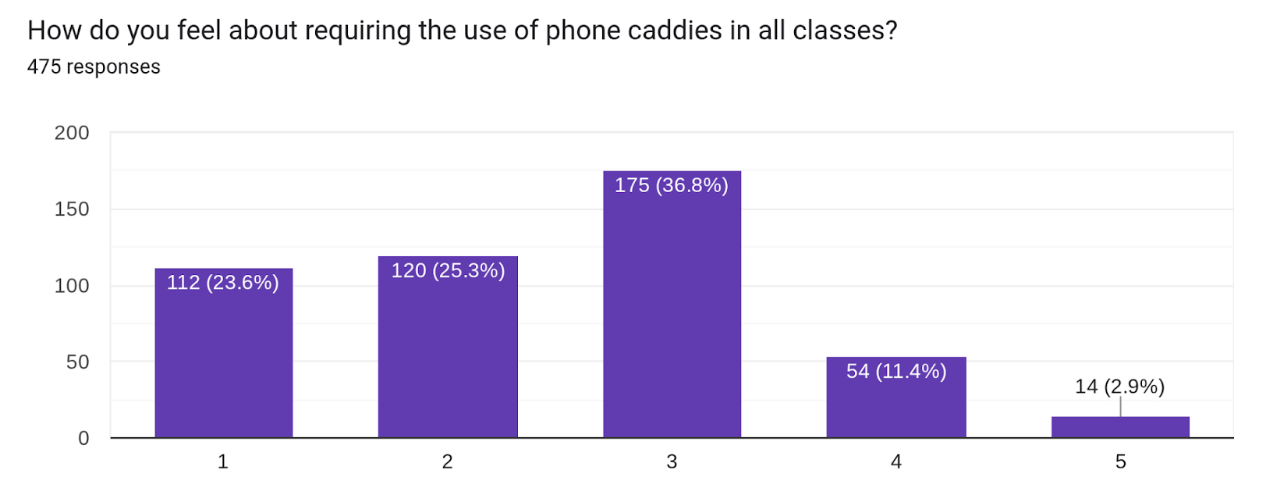
Initially, around 30% of student votes were given to the 1–3 ratings each. We can now see that opinions are slightly shifting more towards the ‘neutral’ 3 stance, and the ‘slightly favor’ 4 option has slightly more than doubled from 5.3% to 11.4%.
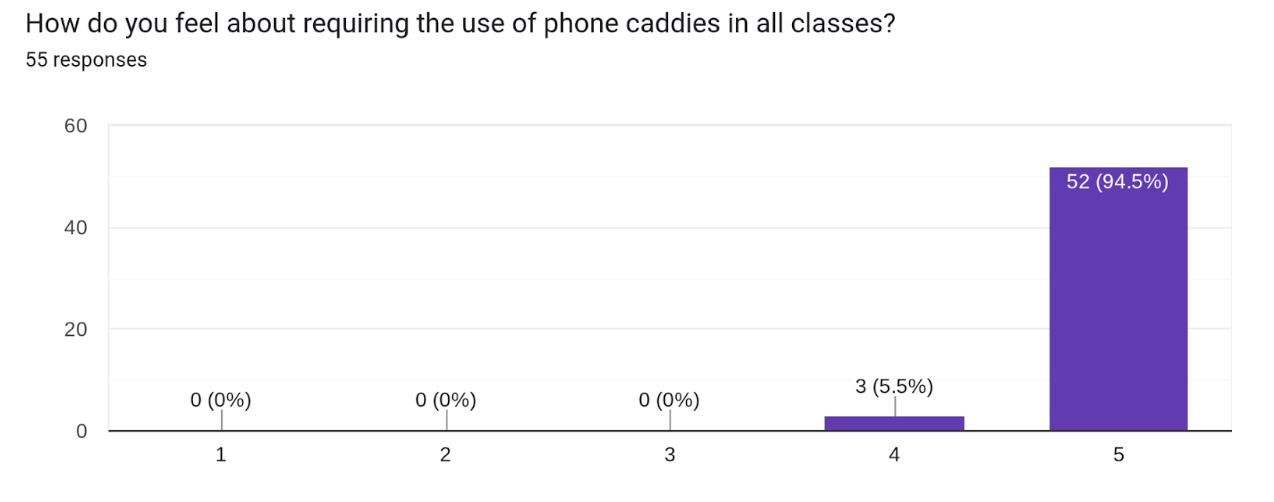
Teacher opinion on this matter has not changed significantly. 4.7% voted 4 initially and 95.3% voted 5. Both these options have only changed by 0.8%.
Just as before, some students believe that “[t]eacher[s] should decide what phone policies they want for their room” because “not every class environment is the same.” One student includes, “I'm aware that some teachers enjoy the fact that a very visible mandate from administration makes it easier for them to enforce: however, this [deciding phone policies] is their job as a teacher.”
However, others are saying that instead of the teacher, students should choose how they handle their devices. “It should be trust and responsibility, not taking our phones because ‘it's the problem.’ … The use of caddies is not stopping anything, just more dishonesty and a general dislike towards staff and school.”
Many, especially upperclassmen, are also sharing stories about how certain tasks need to be done on their phone since access on chromebooks is limited:
The use of phone caddies can be beneficial …, but sometimes, it interrupts my ability to handle other tasks … that can't be done on my chromebook, like updating work schedules or calendars. … I use my personal email for many other important things, like college applications and scholarships.
“I am working on projects post-AP test season, and need it to find sources that are blocked on my chromebook, communicate with group mates, or view records of math done on whiteboards previously.”
Students are also aware of how caddies have been moved to safer locations: “I disliked it at first due to safety issues …, but now that caddies are mostly moved away from windows and doors, I'm more neutral to it.”
Other supporters carry over thoughts from the first survey: “After this policy has been enforced for a while, I've started to notice more participation in classes, and personally, I feel more concentrated on my work.”
Some are “indifferent on the topic.”
Teachers continue to spread the positive effects of caddies, as seen in the following quotes:
I continue to observe students more focused on their classwork without the option of having their phone. In previous years, students would rush through work to be able to go on their phone as a 'reward.' With that option being taken away, students can remain focused and/or actually socialize with one another
It has decreased the amount of missing assignments, increased student engagement and interactions, and improved grades.
One teacher shares a similar sentiment with students: “I like the option for teachers to allow students to listen to music during work time, if deemed appropriate.”
Policy 2: Music Prohibition
Just like before, students still overwhelmingly dislike the music policy. The biggest thing to note, however, is that these feelings are perhaps less extreme, with a 12% drop on the ‘strongly dislike’ 1 rating. Most of the change went to an increase in the 2 rating, which increased from 19.2% to 27.6%.
In general, teachers have grown to become less favorable to this policy. The 5 rating has decreased from 51.6% to 43.6%. Ratings of 3 and 4 have all grown by 4.1% and 6.7% respectively.
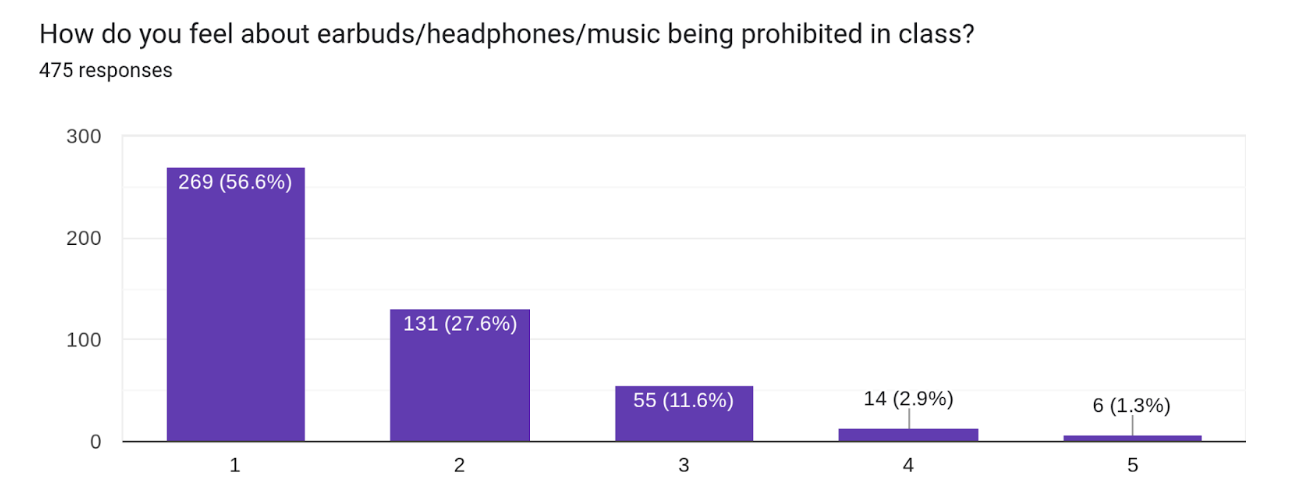
Many, many students are still saying that they would like music during work time as it helps them focus on tasks at hand. They understand not having airpods/earbuds/headphones in during lectures but don’t see the point in the ban after that.
“While I agree with prohibiting earbuds during instruction time, during work time, many students such as myself prefer to work with background music. This often allows me greater focus and allows me to work more efficiently.”
Others simply “don’t really care” or are pushing for more flexibility with this rule.
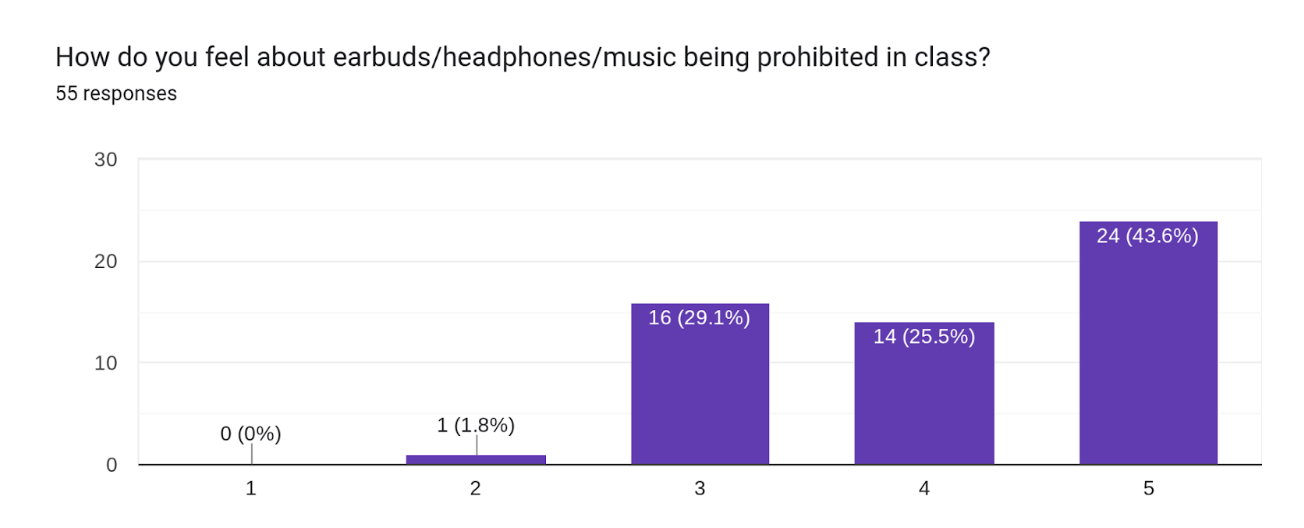
A majority of the teachers have similar responses as the students, saying that the rule makes sense in some cases but shouldn’t be all encompassing:
“I understand the policy, as students do need to learn to not have constant stimulation. There are times I would like to allow students to listen to music, but it is not a deal breaker.”
“I think there needs to be more of a "situation basis" for this rule. Sometimes students need earbuds to simply cancel out noise during work time or listen to music to stay on task during work time.”
Others are not budged and are on similar lines with the rationale provided by Bauer in the second article: “Despite student insistence, many studies have confirmed that multitasking is a myth, so there is no place for them [music devices].”
Policy 3: Phone Access During Hall/Bathroom Breaks
Students continue their trend towards the more favorable side of the scale. The ‘strongly dislike’ 1 rating has decreased by 4.7% while ‘slightly favor’ and ‘strongly favor’ have grown by 2.9% and 2.4% respectively. Ratings of 2 and 3 have not significantly changed.
Teacher favorability continues to drop—although not into the ‘dislike’ ratings of 1 or 2. Votes for 5 dropped from 92.2% to 80%. 3 and 4 increased by 3.9% and 8.2% respectively.

As shown in the data already, many students don’t find themselves affected by this rule too much. “It doesn’t bother me.” They also say that they understand the rule as it could lead to increased hall traffic just because other students want to go on their phones. Still, others bring up communication benefits and how a few “ruin it for everyone else.”
Some are worried about safety despite Bauer’s comments: “Hypothetically if there was an emergency, how would I be able to contact someone if I was out of class without my phone?”
Others argue that this “give[s] their brain a break and allow[s] them to refocus better … as it is scientifically proven that if the brain is given a break with focusing on something for a long time … it helps students focus better and for longer periods.”
There are also worries about phones being left behind and then taken.
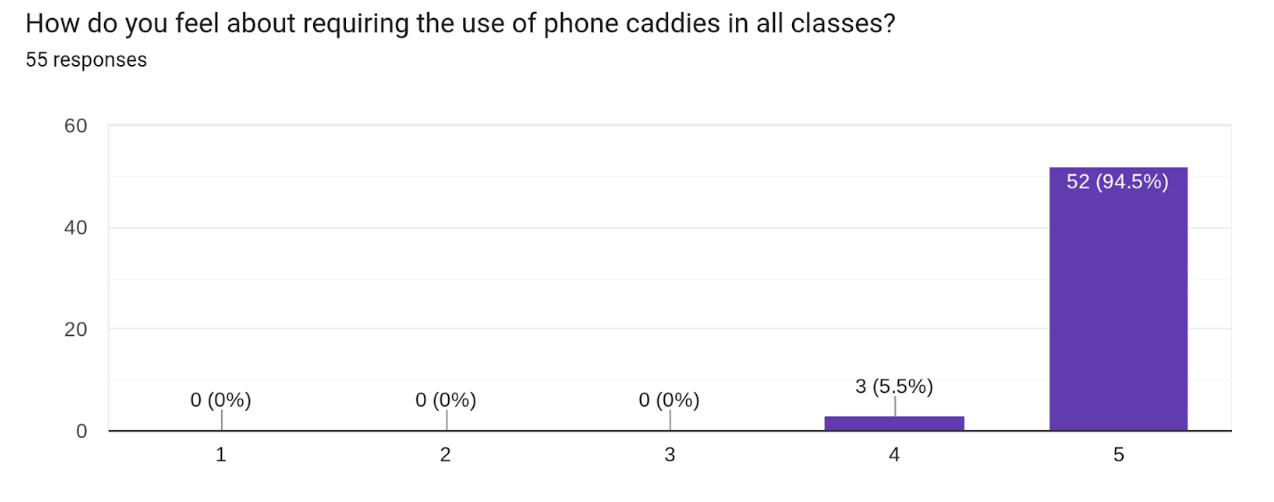
Most teachers don’t believe that students need their phones during bathroom breaks and think that allowing phones would increase distractions. “Less likelihood that students would stay and loiter on their phones, or connect with each other to meet on a bathroom break. Again, if the student's stated purpose was [that] they needed to use the restroom, there should be no need to have their phone with them.”
However, very few teachers acknowledge exceptions: “Bathroom[s] should be a no go, but a hall break… they should be allowed. Choose your battles.”
Policy 4: First/Last 10 Minutes
Student opinion has more or less remained the same, with each option changing no more than 1.6%.
Teachers’ drift towards the ‘dislike’ side speeds up with a drop from 59.4% to 32.7% in the ‘strongly favor’ 5 rating. The percent increase for ratings of 1, 2, 3, and 4 are provided: 2.4%, 7.8%, 6.7%, and 9.9%. (Note: The percentages of the updated teacher graph—shown here—add up to 100.1%.)
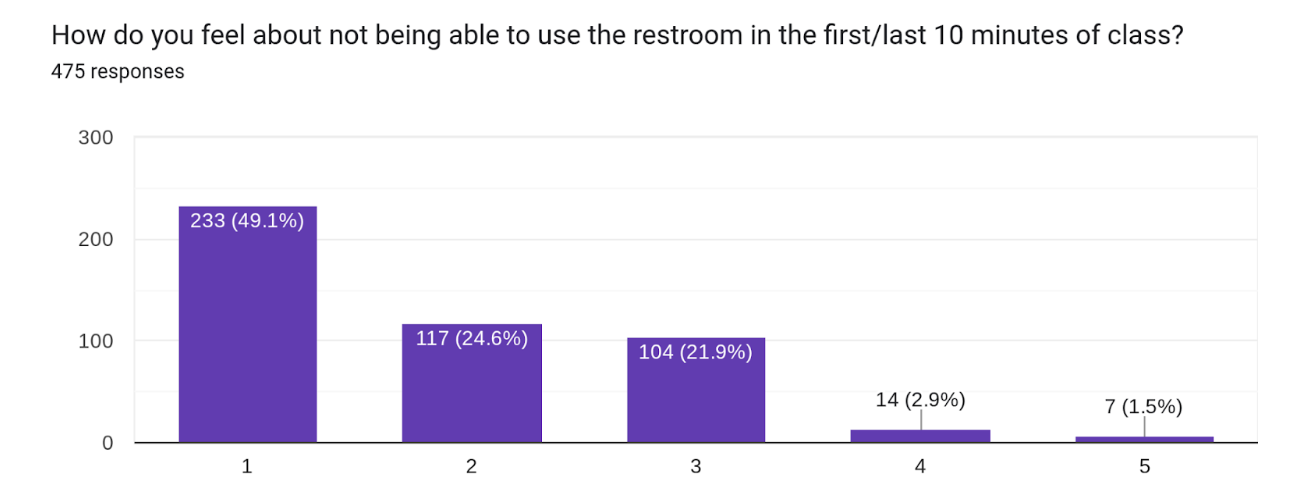
Student opinion is a mix of “I don’t mind” and “weird rule.” Many are commenting on how the first/last 10 minutes would be the best time to go despite Bauer mentioning that this time allows teachers to introduce and close the day properly. He also believed that passing time is sufficient, but many students show disagreement: “Sometimes the lines are super long—especially girl bathrooms—and I either risk being late or going when the bell rings, but because of the rule, I can't.”
Other students simply “don’t see the point” or are frustrated that they now have to miss the middle of a lesson or activity. “I have classes like AP lang where we write essays for the full block, and the first ten minutes is the only time we can use the bathroom.”
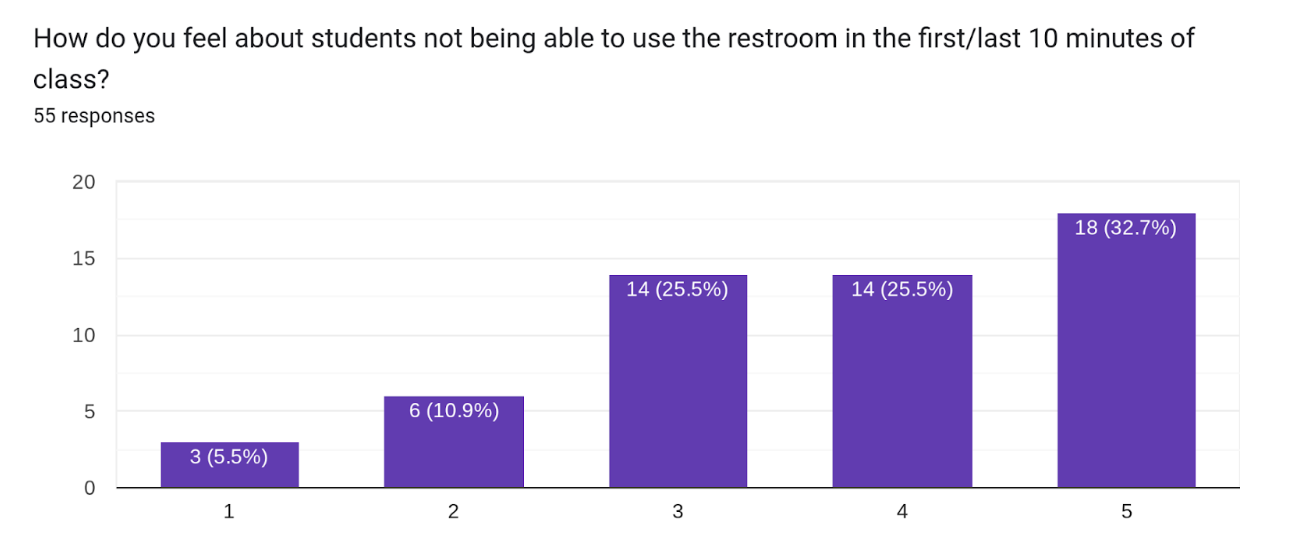
Teachers are also showing a spectrum of considerations for this policy. Some say the first 10 minutes are more important than the last 10 while others are saying that the beginning of class is the best time to miss for students.
I agree more so with the first 10 than the last 10. … [T]eachers don't necessarily have full group activities going right to the bell.
I think this should be up to teacher discretion. The first 10 minutes are often the best time in my classroom as we do a warm up in the beginning.
Some push for more flexibility: “While I understand the policy on a school-wide basis, it continues to be challenging … based on how teachers use instructional time. … I would prefer this [to] be a teacher discretionary policy.”
Teachers continue to express understanding for female students:
“I … think there continues to be a lack of empathy from male administrators to fully understand the lines that happen in female restrooms during passing time.”
“I often miss the line up to the social studies' bathroom myself as a female. In most communities there are 15 stalls at various locations for females. Not at HHS.”
Policy 5: Electronic Passes
Student opinions remain skewed toward the negative side, but considerable jumps have appeared in the 1 and 3 ratings. The amount of students who strongly dislike the passes have decreased from 49.4% to 33.5% while those who are neutral have gone up from 24.1% to 33.1%. Smaller but still noticeable changes occurred in the other ratings: a 4% decrease in 2, 5.7% increase in 4, and 5.4% increase in 5.
Teachers finally show an increase in overall ratings—a considerable one at that. ‘Strongly favor’ has increased from 25% to 34.5%, nearly a 10% spike. On the other hand, a ‘neutral’ 3 shows a 10.2% dip from 37.5% to 27.3%. 1, 2, and 4 changed by +0.5%, -3.2%, +3.3%.
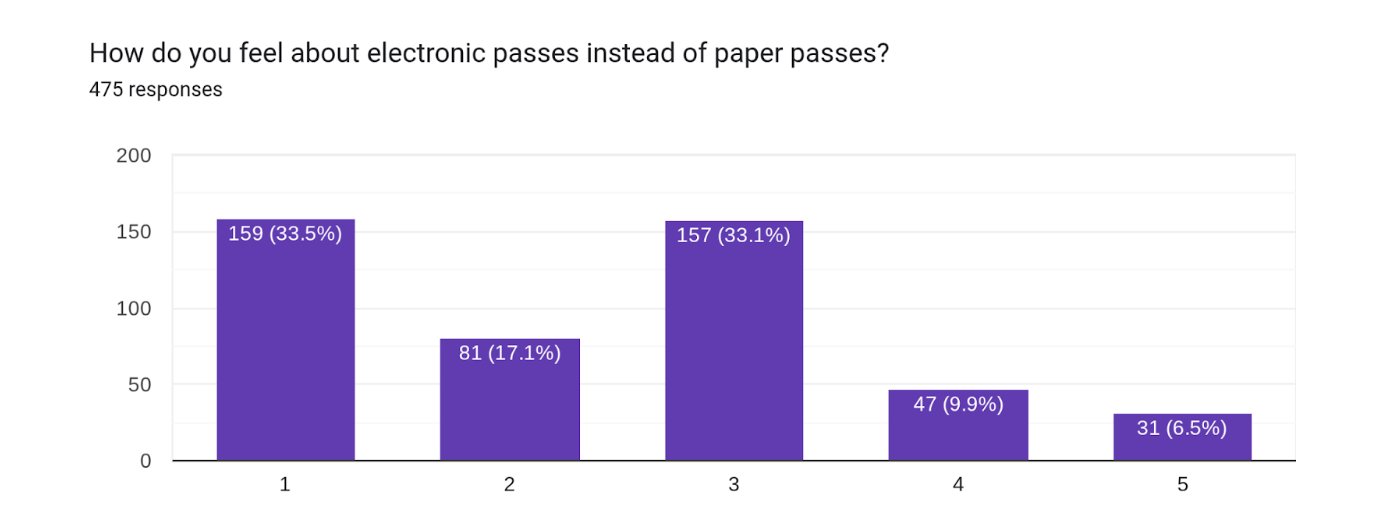
Some remark that this “sav[es] paper and works just as well as a paper pass,” but others disclaim that “[i]t’s not convenient to carry around [a] chromebook as a pass.” In addition, students—when they continuously mention the convenience of paper passes—may be unaware of the troubles that administrative assistants go through with them.
There still seems to be some confusion about when to use electronic passes and when to use the red hallway passes, however. “[S]tudents should only use a red pass if they don’t have a human at their destination” according to Mr. Bauer.
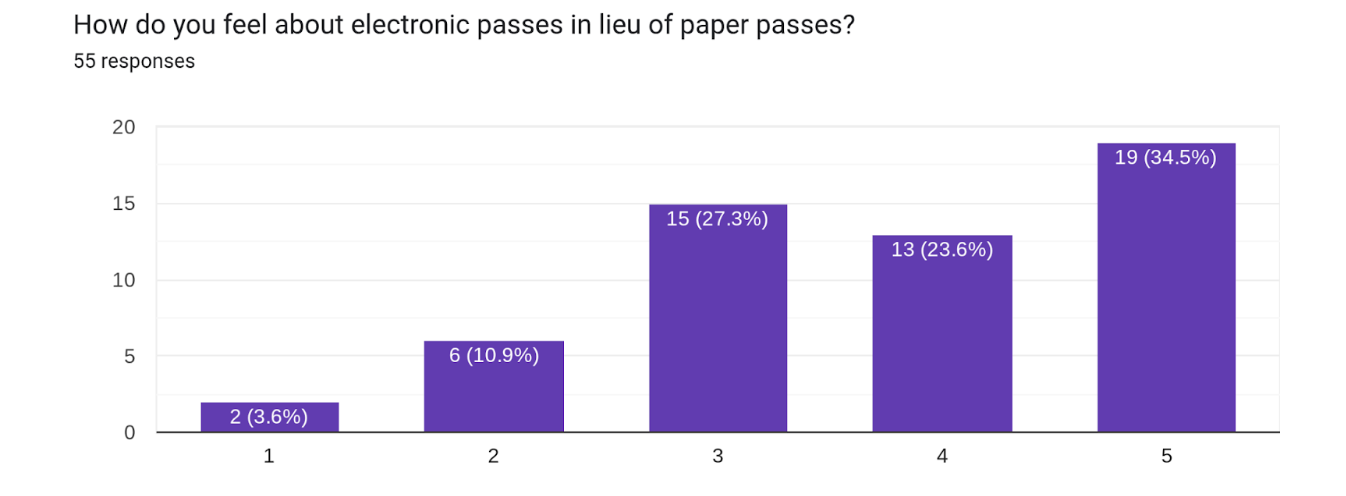
Matching the trend towards favorability, teachers say that the policy will grow as more become accustomed to electronic passes: “While it was an adjustment, in the long run, I think electronic passes provide greater accountability for students and are not difficult to manage.”
In addition, a problem previously faced by paper passes was that kids would hold on to them and reuse them (not the intended purpose). Teachers “have [now] seen less pass abuse this year compared to previous years.”
Still, some are facing the same frustrations that were anticipated in the initial survey: “[It’s] [t]oo hard to manage and include students in email. Paper copies helped." A few specifically brought up the tediousness of electronic passes, saying that they are “more time consuming for the teachers to facilitate in the middle of teaching.”
Policy 6: >15 Minutes Late Results in Absence
Changes are not too significant overall in the student side, the largest being a decrease in 4 and increase in 2. Both changed by ~3–4%. Other ratings show a change of less than 2%.
Teachers turn back, once again, to their old trend of decreasing favorability. ‘Strongly favor’ decreases from 65.6% to 58.2%. ‘Slightly favor’ increases from 23.4% to 27.3%. ‘Neutral’ increases from 9.4% to 10.9%. ‘Strongly dislike’ increases from 1.6% to 3.6%. No change in ‘slightly dislike’ (which was/is at 0%).
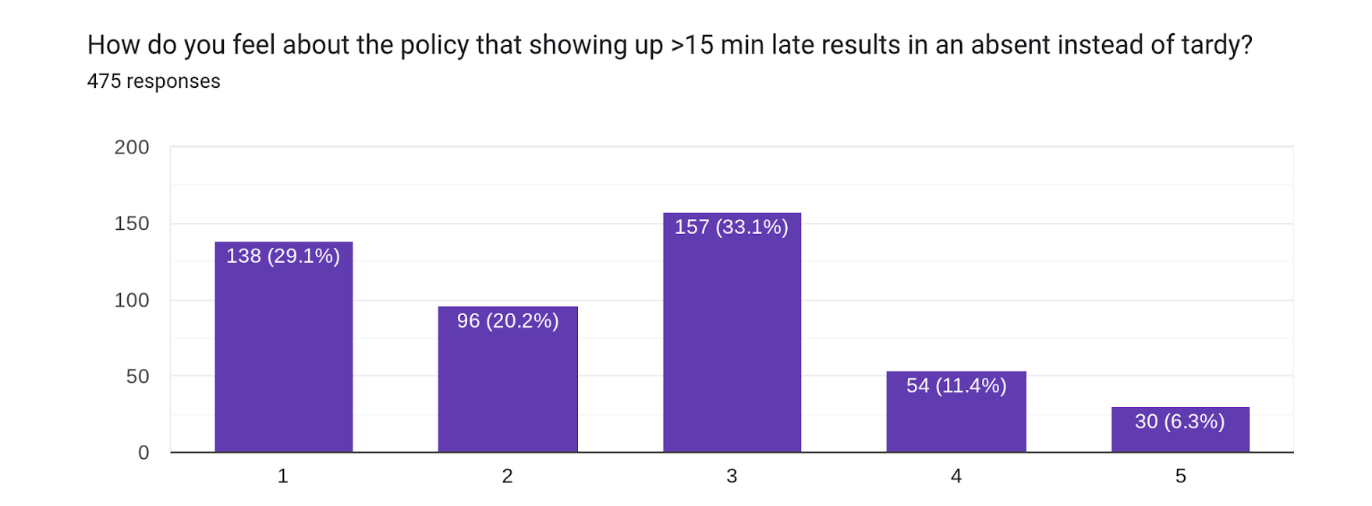
It is apparent from the comments that the topic is very two-sided. Some students “agree with this policy since 15 minutes is plenty of time to get to class” while others “believe that 15 minutes into an 80 minute class is too severe.”
There are also concerns about external factors causing an issue when students can’t control them.
“Many students need more class time during tests for challenging classes like PreCalc, Physics, etc. I remember during AP Physics some tests I took way over the time limit … It happens, students shouldn't be punished for it when there's a valid reason like a test.”
“[I]t’s weird that you wouldn't be in your classroom under 15 minutes. The only exception is in the morning because the weather could prevent you from getting to school on time, since they normally have issues with people taking the bus something because of the weather.”
Bauer did outline in the interview that the policy will be exempt on days of unexpectedly severe weather. Other scenarios were not mentioned.
A potential risk that administrators will have to face with this policy is that students may just accept their fate. “[I]f I am already 15 mins late for whatever reason and I know that I'm already going to be marked absent, I'm just not going to show up to class.”
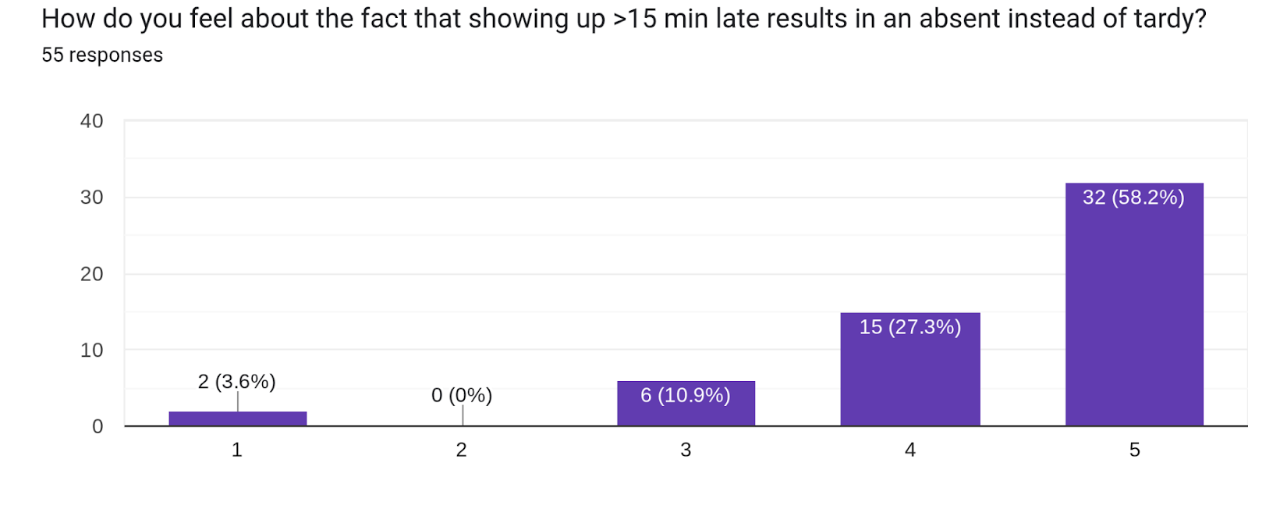
A few teachers also note that “15 minutes is under 20% of the lesson” and that they have mixed feelings about this.
Most are looking towards the benefits however. The policy “[h]olds students more accountable for the class time/content they are missing” and “has reduced the number of late students. Even then, they argue for the same flexibility that students are looking for: “I think there should be leeway to verify a tardy if there are extenuating circumstances, but in general I support this.”
Policy 7: Changes Being Applied in Advisement and Focus
As mentioned before, Policy 7 has been split up due to a change in how Policy 2 applies (i.e. it doesn’t) in Focus. The old graph will still be used in comparison for each of the updated graphs. Comparisons for advisement vs. Focus will be done separately.
Advisement:
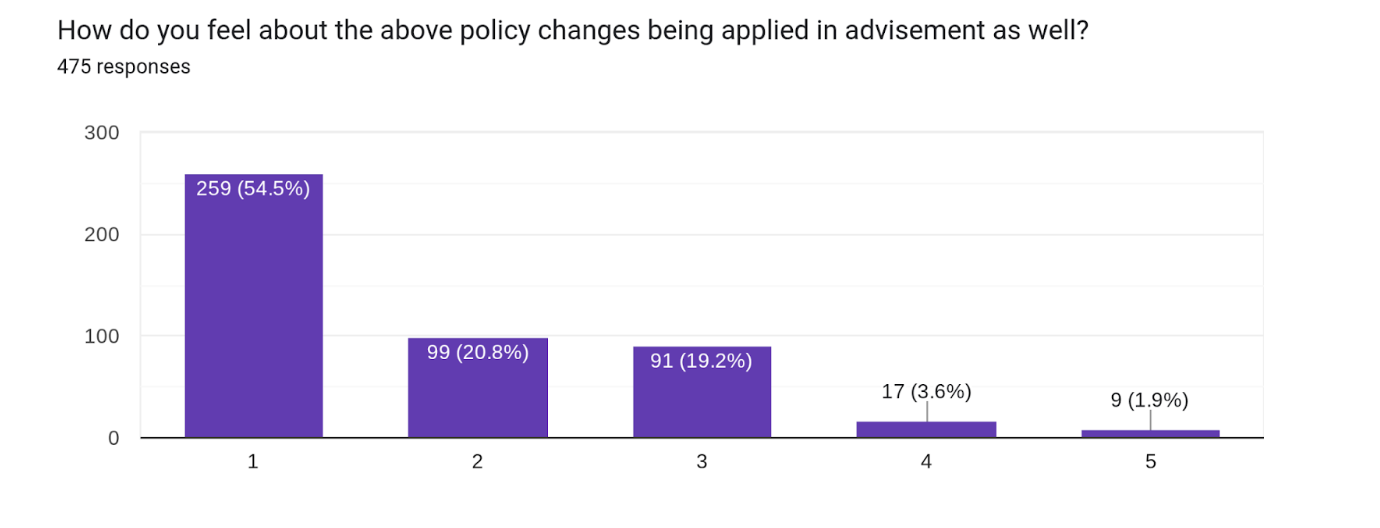
On the topic of advisements, students report a slight increase in favorability. 1 decreased from 68.6% to 54.5%, and most of these votes went to the 2 and 3 ratings, which increased by 7.1% and 4.6% respectively.
Teacher opinions did not jump as drastically. Ratings—from 1 through 5—for advisement are listed: +3.6%, +2.6%, -5.8%, +3%, -3.5%.
A new point was brought up that supports the administration’s adaptability. “I think the way advisement was changed for the second semester is a really good system. Home advisement is kind of pointless unless it's class/grade-relevant.”
Just like before—however—students are claiming that “[a]dvisement should be OUR time.” For the “people [who] choose to use it irresponsibly, that’s their fault.” Many are frustrated at the level of control being exercised in the study-hall-like periods. They suggest advisement being “ a break for students just like lunch.”
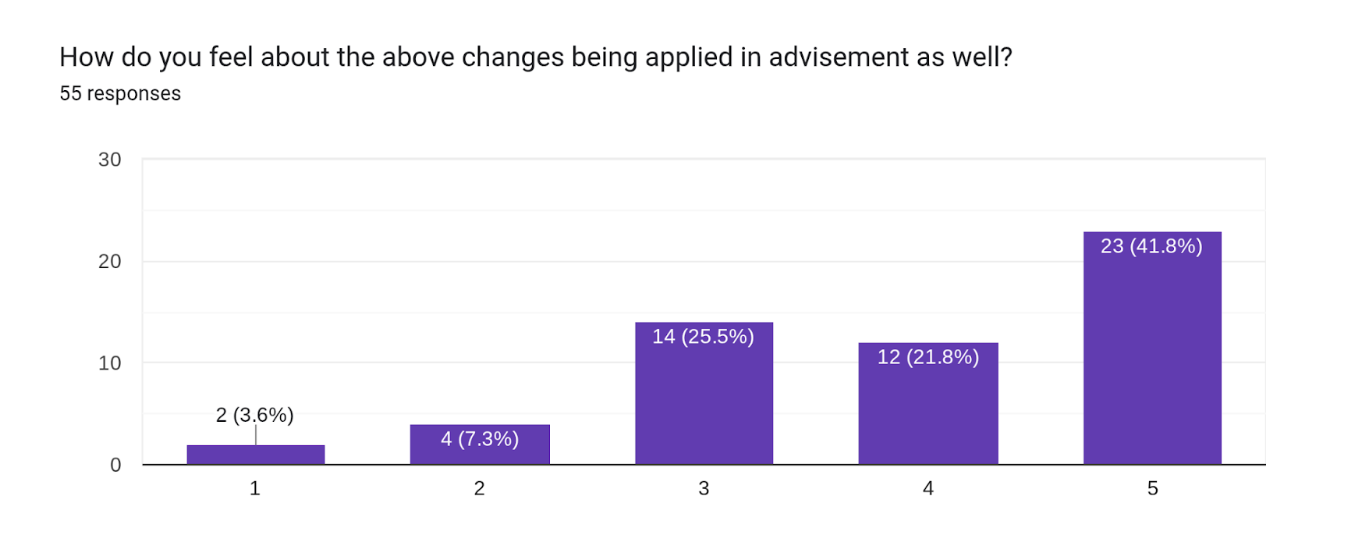
Ironically, a few teachers happened to directly counter the students’ belief: “There needs to be an attitude shift in terms of viewing advisement as 'free time.' Advisement is still academic time, and flex advisement is an opportunity for which students should be thankful. Not all schools have time built in to do work/see teachers/make up missing work.” They argue that “consistency” needs to be practiced, keeping everything uniform throughout the school today.
There are still teachers, however, who agree with students that too much control is being exercised: “Since advisement is used much like a study hall or even a social break during the day, I do not think collecting phones is particularly useful. I think that should be a compromise [that] administration considers.”
A middle ground is also home to a few teachers who wish to include some leeway with headphones and the first/last 10-minute policy.
Focus:
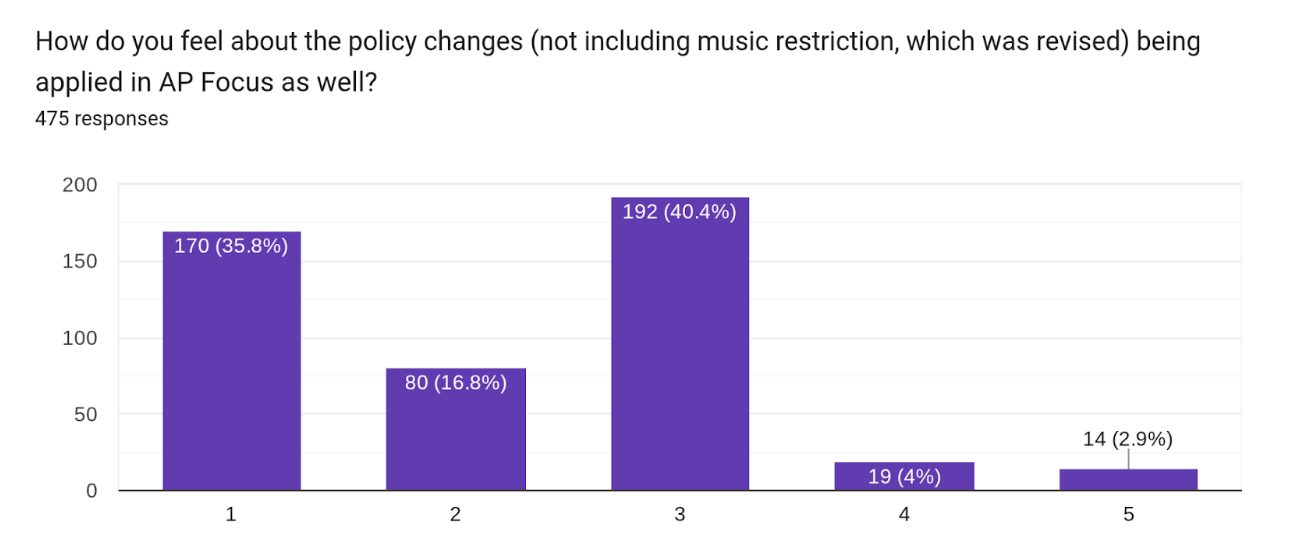
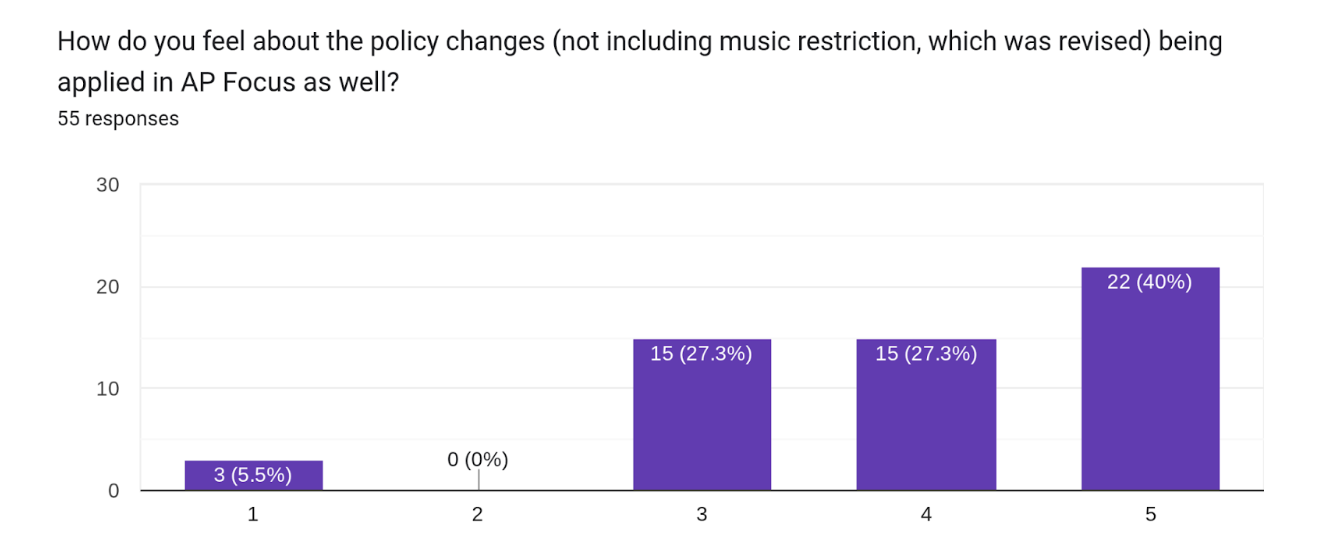
Now for Focus blocks on the student side, we see the biggest opinion shift so far: a 32.8% drop off from 68.6% to 35.8%. Most of these votes went to a 25.8% increase in the ‘neutral’ 3 rating, yet there were still increases in the 2, 4, and 5 ratings.
Teachers’ opinions changed more for this than advisement but still not as much as students. Ratings—1 through 5 again—for Focus are now listed: +5.5%, -4.7%, -4.0%, +8.5%, -5.3%.
The same frustrations about advisement are also prevalent on the topic of Focus blocks. Furthermore, participants mention that it is “quite literally for more academically inclined and responsible students.” They say that this select group of students shouldn’t be regulated with the same restrictions as they “don’t need them” and will be disincentivized from “taking more APs.” (For context, Focus blocks are available to students who have two or more AP classes in a semester.)
But should this group be exempt from the policies just because of taking more rigorous courses? Some don’t seem to think so since “AP advisement [i.e. Focus] is literally the same thing as a regular one; it's just for a specific group of people.” As such, they believe that “[t]he rules should be the same for both.”
Aside from Focus consisting of a marginalized group, opinions have been formed on the pros and cons of applying the policies. “There isn't always something to do in AP Focus” according to a respondent, who “think[s] that it would be nice to have phones” in this case. Students that took the flip side shared, “I was annoyed at first, but I am actually glad that our phones got taken away because I was definitely more productive.”
Pivoting back to a point introduced in the first article, students say, “AP classes and AP focus [are] trying to replicate the college experience.” Because of this, the policies are “not doing kids any good” since colleges don’t care “about going to the bathroom or using your phone.”
One teacher claims that it’s “[n]ot fair” to assume that “all students are not able to be responsible for technology,” but it was evident that this was the minority opinion.
Most are choosing to hold students to their responsibilities: “If your schedule is so busy/rigorous that you need an AP Focus, then you should use it as such.” They “think that students in AP Focus should have the same standards applied/no ‘specialized preference’ for their status,” agreeing with that one student from before.
Policy 8: Removal of After-School Detentions
Student opinion is still dominated by the ‘neutral’ 3 position, but there appears to be a noticeable increase in ratings. The same ‘neutral’ position decreased from 69.4% to 57.3%. This led to an increase of 5.2% and 4.2% for the 4 and 5 ratings respectively.
The ‘neutral’ category for teachers has increased instead, and some of their ‘strongly favor’ votes have been drawn away. 3 had a 8.3% increase while 5 had a 10.2% drop.
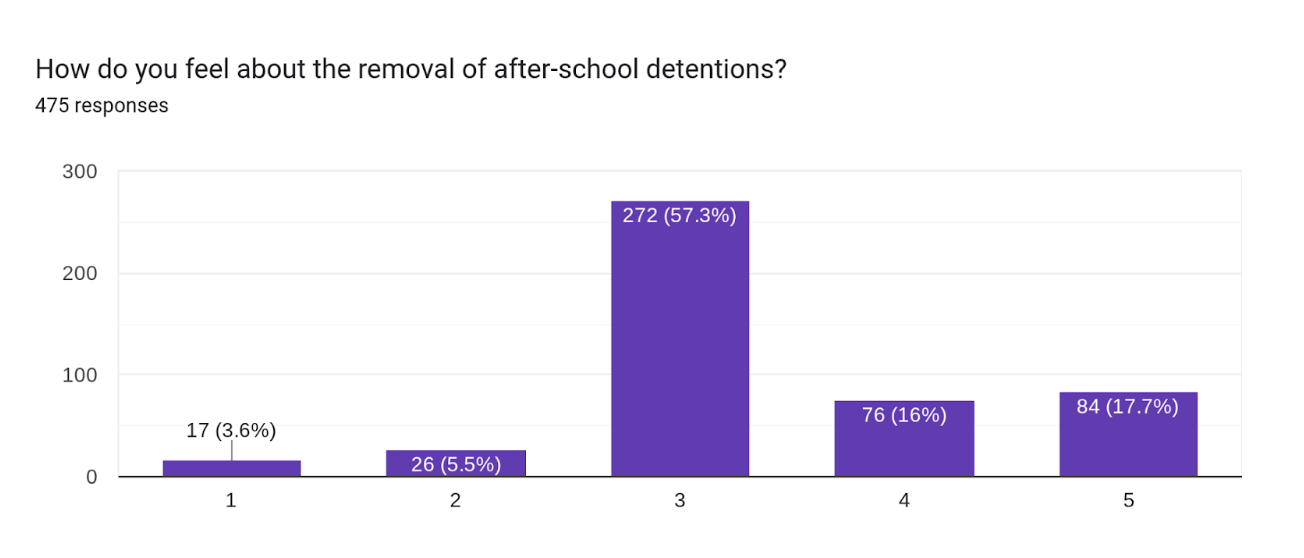
Many students don’t care about this or are unaware of other punishments since—just like from the initial survey—they don’t have to face detention all that much, which can be seen as a good thing. For those who are wondering what the other punishments are, the administration team revealed that they will customize consequences depending on the problem. See the second article for more details/examples.
This second point was also already mentioned in the initial survey: “Students have after school activities, work, and other responsibilities to attend to after school.” Having to attend these after-school detentions would prohibit students from attending sports practices, extracurricular meetings, and getting to work on time.
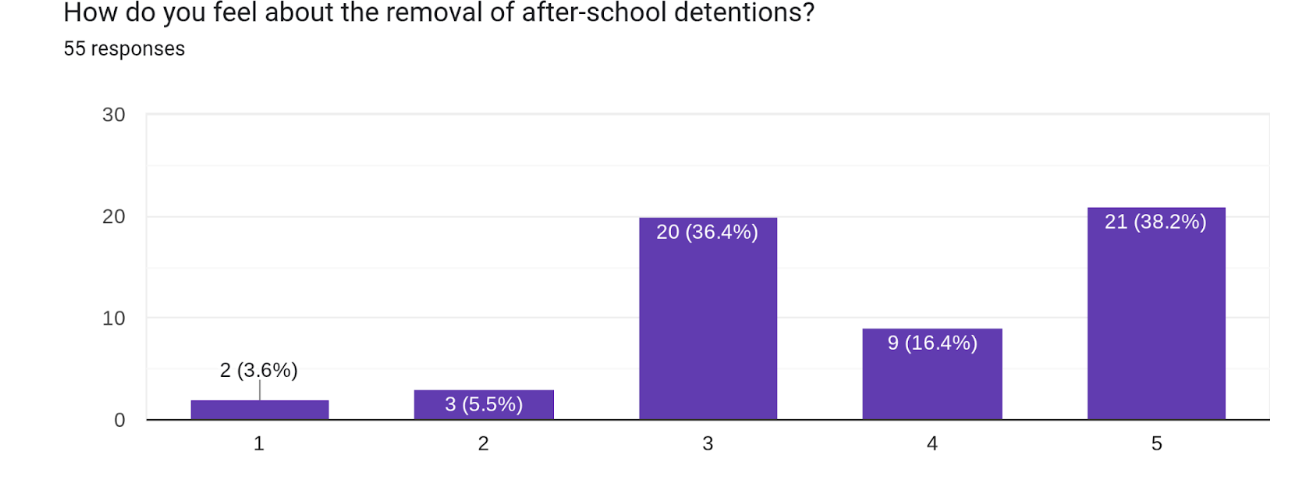
Teachers also understand that “[s]ome of these kids have to work jobs.”
In addition, an attitude that hasn’t quelled yet is how ineffective the old detentions (after-school ones) were: “They never worked!” “Students did not take them seriously anyways.” “[T]hey are not a consequence related to the ‘crime.’”
Policy 9: Administration & Staff Visibility
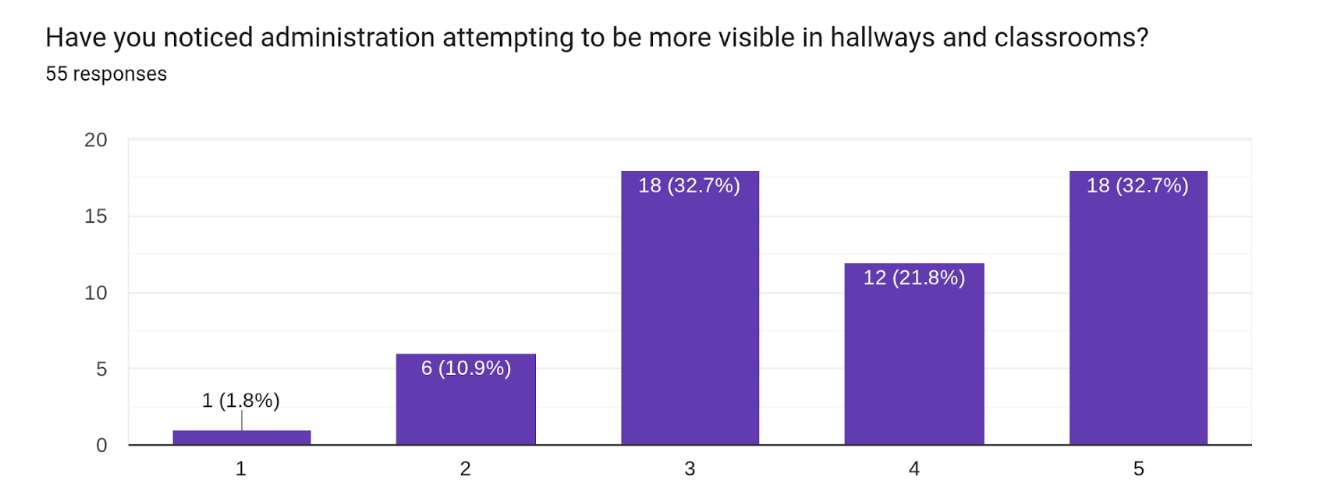
As a reminder, 1 corresponds to “Didn’t notice at all” while 5 denotes “Noticed immediately.”
We see that students have begun to notice more administration and staff members in hallways and classrooms. This is evident with the 5.6% increase in ratings of 4 and 5.4% decrease in ratings of 1.
In the first survey that was sent out, teachers were asked what they felt “about administration and fellow staff members attempting to be more visible.” They were posed a separate question this time on whether they noticed administration attempting to be more visible or not. The data gathered from each cannot be directly compared, but we can observe that most teachers have generally agreed to noticing administration’s increased visibility.
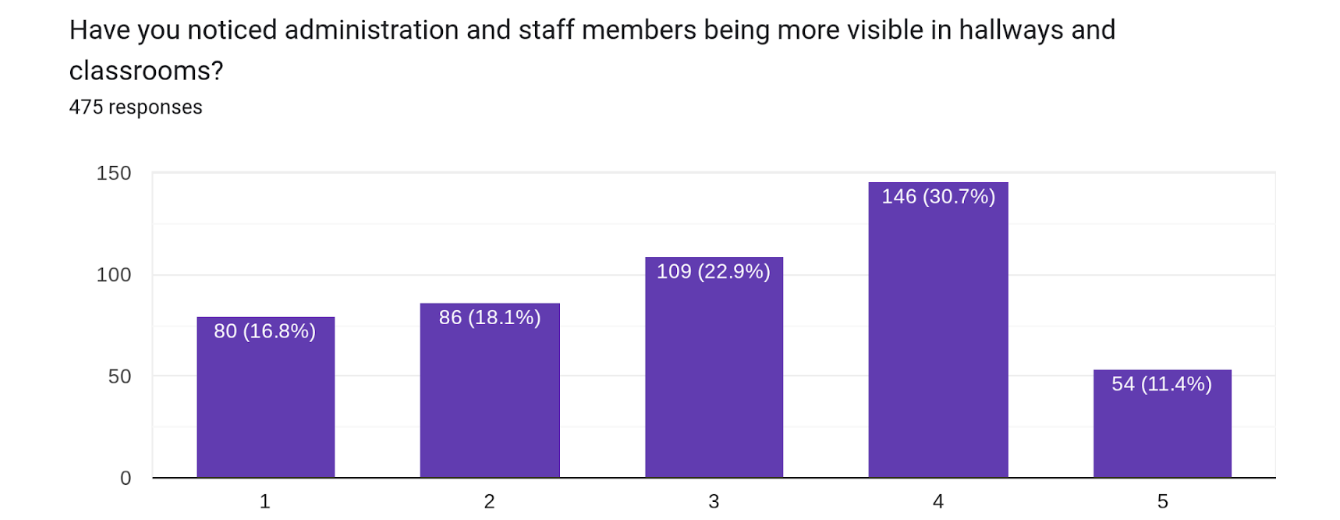
Some students still find the increased visibility to be “uncomfortable” despite what Bauer said about this not being the intention. He said that the administration’s goal is to be able to connect with the student body more, sharing gratitude and thanks where deserved. Not all students are fully aware of this mindset though: ”I have noticed more staff members in the lunchroom and hallways, which I didn't really think much of until reading this. I think this is a + [plus] to ensure no one is breaking rules, fighting, etc.”
Luckily, others say that “[i]t’s nice to see administration as part of the student body” and even believe that “a normal administration should” be doing this.
Turning to teachers now, students show appreciation for being greeted at the door: “Every teacher is outside waiting until the bell rings, [which] definitely makes it easier on kids who are still learning the school.”
Teachers, of course, were only asked about the administration’s visibility. They “did see administration frequently in the first few weeks/month of school.” This may have not carried over to the rest of the year however, and one teacher has “not yet been formally observed even once this year by administration, which is a deviation from previous administrations.” This is most likely referring to the practice of an admin visiting and sitting in on a class. The teachers do find this year’s administrators to be more approachable though.
Policy 10: Enforcement of Dress Code
Policy 10 returns to the “Strongly dislike” to “Strongly favor” scale.
Student opinions have remained almost unchanged since the initial survey; no rating has shifted more than 2%.
The same cannot be said for teachers, who show another decrease in ratings. 5 went from 76.6% to 58.2%, which resulted in an almost-even increase for ratings of 3 and 4. One teacher voted a 2 where there used to be none.
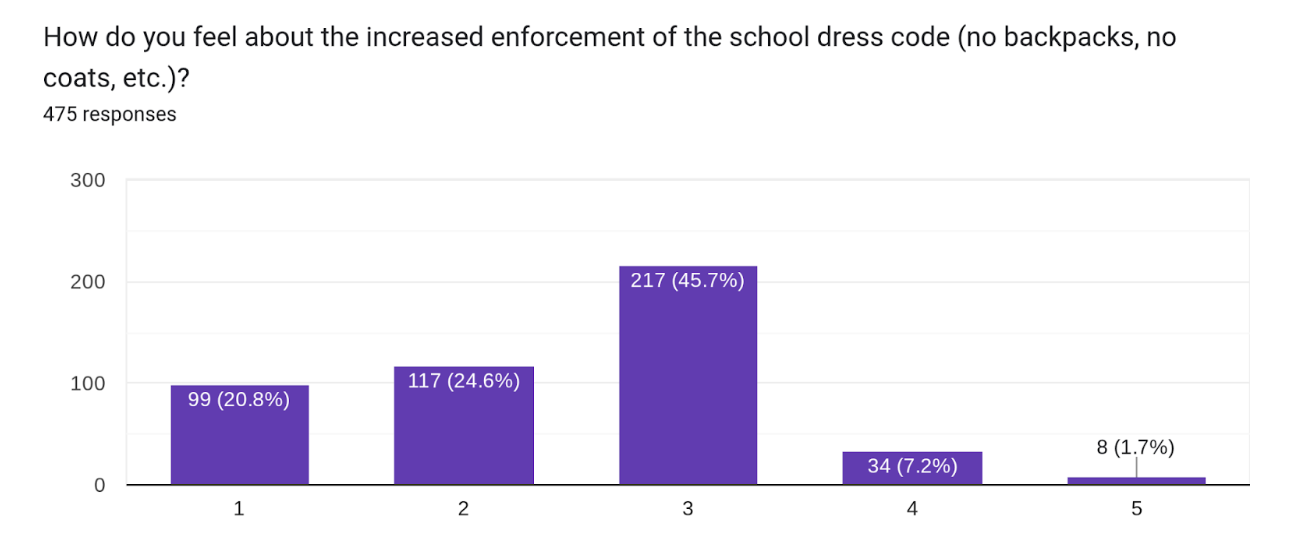
The reason for the dress code is for safety and security, which is understood by some but not all students. “No backpacks, coats, hats, or blankets makes sense to me because they can hide things that aren’t allowed.”
Others—who may be unaware of security concerns—focus on the utility of such items. “[S]ometimes, I would prefer to just bring [a] backpack to class, and I also get cold in some of my classes where I could use a coat.” Bringing coats into class was actually mentioned in the comments a lot: “[I]t’s really cold sometimes, and I would like my coat.”
Another student looked beyond the traditional security protocols to recommend “exceptions to this rule … like kids who are physically disabled.”
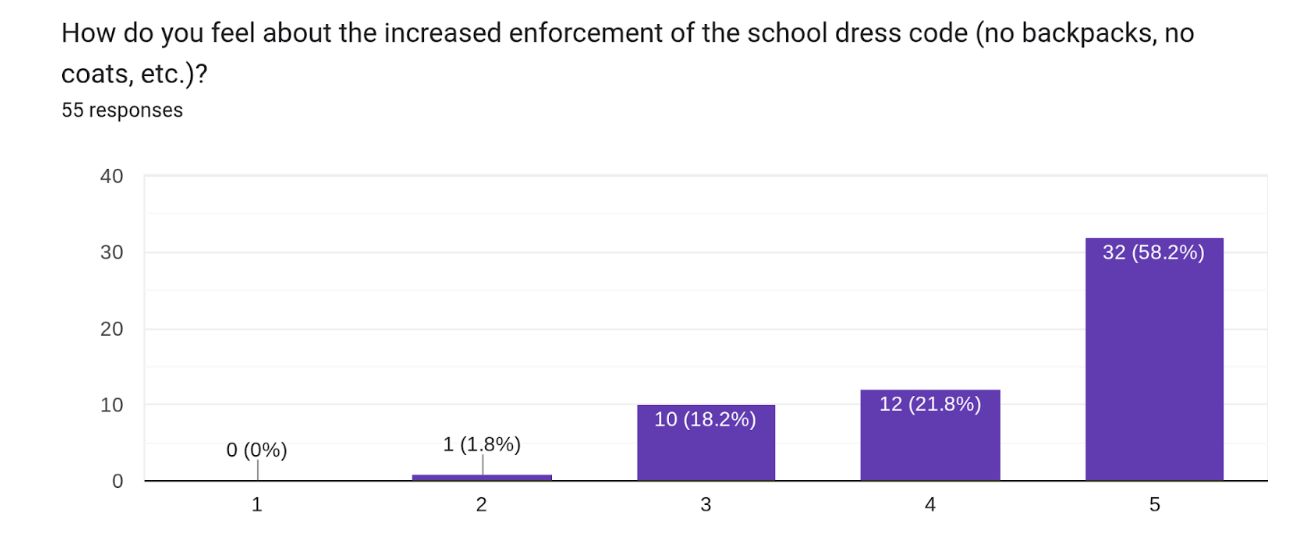
Teachers clearly understand that not everyone may not be aware of why dress codes exist: “I wish more students understood that backpacks are a safety thing.” These codes can act not only as a way to communicate dressing expectations but also as a way to account for risks.
As mentioned in our second article, the dress code was never a new policy; it just wasn’t enforced. Teachers say that “[t]here is no purpose to a policy unless it is being enforced” and are still noticing inconsistencies “beyond the outer wear (coats/backpacks). [They] still get kids at the end of the day who are in egregious violation of dress code but have clearly gotten past a number of teachers and admin to get to 4th block.” As a call to action, one teacher says, “I'd like to see them [administration] adjust the dress code to reflect what our staff is willing to police.”
Policy 11: Wednesday Advisement
Since Policy 11 was introduced halfway through the school year, old data does not exist for us to look back on. The change—for those who are unfamiliar—was the addition of an advisement period in between third and fourth block on Wednesdays. This resulted in an altered schedule where class times were cut slightly short. Late start remained in effect.
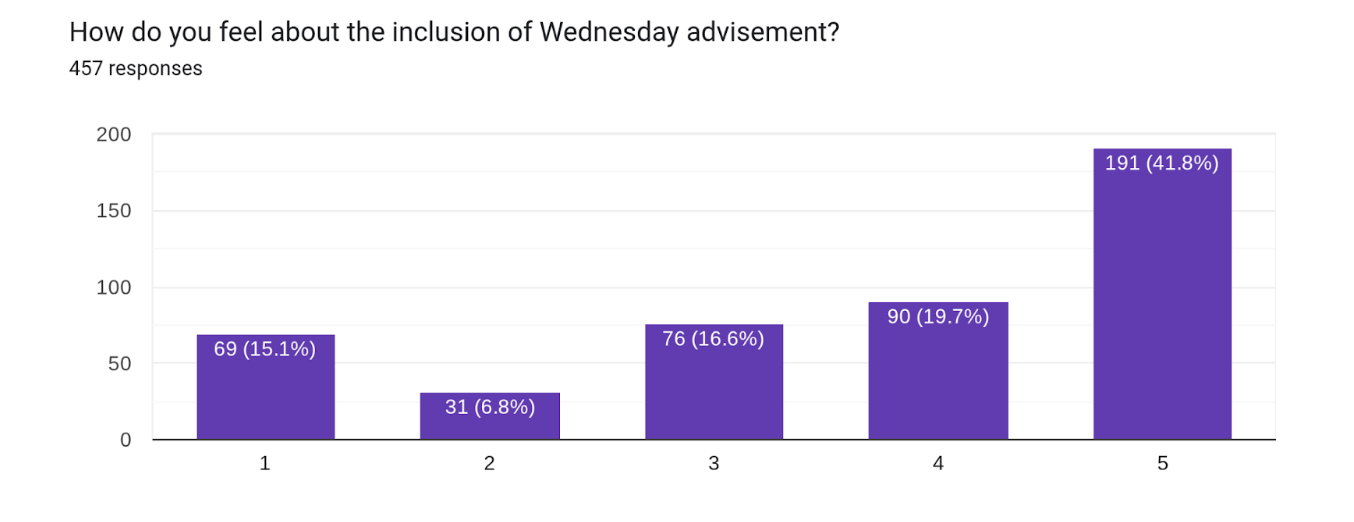
Many students think it’s “nice to have a little break between all of [their] classes” since they “can at least get … homework done for one class.” However, just as many are “not a big fan of having it at the end of the day.” They “won't be able to study before any tests” and “feel less motivated towards the end of the day.” One student isn’t fazed by the timing however: “I LOVE WEDNESDAY ADVISEMENT! I've been waiting for the day that advisement is in the 2nd half of the school day and not in the morning. Best thing ever.”
Those who support having a Wednesday advisement are still critical of some aspects of it, like “classes being shorter” and “lunch at 10:30 [am].”
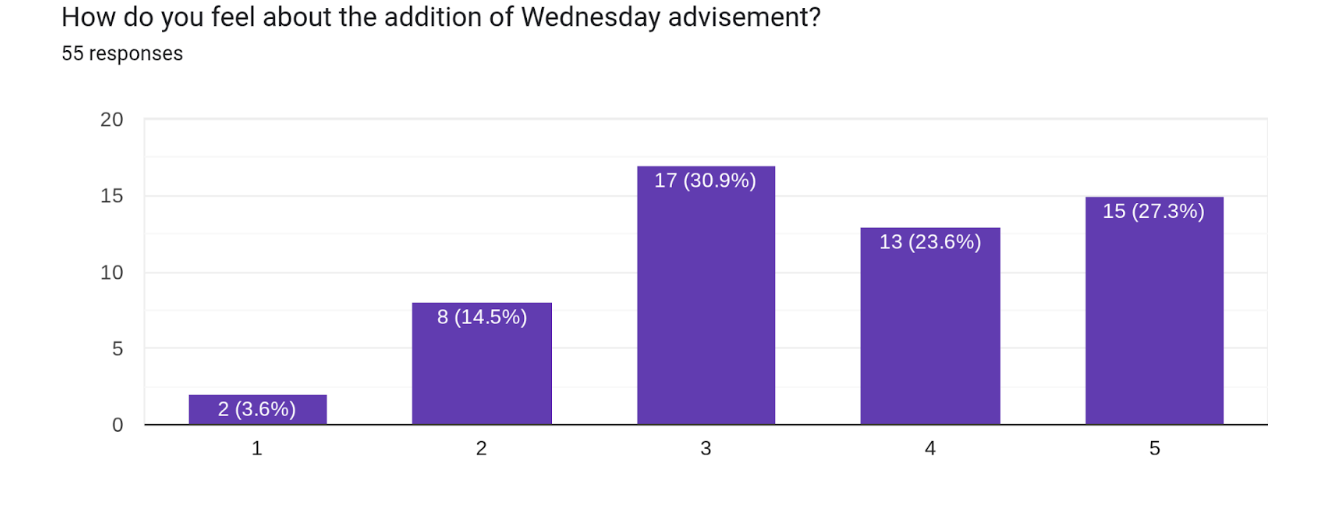
Teachers also show a split opinion, but a majority are against losing class time:
“Wednesday advisement: I do not believe this is a good use of academic time. Taking time AWAY from class blocks to provide the typical kid with a study hall has not been a positive experience for me as a teacher. I think advisement four days a week is plenty of time. Having advisement crammed into the day is disruptive and has notably altered how I plan those days and what I can accomplish. I find it a poor replacement for actual class time if we value instructional time as an institution.”
Those who show support “prefer having another opportunity to check in with students/provide assistance outside of class time.”
Other Things Noticed
In the original article, students and teachers were asked about other things they may have noticed and were asked this once again. Some included suggestions/critique as well, which will be included alongside things noticed.
Students:
Students are aware that “[t]he music program has a lot of upcoming changes.” A small portion of them are fearful of cuts being made in terms of number of participants, but others are neutral until official announcements are shared.
Second semester brought another round of small changes to HHS, one of them being the career day. A student says, “I noticed we started doing fun days and career days, which honestly I don't like that much. I am usually pretty busy and have stuff to work on. During the fun day, I think there should be at least a few classrooms where you can just work.”
Traditionally, the Hamilton weight room has been open to students that wish to come in and exercise on their own time. However, students have noticed “[g]ym locker rooms being locked” and an “increased restriction on use of the weight room outside of SAS.” Two respondents displayed negative feelings about this shift.
Another major change was made to the grading system. Here’s what one student had to say: “I feel like the administration is a lot better than last year and are making changes that make sense and benefit our school as a whole. However, I do feel like the rubric scale is kind of dumb and should be changed.”
For the Flex advisement system, a student found it “to be effective” but believed that “the system needs to be further refined.” Specifically, “[t]he current interface after the inclusion of Wednesday advisement is messy and should be fixed so that all advisement sign ups are in the same element.” Two other respondents commented on Flex negatively; no elaboration was provided.
Students found “social-emotional learning lessons like Second Step in advisement [to be] unnecessary.” It was “especially detrimental to students … trying to get homework done” since “the lessons are simple and tell the students things they already know.” A suggestion was made to the student board about doing “a rework of the social-emotional learning lessons” or “get[ting] rid of it entirely.”
Many of the students reminisced about their initial shocks and pointed out a potential communication flaw, which Bauer did acknowledge during the interview.
I think these changes happened too quickly with no warning. This was the school's first impression of the entire new administration, and it wasn't a great first impression. I hope it improves for the benefit of the students and not the admin. The current changes being made and ones that have already been made were to benefit the admin, not the students.
These policies are widening the already large gap between admin and students. In the end it really should be up to the teachers when students can and can’t use their phone or use the hall pass. A lot of these policies are controversial because they are built off of situations which should be evaluated on a case-by-case basis by teachers. Teachers can tell when it’s not a good time to have phones or leave class to use the restroom, not restrictive policies.
Teachers:
Teachers felt the exact opposite about Flex: “Flex advisement - way better than being locked in for 2–3 weeks at a time.”
They’ve also found that “[s]tudent behavior issues have been dealt with faster. And more appropriately.” Previous years’ administration has been known to be a lot looser with handling students’ actions—including but not limited to inappropriate language, tardiness, and disruptive behavior. Still, there are areas for improvements as one teacher finds “consistency” lacking: “If we aren't going to enforce rules, they should not be on the books.”
There remains concerns however. One teacher comments, “I remain disappointed that [the] administration will not have conversations with teachers about the inclusion of a final exam schedule.” This wasn’t the only lack of communication that frustrated the HHS body. It was briefly mentioned in the previous articles that teachers had been somewhat aware of the policies beforehand whilst students were not. Some teachers are considerate of this and say,
[A]dministration needs to review how they roll out policies and communicate with the student body. Most of the outrage is performative and reactionary; this could easily be resolved if administration rolled out policy changes to students in a timely fashion and frontloaded the rationale. They seem to treat students like they are petulant and disobedient, which is becoming a self-fulfilling prophecy. I also believe that admin needs to better gauge the reactions of both teachers AND students and make them partners in some of these changes so [that] it doesn't feel like things are constantly being done to us instead of with us.
Effect of Changes
Students and teachers, once again, were asked to rate how different groups in Hamilton would be affected. (See graph below.)
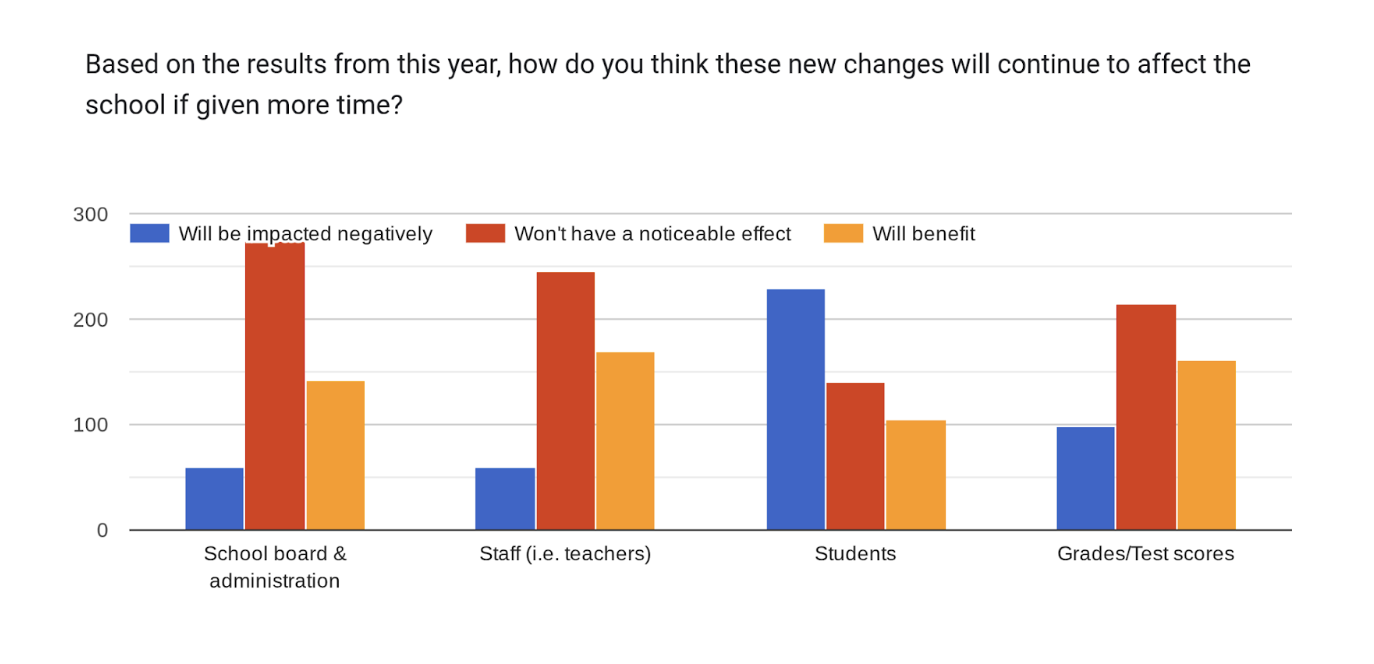
In terms of plurality, student opinion has not changed for any of the groups since the initial survey, but it does appear that the votes are beginning to balance out more.
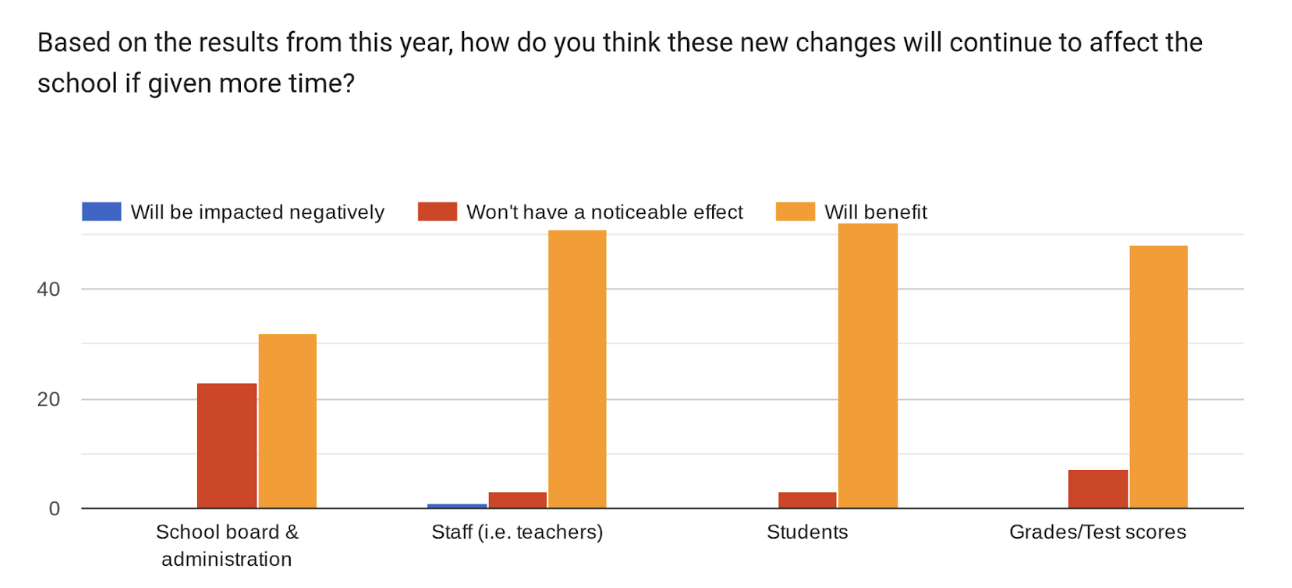
The teachers show the same pattern. That is, popular vote in the updated graph remains the same compared to the old graph and votes are starting to balance out more—although not as much as the students.
Hamilton Atmosphere
They were also asked once more about how much the school atmosphere would improve if any.
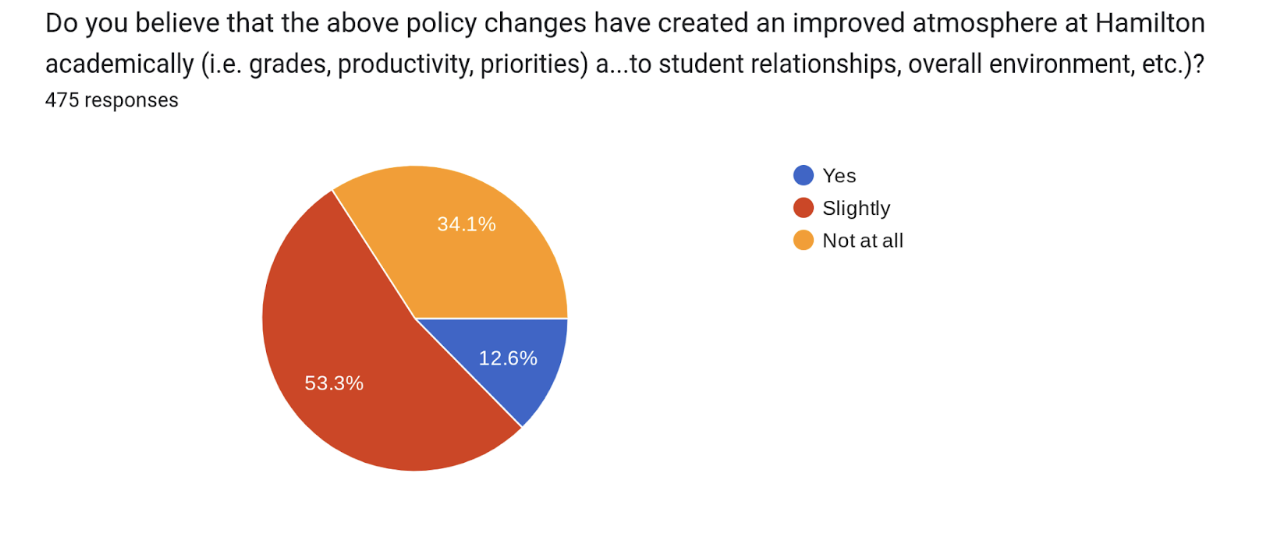
Students show a greater belief in an improved atmosphere compared to earlier in the year. 22.2% less people are saying that the atmosphere is ‘not at all’ improving. 18.1% more are saying that it’s slightly improved. 4.0% more are directly saying ‘yes’ to noticeable improvement.
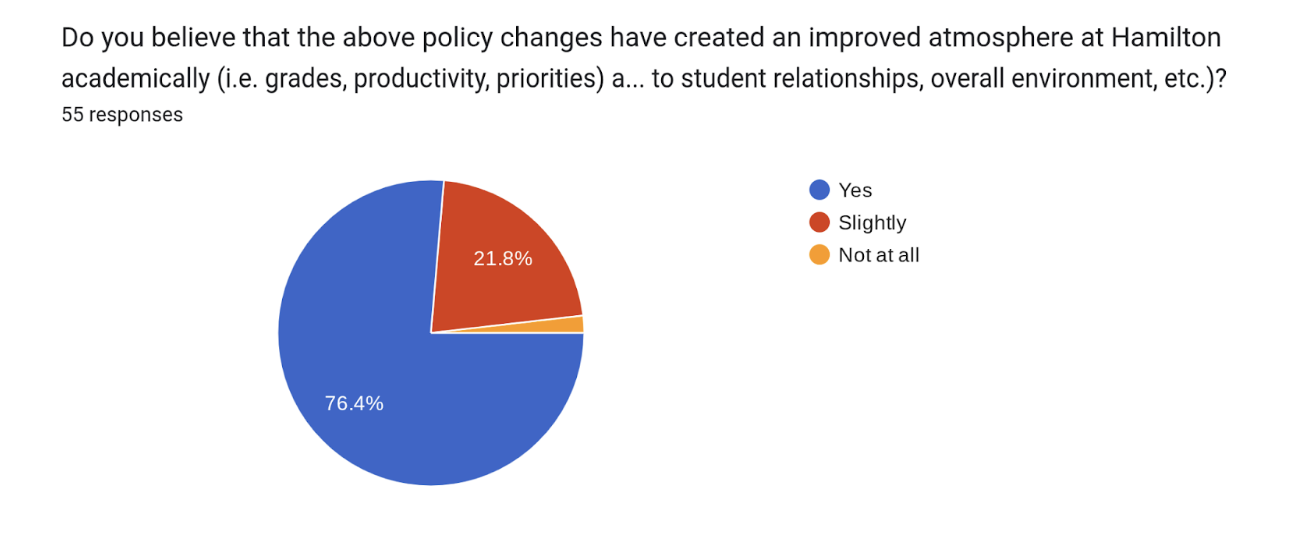
Teachers, however, are declining in confidence. 8% less are straight out saying ‘yes’ to improvement while 7.7% more are saying ‘slight’ improvement has come.
A Change in Mindset
With all the changes now observed, it is safe to say that peoples’ opinions have calmed down since the initial shock reaction. Students that used to be overwhelmingly critical have begun showing more support, and teachers that used to be showering praise have begun drifting towards neutrality. This does not mean that students are now mostly favorable to the policies and that teachers are not; rather, the popular opinion of both parties still remains the same in terms of negative or positive. The door does open, however, for the possibility of a neutral convergence point—a theory that could be considered highly interesting given recent circumstances of larger societal views tending to spiral towards extremity.
Students and teachers were also asked about how their thoughts on the policies may have changed overtime, so let’s take a look and hear it from them directly. Quotes have been organized to begin with ones where opinions have improved and end with those that have worsened.
Students:
Some students notice themselves becoming “more efficient in the classroom” after the implementation of the policies, but others only see more productivity in “some aspects” and not all. One initially found it inconvenient to not be able to bring phones “when going to the bathroom, but when kids stopped spending half an hour ‘going to the bathroom,’ [they] thought it was a good rule.” Others mention a slight “improvement in [their] grades since last year” but note that “[p]eople still find ways to sneak their phones in class. It [the policies] is not preventing anything."
A large portion has just grown to become familiar with the rules, perhaps playing a part in the neutralization of opinions over the school year.
I used to hate that I had to put my phone away in class; now I've gotten used to it.
I have grown indifferent to most policies since there isn't much the students can do. We tried to fill petitions and spread awareness to certain policies, but nothing came about it.
I initially thought they would be a lot worse and more impactful, but now I think that most of them either have little effect on my day to day experience or are only slightly harmful at worst.
Few people said that “they [the policies] weren't that bad at first” but now believe that some should be removed.
Teachers:
Teachers had a lot less to say than students about mentality shifts: Most opinions had “not changed” and were “just more affirmed.”
Final comments
As we wrap up the article and series along with it, we thank all our survey responders for participating, Mr. Bauer for the interview, and all the readers who have been a part of this journey. It has been extremely interesting to see all the changes and the wide array of perspectives that come along with them from the initial shock to the gradual acceptance. We can only remain curious of how these policies—and perhaps more?— will continue to shape the history here at Hamilton, so for now, good luck to all in your future endeavors and remember to confidently charge into change!
“The only way to make sense out of change is to plunge into it, move with it, and join the dance.”
—Alan Watts