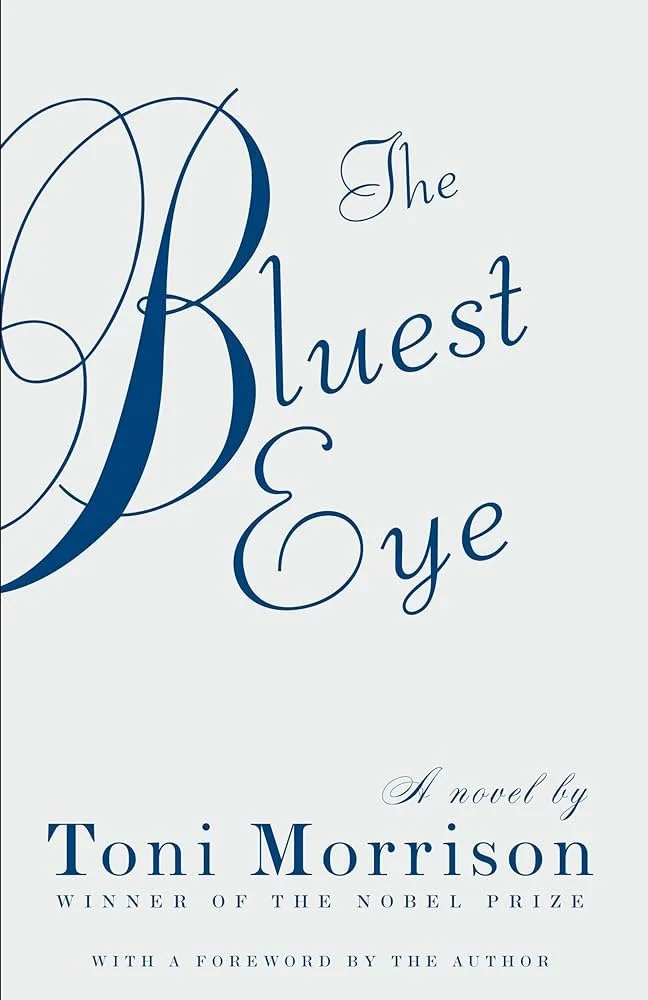
Banned Book of the Month: The Bluest Eye
Photo from Amazon.com
Emersen Cwiklinski
About the Author: The Bluest Eye is written by Toni Morrison, a well renowned author of contemporary novels that often detail the experiences of the Black community. Morrison grew up in the Midwest, and always had conviction for equal rights regarding race. She went to Howard University for her bachelor’s degree and then Cornell University for her masters. She taught at Texas Southern University before beginning her career as an author. After teaching, she did editing work, and while doing so, she began writing novels. Her first novel, The Bluest Eye, was a work in progress during her editing career, and it blossomed into a well-known prose novel about the disparity between Black and White culture. After writing more novels about the Black experience, Morrison was honored with many awards. In 1993, Morrison was awarded the Nobel Prize for Literature, making her the first Black female writer to receive this award. Morrison also won a Pulitzer Prize, praise from New York Times, and the US Presidential Medal of Freedom. Eventually, Morrison passed away in 2019 from pneumonia, but left a lasting legacy of her successes relating to discrimination and literature.
Summary: The Bluest Eye follows the lives of Black youth facing discrimination. The Bluest Eye is narrated by a young Black girl named Claudia and readers see the experience of different characters from Claudia’s perspective. Claudia’s family ends up taking in a man named Henry, and a young girl named Pecola. Henry is a boarder; Pecola is a foster child. Each character in The Bluest Eye has their own conflicts with themselves, family, and society. The Bluest Eye explores these different conflicts, but primarily follows Pecola. Claudia feels pity for Pecola since she feels ugly due to not having blue eyes. Pecola eventually moves back with her dysfunctional family, and is constantly reminded of her “ugliness.” Pecola is raped and abused by her father, becomes impregnated, and later on, goes mad. During Pecola’s madness, she believes that she has fulfilled her deepest wish–to have blue eyes. Pecola desires what she feels is true beauty, and her mind causes her to believe she has fulfilled that desire. Pecola had faced discrimination and hatred from White members of her community for being Black, prior to her hysteria. From the hatred Pecola received from her community, she felt that her characteristics made her less beautiful and less worthy. Pecola faces abuse from her parents, community members, and societal standards as a whole. Pecola continues to spiral into insanity, and feels as if she has become pretty since her mind continues to deceive her in many ways throughout the end of the book. The Bluest Eye covers the disturbing treatment towards Pecola, and the standards that Black people had been pressured by in the community.
Why it’s banned: The Bluest Eye is banned for its disturbing scenes and topics and the intense depiction of racism and discrimination. As stated previously, Pecola faces physical, emotional, and sexual abuse which is described and deemed as “too sensitive” for literature. The trauma that Pecola and other characters face has been the reason for banning The Bluest Eye. Along with the disturbing scenes and topics relating to abuse, the mention of racism and discrimination also has been a factor that has caused The Bluest Eye to be banned. Topics of racism and discrimination are shared as a way to open the door to discussions regarding injustices that people of color face, such as in this novel, yet many institutions still banned The Bluest Eye, which has closed that door to understanding.
If looking for where to find The Bluest Eye, Pauline Haass Library, Menomonee Falls Public Library, and Hamilton’s Library all offer copies to read.