Book Review: Katabasis by R.F. Kuang
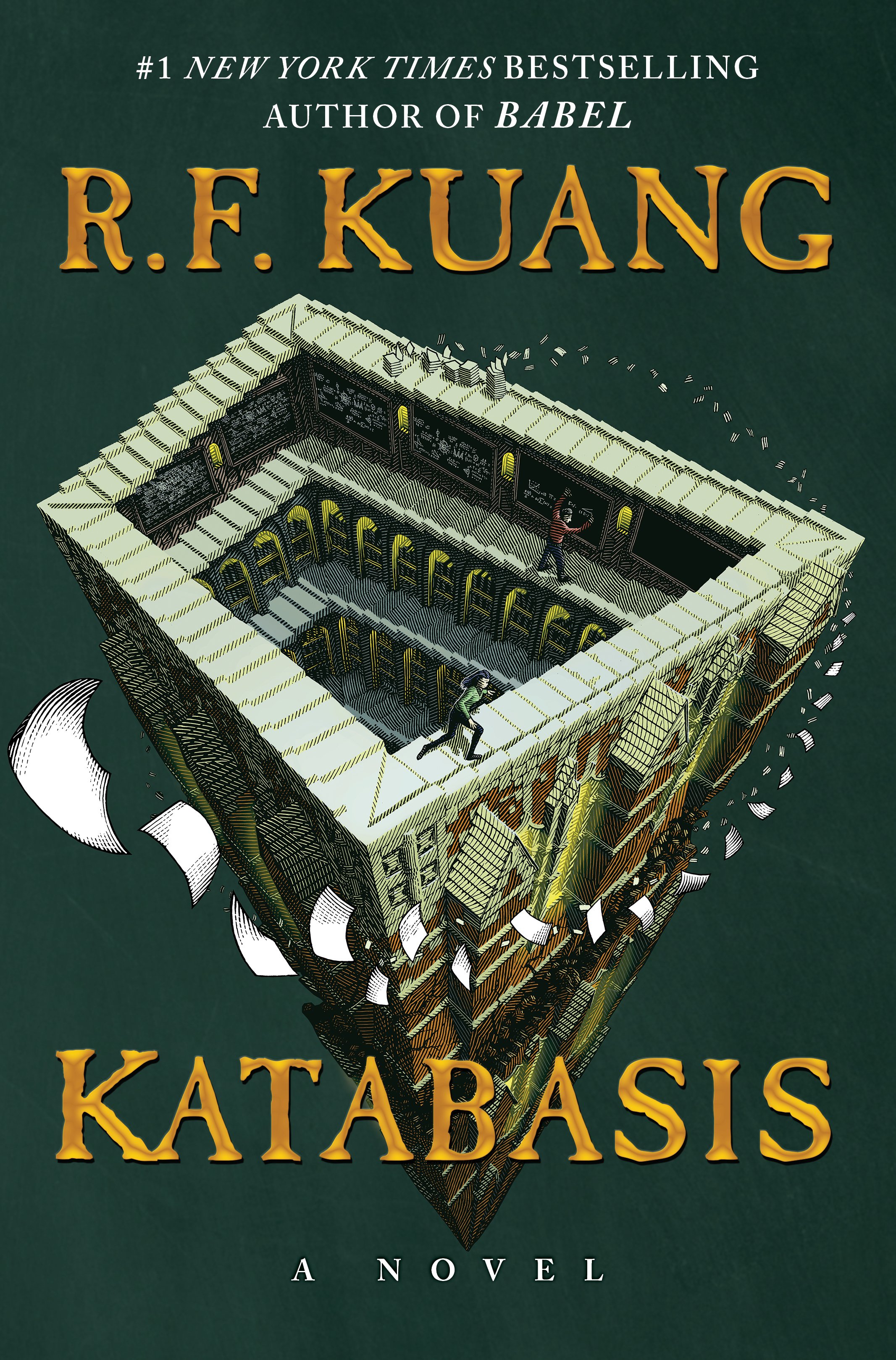
Photo from Goodreads.
Lari Li
Imagine this: you’re a postgraduate student pursuing a PhD in analytic magick at Cambridge. Your program is so highly esteemed that one recommendation letter from your professor can land you a job anywhere. In your last year—just as you’re about to defend your dissertation—your professor, Jacob Grimes, dies in a freak accident.
What do you do now? Transfer to your rival, Oxford? Go overseas to America and come home to the Ivies? Leave magick altogether and get a degree in neuroscience instead? No, no, and no. Isn’t the answer obvious? You go to Hell, of course! I mean, you’d do anything for that letter of recommendation, right?
If you’re Alice Law, that is. And of course the one person to accompany you on this journey is your academic rival, that no-good-nepo-baby-goody-two-shoes-mister-doesn’t-have-to-try Peter Murdoch.
“‘Hell’s lonely,’ said Peter. ‘You’ll want company.’”
“‘Hell is other people, I’ve heard.’”
You have a two-week supply of Lembas bread and water in your Perpetual Flask. You have vague, conflicting accounts of the realm from those who made the journey, like Greek musician Orpheus on his task to save his lover Eurydice, or Trojan hero Aeneas. You also have an insouciant know-it-all named Peter telling you to assume that Hell is a hyperbolic space. You decide you’re ready as you’ll ever be to retrieve your professor’s soul from Hell and drag it back.
You’re a scholar. You like to think you know everything. Your eidetic memory is full of philosophy, rock-climbing techniques, and mathematical postulates. But ever since your professor died, you only know one thing: You’re hell bent on getting that recommendation letter.
Overview
This is Katabasis by R.F. Kuang. Meaning “descent” in Greek, or “a journey to the Underworld” when used in the context of Greek mythology, Katabasis was published on August 26, 2025, so it’s a read fresh off the printer for you all! I was instantly reminded of Percy Jackson and Annabeth Chase’s journey to Tartarus in Rick Riordan’s House of Hades. If you enjoyed following Percy and Annabeth through Tartarus, Katabasis is similar, including Greek, Egyptian, and Chinese mythology. However, I would say that House of Hades is catered more toward younger readers while Katabasis gives a very intellectually stimulating experience. Acknowledgments at the end of the book include special thanks to those in the MIT philosophy department, so many scholarly minds are at play in the book here, not just Alice and Peter’s!
In Katabasis, magic is not magic. Instead, it’s built upon logic, paradox, mathematical postulates, and philosophy. In my review of the Poppy War trilogy, you’ll see that R.F. Kuang books and Kuang herself offer boatloads of intellect. In Katabasis, you’ll learn about the foundations of logic as well as famous paradoxes like the Sorites Paradox and the Liar Paradox, all in a digestible form.
Here are all the themes that I picked up: power, abuse of power, ambition, misogyny, betrayal, loyalty, memory and trauma, the weight of knowledge, existentialism, legacy, and transformation.
Comments
Katabasis was written where academia is central to the plot and the characters. Naturally, there were lots of plot breaks as Alice went on tangents about the things she’s learned and how she applied them in Hell. A glimpse into her scholarly mind, if you will.
Katabasis also started off right as Alice was about to enter Hell, so readers were not given any context on her life. They didn’t know anything about Alice and Peter’s history as academic rivals either. All of their background stories were sprinkled throughout the book, and it could get long. Kuang was still able to seamlessly transition between plot, concepts, and background information all while keeping readers engaged.
There were so many cool and tricky concepts that I learned, and it was easy to differentiate between real scientific and mathematical concepts and the minimal made-up concepts in the book due to Kuang’s elaboration in the Acknowledgements.
Katabasis was a very enjoyable read, and I especially liked seeing Alice’s character development. It definitely reminded me of the Poppy War trilogy in which readers are led to believe one idea for most of the story until a flash of clarity turns the tide. It’s hard to explain exactly what I mean without revealing the plot, but those who read it will understand. I highly encourage it! It takes a lot of skill as a writer to immerse readers in one warm idea, then submerge them in the next, but in the form of an ice bath.
Quotes
Here are my favorite quotes from Katabasis.
“How wonderful, truly, to have a friend whose silence you adored.”
“She was not alone. She was safe. There was at least a single other soul in this universe who vibrated at her same frequency.”
“And if falling in love was discovery, was letting yourself be discovered the equivalent to being loved?”
“...academia respected discipline, rewarded effort, but even more, it adored genius that didn’t have to try.”
“Surely no one else lived like this—burdened by the tiniest details they assumed had enormous consequences. Surely no one else was so anchored by anxiety. Other people could stumble and shake their heads and move on. How she envied their lightness.”
“All the stories were wrong—no siren's call was as alluring as the sea itself, and the quiet dark beyond the shore.”
“In all the stories, sojourners in Hell rarely perished there. It was in the world of the living where they met their tragic ends.”
“If the world could be fluid for you once, how many more times could you make it dance according to your whimsy?”
Another favorite: “Nothing is better than eternal happiness. A cheese toastie is better than nothing. Shouldn’t it stand to reason, then, that a cheese toastie is better than eternal happiness? Wouldn’t that be nice, Alice thought. A cheese toastie here, at the end of the world.”
My personal favorite, four dead Cambridge students speaking to Alice on reincarnation:
“‘Being an idiot!’ All four Shades shuddered; a quivering mass of jelly. ‘Oh, the horror! Oh, to not be clever!’ And one of them wailed, ‘What if you never learn to read!’”