Book Review: The Poppy War Trilogy
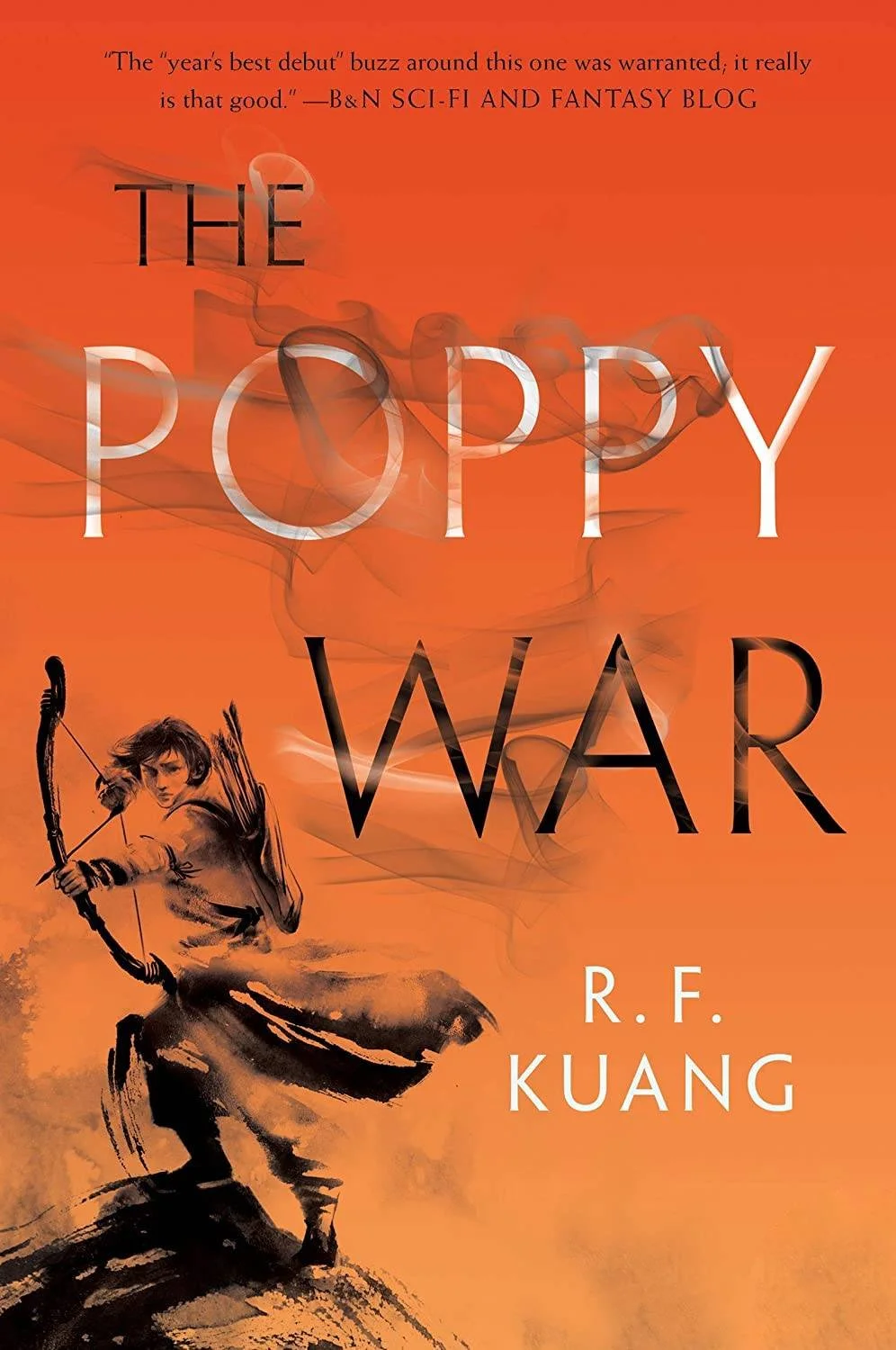
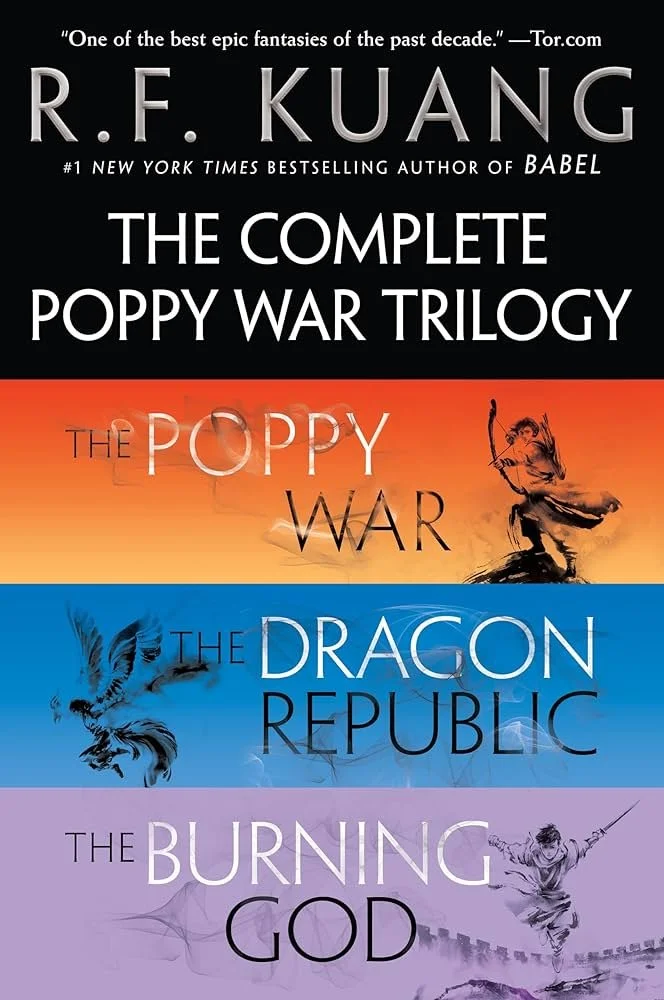
Photo from Amazon.com.
Lari Li
“Fire and water looked so lovely together. It was a pity they destroyed each other by nature.”
About the Series
For fans of unreliable narrators, mental spirals, and wartime fantasy; the Poppy War Trilogy should be next on your to-read list! This trilogy features The Poppy War, The Dragon Republic, and The Burning God, respectively. There’s also a 19-page novella called The Drowning Faith between the second and third book, told from character Nezha’s point of view.
Written by Chinese-American novelist R.F. Kuang at age 19, The Poppy War was published just two years later. Spanning 1850 pages, it took about two weeks to read over the summer. The length did not propose as much of a challenge compared to the devastating storyline.
“Oh, but history moved in such vicious circles” is what I essentially consider Kuang’s thesis statement for the whole trilogy. You’ll see.
Kuang is currently at Yale University pursuing a PhD in East Asian Languages and Literatures, and the Poppy War trilogy is based on the Second Sino-Japanese War (part of World War II). Rich with information, these books are built on years of intellect and are right in Kuang’s area of expertise.
I would recommend this trilogy if you want a longer read. It was enjoyable in happier times, and Kuang has got a great sense of humor. It was still a difficult read overall, as war is central. Breaks are strongly recommended and reader discretion is advised. Here are all the themes that I picked up: losing oneself, realities of war, betrayal, innocence lost, identity crisis, cycles, faith and divinity, sacrifice, trauma, transformation, addiction, vengeance, colonialism, colorism, dehumanization, coming of age, ethical dilemmas, morality, education, and corruption.
Brief Overview (No Spoilers!)
The trilogy follows main (and morally grey) character Runin “Rin” Fang, a war orphan whose parents were lost in the first two Poppy Wars. Drawing upon China’s provincial system, Rin resides in the Rooster Province of fictional country Nikan. She begins the first 14 years of her life as a shopgirl—but not just any kind. In the country town of Tikany, she lives with Uncle and Auntie Fang, abusive opium smugglers, and their biological son Kesegi. Every household was forced to take in at least one war orphan to prevent poverty and hunger-derived crime in the future, much to the Fangs' distaste. Rin was responsible for delivering opium and keeping track of imports in the shop.
With threats of being married off to a man three times her age, she studies day and night for the Keju exam to enroll at Nikan’s top school—Sinegard—the only school with free tuition, Rin’s only option. Sinegard is a military academy, one that kids across the country spend the first 16 years of their life studying for. Rin had to do it in two, utilizing very extreme study methods and pushing the limits of human capability.
When she arrives at Sinegard in the North, she’s hit with a culture shock. She already stands out with her darker skin and unlikely demographics. The Keju was designed to keep the rich in power, and Rin had defied those odds by qualifying from the rural South. With only 50 kids in Rin’s first year class, 35 were expected to remain after the Trials—an end-of-year exam where they must prove themselves to receive bids to become an apprentice of at least one instructor: Lore (Master Jiang), Combat (Master Jun), Strategy (Master Irjah), Medicine (Master Enro), or Linguistics (Master Jima).
Rin makes friends (like Kitay, my favorite character) and enemies (like Nezha) in her first year. She looks up to Sinegard’s prodigy and the last Speerly Altan, who was native to the island of Speer, which experienced a genocide in the Second Poppy War. Rin also forms love-hate relationships with her roommates Venka and Niang, the two other girls at Sinegard.
Eventually, Sinegard drama and tensions are behind the first year class as Nikan enters the Third Poppy War. Rin, discovering her shamanic abilities and connection with the Phoenix—one of the 48 gods in the Pantheon—climbs the ranks from assassin to general, pivoting as old enemies are destroyed and new enemies arise. She’s forced to grapple with the different sides of history and of the war, whether that’s century-long geopolitical tensions with Mugen (the island nation off the Eastern coast of Nikan), the Hesperians (considered oppressors, or “blue-eyed devils of the West”), the Republic (a promising new ideology for Democracy), the South and its Warlords (whose identity Rin tried so desperately to escape at Sinegard), or the legendary Trifecta (the three most powerful figures in Nikara history).
Rin meets—and trains—new shamans. All shreds of innocence leave the kids as they’re forced to face the horrors and reality of war and betrayal.
Thoughts
This series is super plot-heavy, with extremely vivid imagery and complex character development. True devastation came in Chapter 21 of The Poppy War, and the last two chapters of The Burning God. The conclusion to the series was so powerfully written and concluded every subconscious theme that Kuang built within readers’ minds. It felt like a punch to the gut. I wholeheartedly believe that Kuang was holding back in every single chapter of the series just so she could deliver such a powerful conclusion at the end.
I really love how well Kuang created Rin’s character and made her so complex and with inner dialogue. Readers get a glimpse into Rin’s mind, exploring her selfish thoughts and primal motivations.
While the genre of the series is labelled as fantasy, I personally think that the fantasy is kept to pretty realistic standards. Yes, there are fantasy elements, but not so much to the point where it’s confusing or hard to follow along. Kuang is a very educated individual and is able to bridge the gap between reality and fantasy through facts alone. I consider her to have her own place within the fantasy genre, her own subgenre.
The ending was…realistic. You’ll come to love the vivid and complex world that Kuang has painted, with powerful symbolism and character dynamics, beautiful storylines, and archetypes of all sorts. It also will make you rethink the whole series.
Nikan has a very rich history and readers will realize that what they’re dealing with is so much bigger than just a couple students in a military academy and the war they’ve gotten into. The most tragic part of it was the lives that these kids, really, were thrown into and the positions they were forced to take, all because they were born into something bigger than themselves.
“She saw it in a flash of utter clarity... History repeated itself, and she was only the latest iteration of the same scene in a tapestry that had been spun long before her birth.”
There is always so much to dissect. If you’re looking for your next powerfully moving and vibrant read that will get readers talking for days, The Poppy War is for you.
Quotes
Here are some of my favorite quotes from the trilogy:
“The only power strong enough to shatter you is the power you give someone else to lead you.”
“‘Nothing lasts,’ said Nezha, at the same time that Kitay said, ‘The world doesn’t exist.’”
“At the end of the day whoever is alive is the side that wins. War doesn’t determine who’s right. War determines who remains.”
“I am a mortal who has woken up, and there is power in awareness.”
“‘They were monsters!’ Rin shrieked. ‘They were not human!’ ‘Have you ever considered,’ he said slowly, ‘that that was exactly what they thought of us?’”
“I have become something wonderful, she thought. I have become something terrible. Was she now a goddess or a monster? Perhaps neither. Perhaps both.”
“Let them think of us as dirt, Rin thought... but dirt was common, ubiquitous, patient and necessary. The soil gave life to the country. and the earth always reclaimed what it was owed.”
“War was not a game, where one fought for honor and admiration, where masters would keep her from sustaining any real harm. War was a nightmare.”
“It’s easy to be brave. Harder to know when not to fight.”
“The fire doesn’t give, the fire takes, and takes, and takes.”
“If you hold the fate of the country in your hands, if you have accepted your obligation to your people, then your life ceases to be your own.”
“The future is a pattern dependent on the movements of the present.”