More Than Just “A Game”
Photos submitted by Hamilton Drama Society.
The 2025 competitive One-Act Play, “A Game,” recently completed its competitive run at State at UW Stevens Point. The show was a huge success, going down in Hamilton Drama (HSD) history as its third One Act to sweep State. The show was a first to HDS because of its interesting genre and messages that lay within the twisted plot of this show.
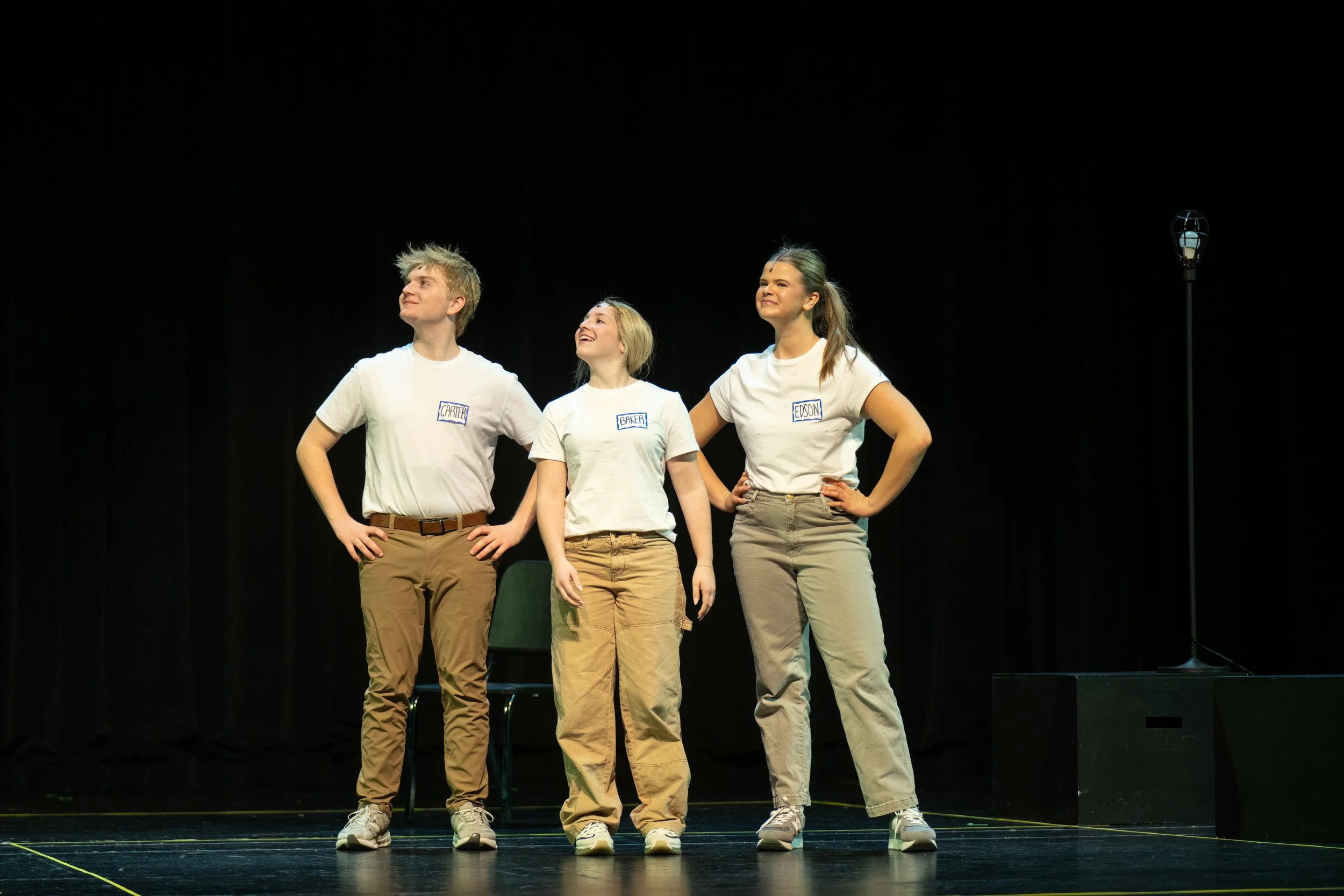
The show begins with Dr. Henning (Lauren Steighner, senior), as she approves of the setup for an experiment she is about to begin. Three participants walk in. They do not know their names and instead have one assigned to them by the doctor. They are then each given a chunk of the floor, all three of them equal in size. They then repeat the phrase “This is my land. It is mine. It is beautiful, and it is mine.” over and over using a light as a promt for the phrase—until eventually they say it on their own. Slowly, they begin to lose their childlike innocence and fight over the other objects in the room. This turns into a harsh power struggle as each one competes to have the most property. The show ends when Dr. Henning tries to end the experiment and the three test subjects end up brutally murdering her. The show calls the audience to ask many questions about the society we live in, and what makes one person superior to another.
“I’m not Carter, you’re Carter.”
The play begins in the genre “Theatre of the Absurd”. This genre is defined by a series of dialogue and actions that hold no material meaning whatsoever. Sentences are pointless and events lack distinction and meaning. The reason for this absurd style is because some playwrights believe that by writing characters and plots free of meaning and storylines, it leaves space for human nature to be displayed onstage honestly and plainly.
“A Game” opens with winding, repeating dialogue in which the characters debate each other's names and the meaning around them. The energy onstage is light and playful. Someone watching the show for the first time might believe the entire show would continue with such meaningless dialogue and a winding, pointless plot. However, this would prove to be false when the show takes a dramatic turn.
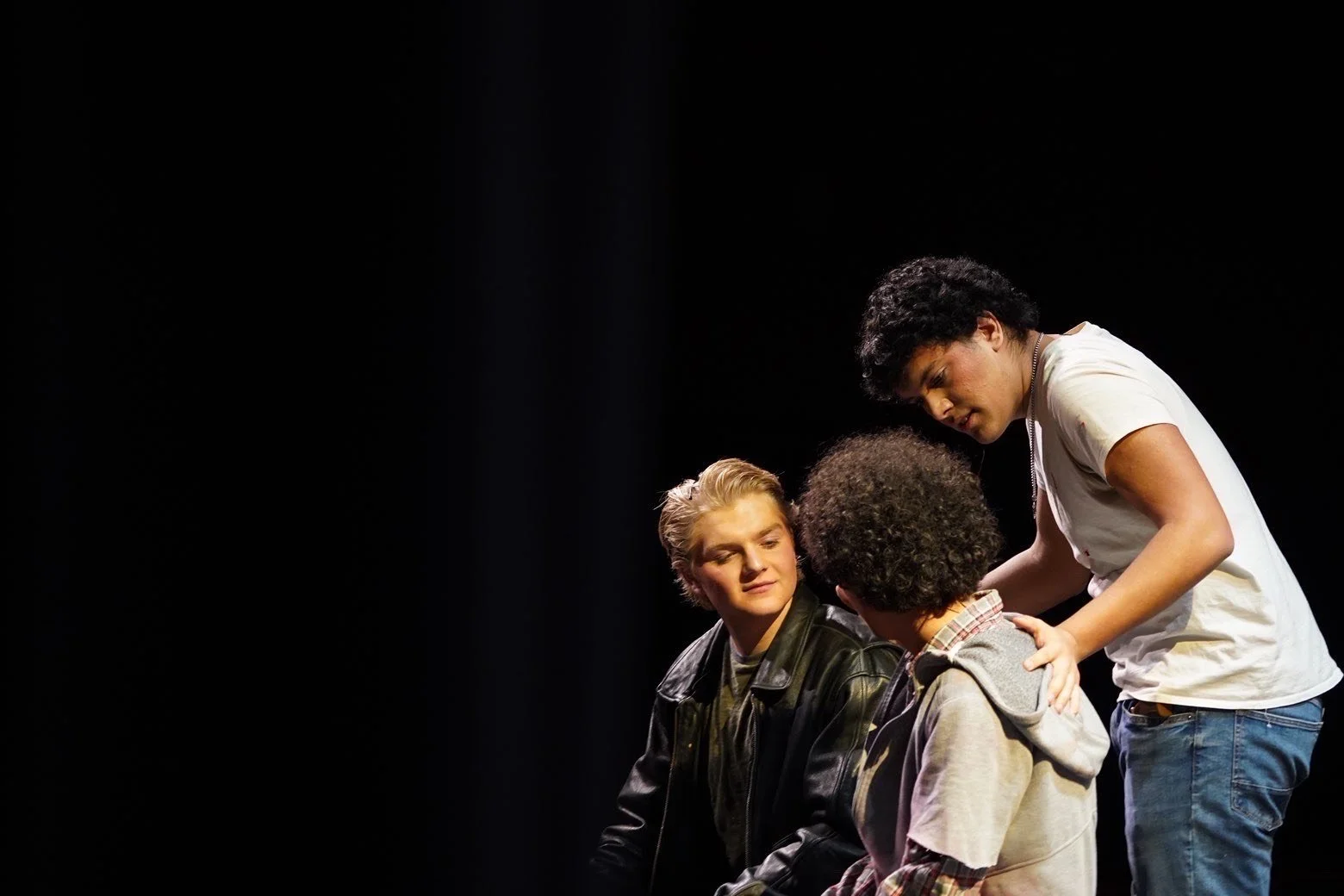
The winding dialogue exchanged between the three game participants, Carter (Elijah Karnthaler, senior), Baker (Sydney Nicholas, senior), and Edson (Livy Powell, junior) made the show a nightmare to memorize. Nearly every line is repeated at different times by each of the three characters, with no pattern whatsoever. Imagine trying to memorize 100 random number digits. It sounds pretty hard. Now replace those digits with phrases such as “I have to go to the bathroom”, “Hey, that’s right”, and “I don’t like this game”. Now remember the exact order the phrases are said in, rotating between three people with no pattern whatsoever. That is exactly what memorizing the first half of this script was like.
The cast of four began rehearsing in July, as competition begins at the end of October, so that they had as much time as possible to learn the material. In the end, with the nature of the script, it took until the beginning of October in order to be accurately memorized. That's four months of memorization.
“This makes me God”
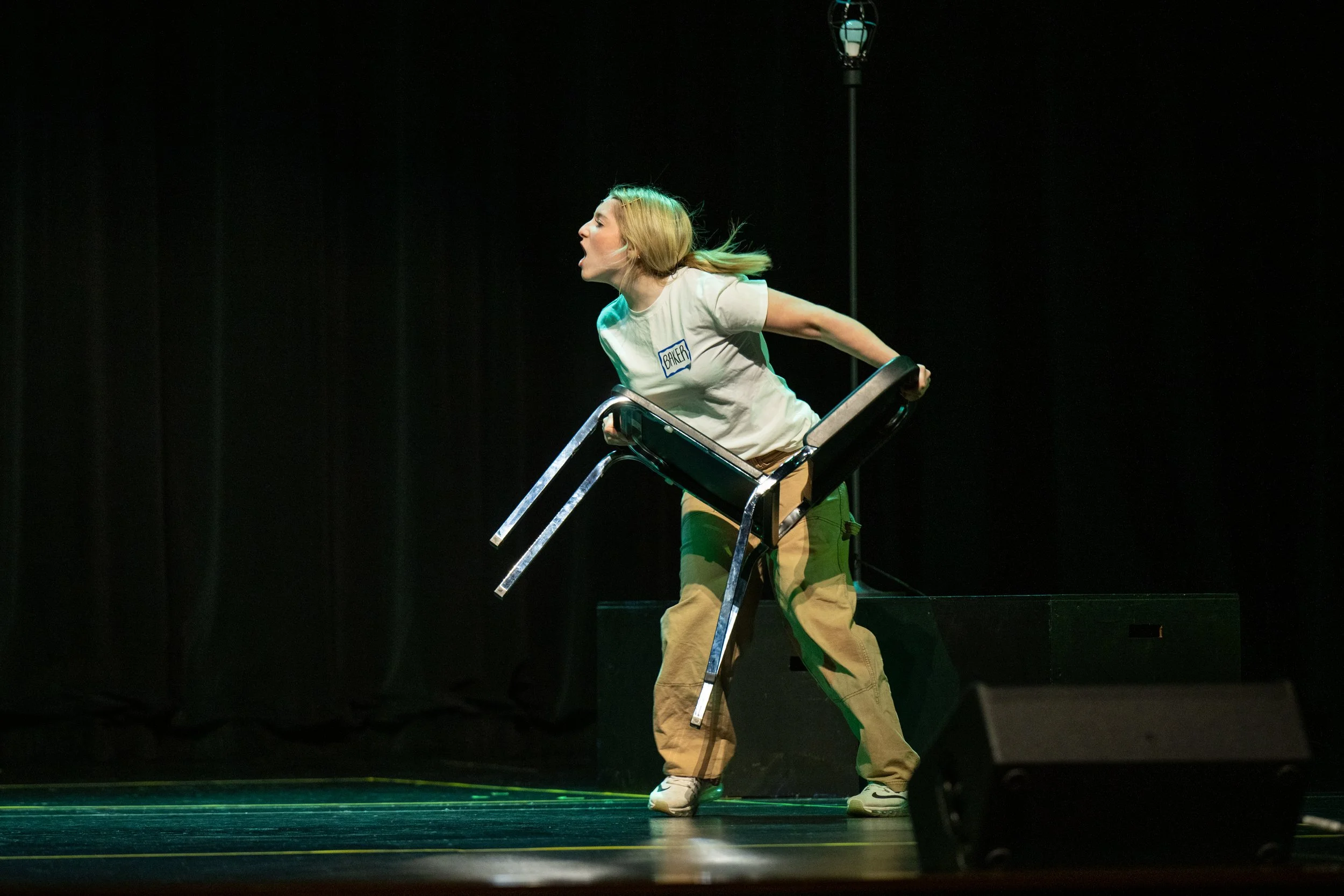
Even though the show begins as “Theatre of the Absurd,” it slowly shifts into something much darker. The show contains implications about nationalism, conflicts between countries, political metaphors, and brings up the questions of “what makes someone superior to others?” and “why do we feel the need to have the most?” Each of the three characters possess equal territories, but throughout the show insignificant objects cause the characters to believe that the equal territories are fundamentally unequal. They believe that a chair gives the owner the power to be the god of others and allows for its owner to invade the others, and that a locked door gives the owner control over the others.
The show is meant to be critical of society and reflect human nature. It displays polarization and how people naturally divide and force inferiority onto others. It causes us to question why things are the way that they are in society. Why is one country superior to others? Why are some people seen as inferior? What material things in our own lives have we given false meaning and importance to? The violent end of the show, in which the characters lose all sense of humanity and become animalistic, represents the violence that results from a fight for superiority.
Portraying this onstage was a challenge. The nature of this show required a build in energy and a large, gradual shift in tone. To begin with friendly, childlike banter and end with an animalistic murder with no singular moment of tonal shift was the hardest part of this show. To make this as realistic as possible, the actors focused on their breath. By using breath as the driving force of emotion in the show, they are able to not only make lines sound more believable, but to also allow energy to be passed between actors even when a character is not speaking. By strategically using breath, they were able to escalate the tone to become more animalistic in a way that audience members sense but don’t necessarily notice until it’s already occurred. By using breath to allow the emotions of the characters and the dynamic tone of the show to be displayed, this cast was able to elevate their performance into becoming one of the best shows in the state.
“I know what you were gonna do with the chair. You were going to use it to invade us!”
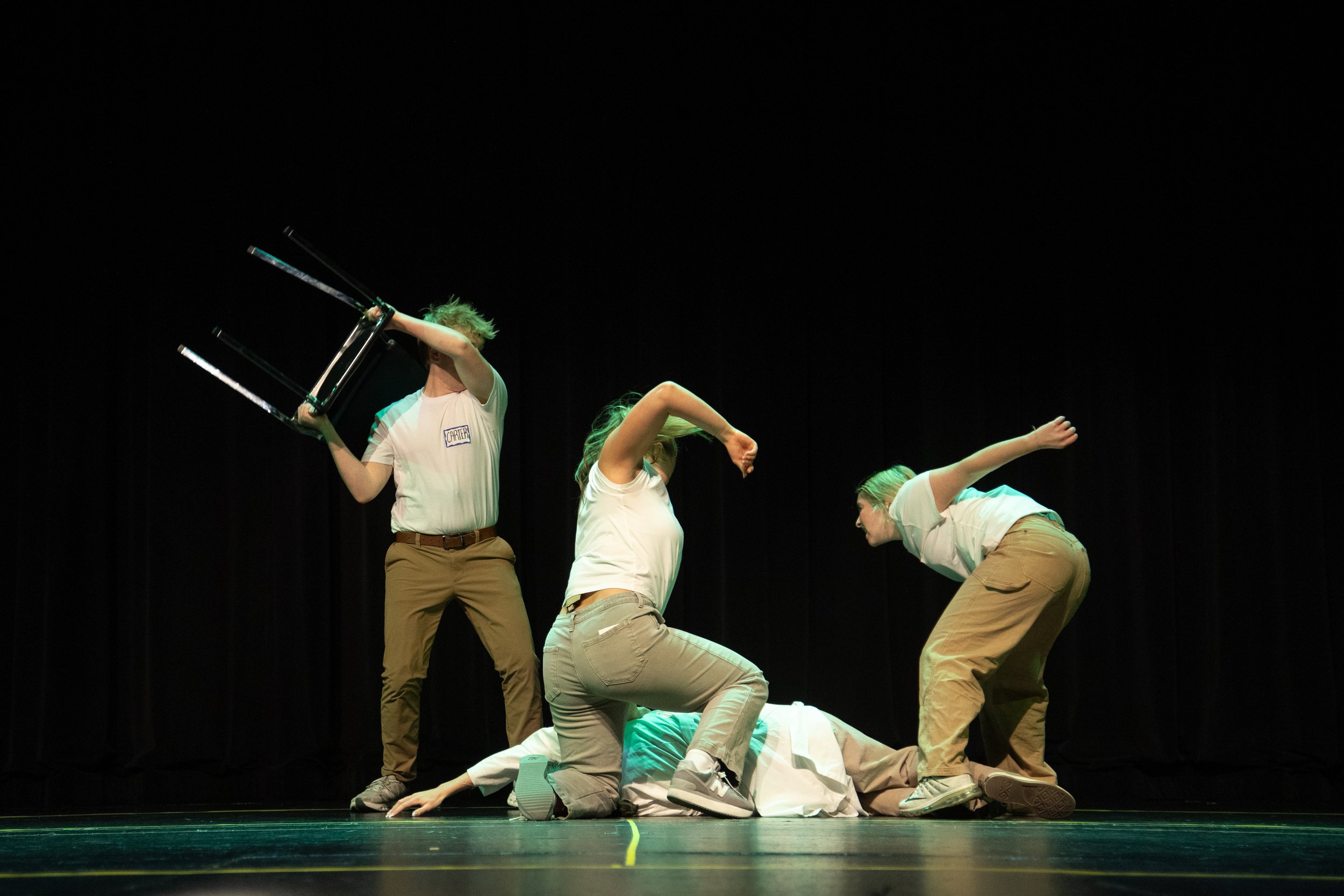
One unique factor in this show that is usually not incorporated into the Hamilton competitive One Acts was the use of onstage violence. When Dr. Henning re-enters in order to end the experiment, the trio of testees are so far gone that they are all literally fighting over the chair. When Henning tries to pull Baker away from the chair, Henning becomes the new focus of the violence. Rather than the trio fighting each other, they all join together against Henning. Henning then gets brutally shoved from person to person until she gets thrown to the floor. She is then beaten and eventually killed from being hit repeatedly by the chair.
In order to produce this scene safely, there were a lot of unique rehearsals that had to occur. For the rehearsal in which the actors learned the violence, they went into the dance studio in the Hamilton Fine Arts Center. The rehearsal was closed,—meaning that no one except the four actors and the director, Mrs. Troy, were allowed in the room—and it was a very intense rehearsal. They spent two hours learning how to effectively push, shove, throw, kick, smash, and kill Dr. Henning. For physical violence onstage the most important thing is that the person who is receiving the violence is the one in control. That means that to an audience member, it may look like Dr. Henning was being hurt, while in reality, she was the one in control of everything, and the other actors were following the speed and direction that she started. This rehearsal was a big bonding moment for the cast, because they were working together very closely and were able to laugh off any mishaps that occurred. This bond allowed them to be able to communicate nonverbally during the violence and work together in order to ensure the safety and integrity of the scene.
With physical violence onstage, it is very important to be well rehearsed in order to have a plan for when something wrong may occur. At their state performance, Dr. Henning ended up falling about 6 feet away from the center of the stage, where she is supposed to be for when she dies. Because of the rehearsals, trust, and discussions that had occurred between the actors, they knew they could trust each other to make slight changes in order to get the scene back on track. Livy Powell, playing Edson, in that moment grabbed Lauren Steighner, playing Dr. Henning, and spontaneously dragged her across the stage, which ended up making the energy onstage even more believable. That moment received lots of praise, as the audience thought that it was one of the most terrifying, intense moments of the show. However, all of the actors felt completely safe onstage while it was happening. This goes to show the importance of having a bonded and trusting relationship between actors during scenes like that. Due to the trust the actors had built, they were able to turn what could have been a disaster into a wonderful and terrifying moment.
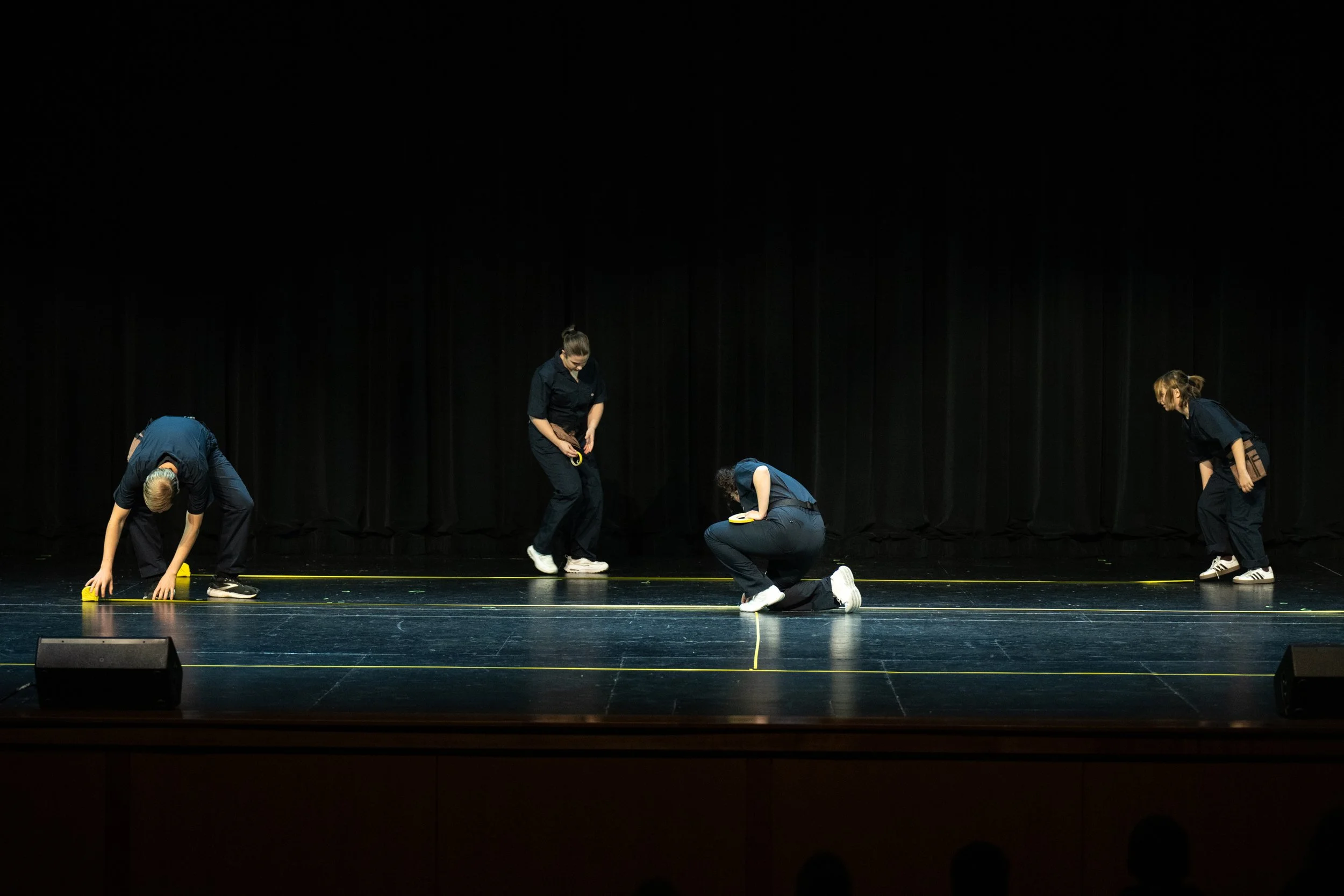
“Three separate but equal territories.”
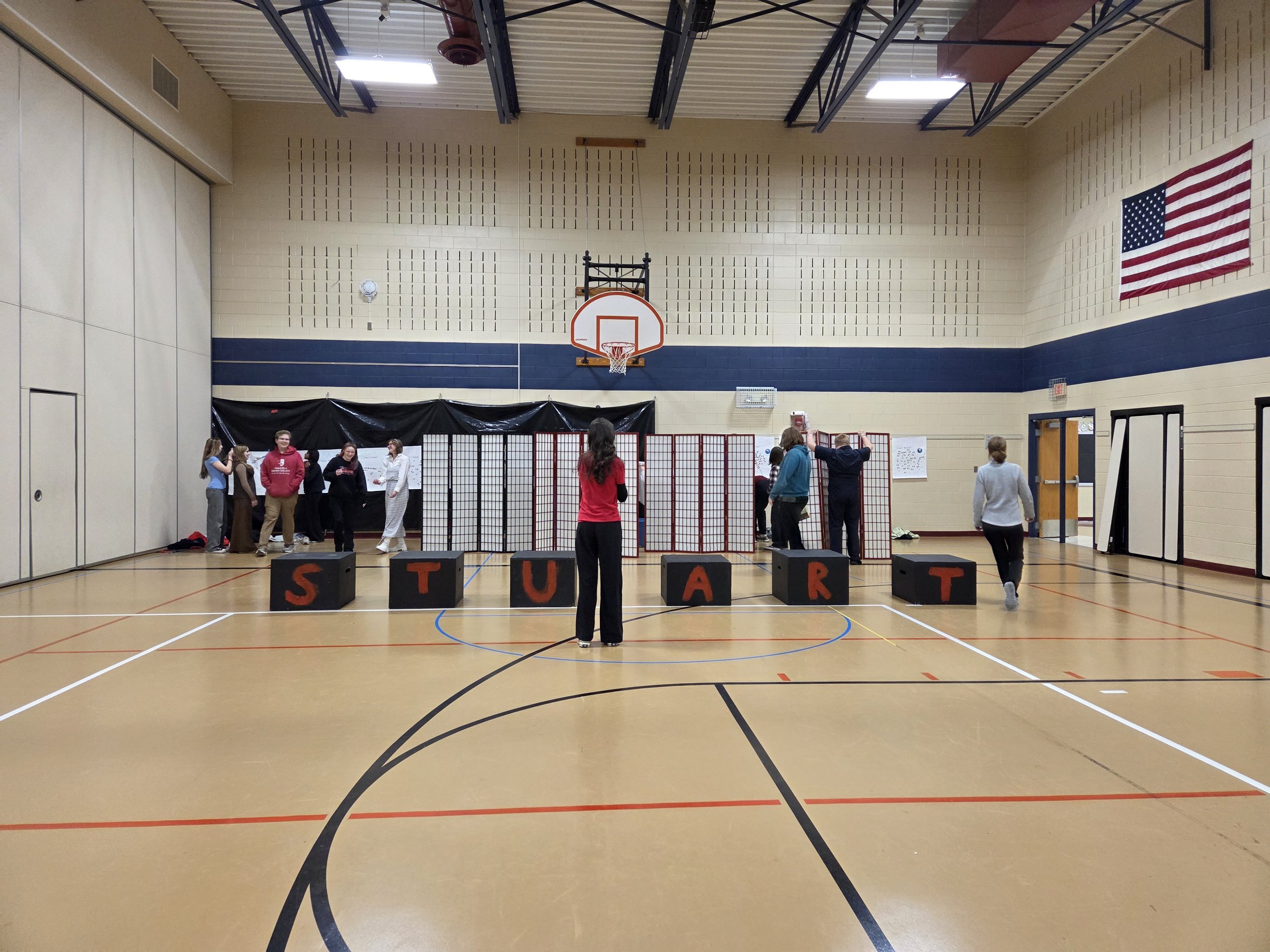
For this show, Mrs. Troy had a unique idea for how to incorporate the run crew into the show in a way that made the whole show feel more cohesive. The set was unique in that it called for three sections of the stage to be taped out in different shapes that all have the exact same area. The area of the sections being exactly the same was an essential part of the plot. This meant that in order for the set to be taped out perfectly, it would need to be done slowly with tape measures and preciseness. In order to fulfill this task, it was going to take about five minutes before the show in order for the run crew to tape out the boxes.
Mrs. Troy was faced with a decision. Do we let the audience sit and watch a dark stage with the run crew running around with tape for five minutes in awkward silence? Or do we find an alternative solution?
The solution was to dress the run crew in worker uniforms, give them a loose script of small talk for them to have with each other, and incorporate the entire creation of the set into the show. This meant that as the audience lights darkened and they looked to the stage in anticipation, rather than being met with the usual darkness and crew members rushing to set up and hurry offstage, they were greeted by four friendly workers conversing on a bare stage while taping the set. At the end of the show, these workers carried off the dead body of Dr. Henning and ripped up the tape, all in-character. The actors playing these workers were responsible for creating a complete scene out of almost entirely improv.
This unique blend between the cast and crew helped add to the message that the play is meant to mimic society and human nature.
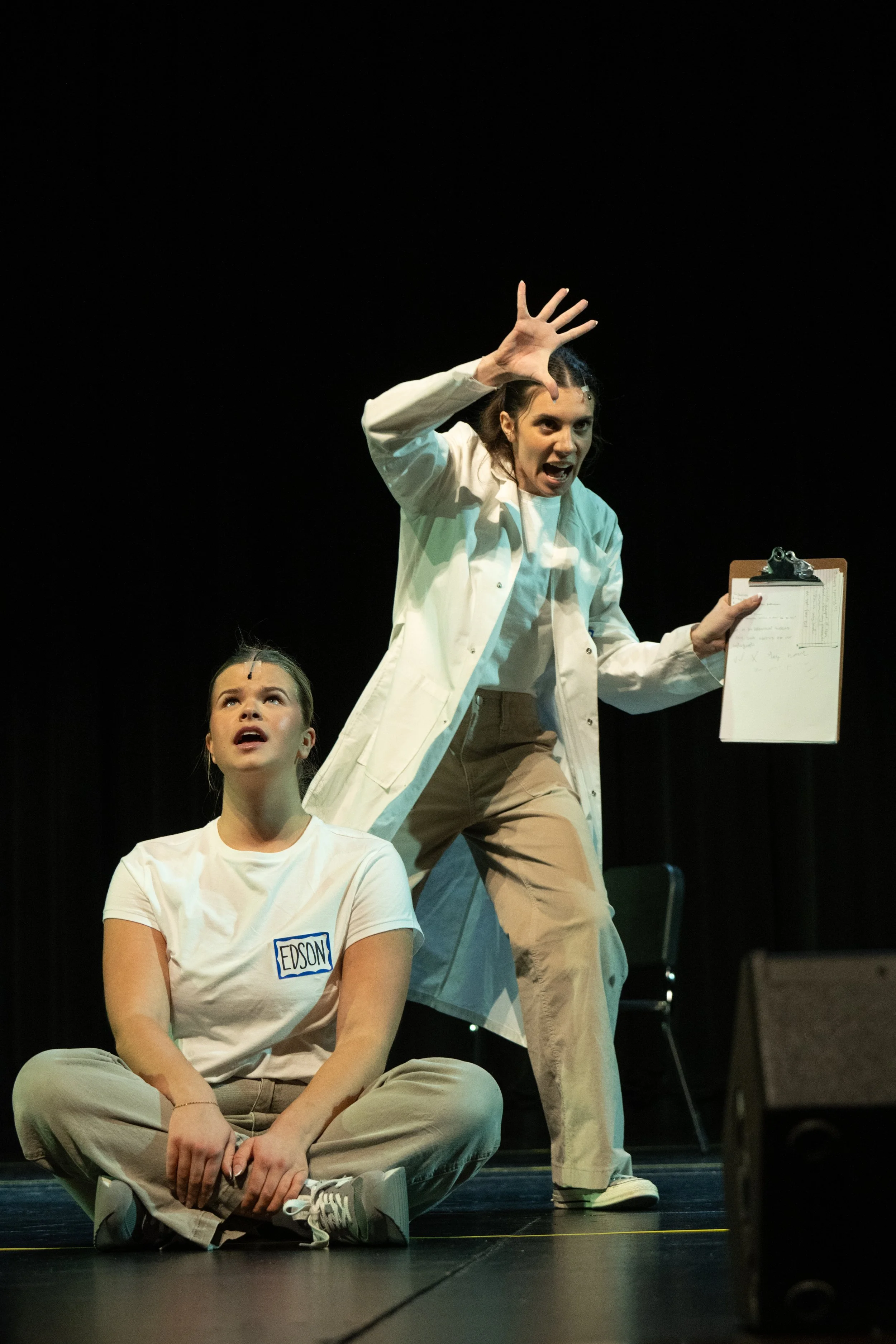
“Ontogeny recapitulates phylogeny!”
The “A Game” cast ended up working through many last minute changes. They proved time and time again that they work best under pressure. The road towards memorization was so difficult that it took many months. They got to the second week of October, with a week and a half left until the first competition, still struggling to get through the show offbook, when they got news that felt earth-shattering. Their first competition had been moved a week earlier. They now had less than a week to prepare before competing.
The task of memorizing and taking the show to competition-level in just two rehearsals felt impossible. But the cast demonenstrated their full ability, locking in; the competition went great, proving everyone who was worried wrong. The thrill and anticipation of the countdown to competition lit a fire within the cast, allowing them to work harder and create a show even better than if they had been able to go by the original time line.
Districts wasn’t the only time that this cast had to adapt to a setback with competition. When the show qualified for state, they found out the dimensions of the stage they'd be performing on. It turned out that they would need to shrink the dimensions of the tape “territories” in order to fit the entire set onto the stage. This caused some panic amongst the cast and crew, as they had to do quick math in order to adjust the dimensions of the tape and then had to rehearse taping it out multiple times until they could literally do it in their sleep. They then had to rehearse the show with the shrunken territories. The smaller stage meant less room for combat to take place. They had to re-block some moments in the show, as well as re-rehearse the stage combat to ensure that they could do everything safely within the confines of a smaller stage.
Part of the cast’s warm-up before the show was practicing the stage combat to make sure that they all felt comfortable performing it that day. At state, they were warming up in a classroom that happened to have incredibly slippery floors. This caused several mishaps with the combat just minutes before performing the actual show. When Steighner, as Henning, pulled Nicholas, as Baker, out of the fight, Nicholas ended up falling and sliding away—which was definitely not in the script. Afterwards, when Steighner was shoved toward Powell,—as Edson—who was supposed to catch her, Steighner slipped and ended up sliding in the wrong direction, causing her to fall in the wrong spot for her character’s death. This caused some apprehension amongst the cast, because they all wanted everything to go according to plan. In the end, these mishaps helped the cast to lock in and focus so that if anything went wrong, they would be able to handle it. In the end, even when things went wrong during the performance, these mishaps allowed the cast to be more prepared than ever.
The cast of “A Game” proved time and time again that they can think on their feet and work best under pressure. Anytime something seemed to threaten their performance, this cast was able to make the best of the scenario and find success.
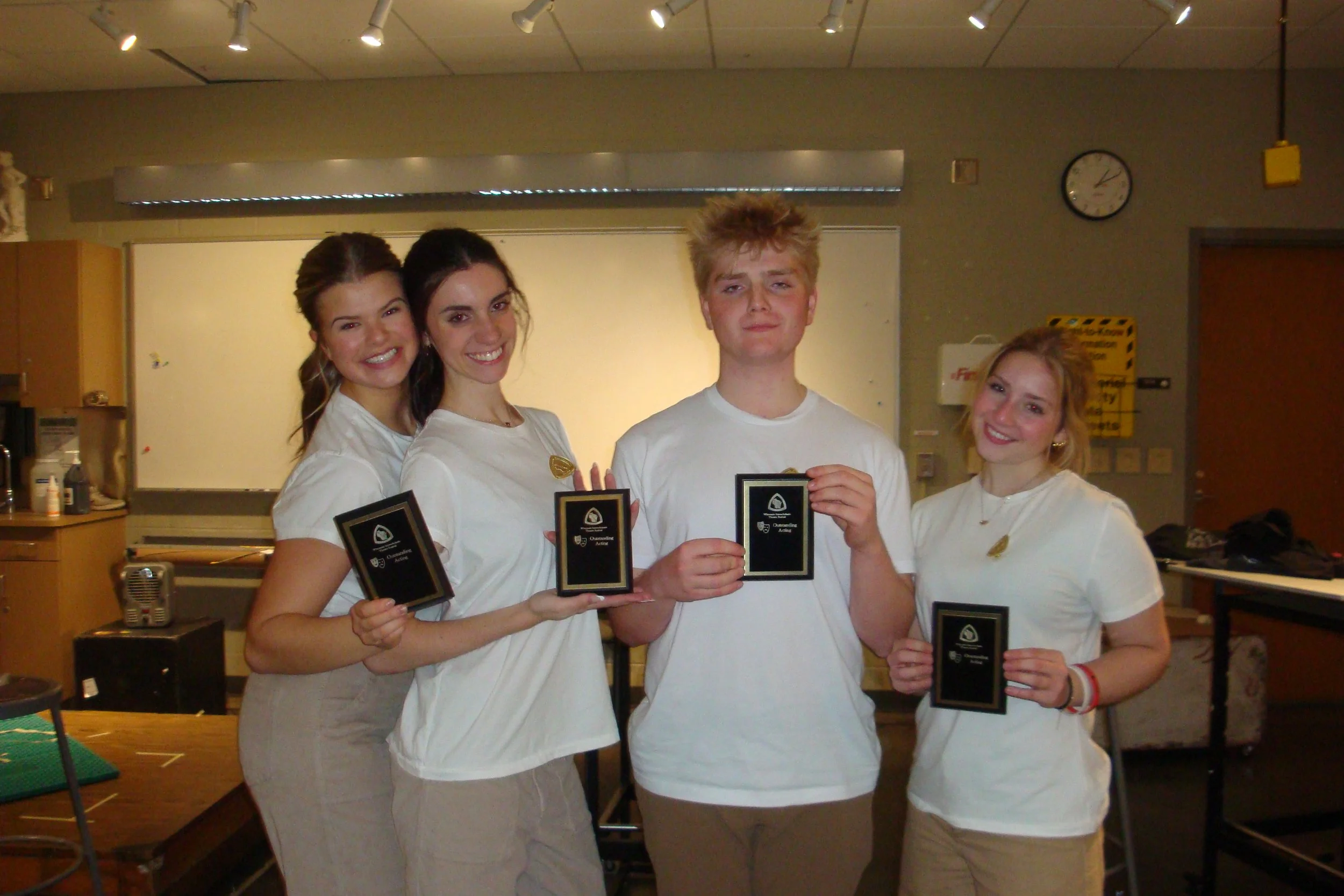
“How were we supposed to know how important it would be?”
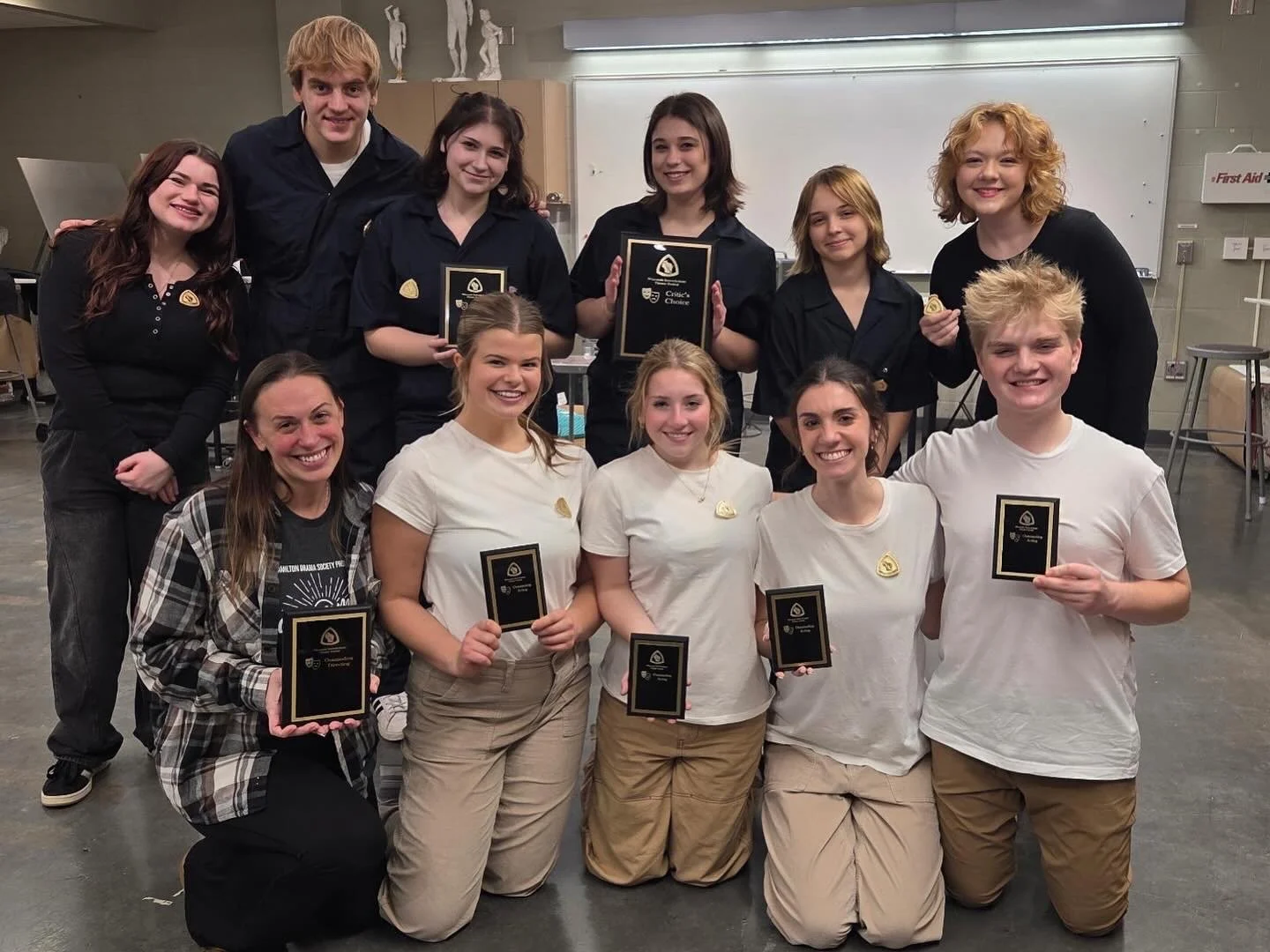
“A Game” became the third Hamilton Drama production to sweep at State! They took home Outstanding Direction, Outstanding Ensemble, Critic’s Choice, and each of the four actors received an Outstanding Acting Award. By winning Critic’s Choice, the judges credited “A Game” as one of the best shows at State.
However, it wasn’t the awards that made the show so impactful. It was the cast and crew; their bond and dedication that made the show what it was. Their collaboration and closeness was what made the show truly one-of-a-kind.
A unique opportunity the group was given this year was the chance to perform as a part of the Hamilton Drama Fall Show: A Night of Two One Acts. During this show, the “A Game” cast and crew got to work closely alongside the “Paper or Plastic” cast and crew. This collaborative show allowed the mostly-underclassman cast of “Paper or Plastic” to view the process of the competitive One Act more closely. This will hopefully foster an appreciation for the One Act within younger students, who will audition for the One Act for the years to come.
Congratulations to the Cast and Crew of A Game on all of their hard work and for putting on a phenomenal show!
CAST:
Elijah Karnthaler as Carter
Sydney Nicholas as Baker
Livy Powell as Edson
Lauren Steighner as Dr. Henning
CREW:
Colie Sobotta
Elena Stone
Josiah Bender
Emily Muehlenbach
Emma Suneja
Jasper Bauer-Loftus