
Taking the Edge Off
Have you ever looked at an airplane window? Not at the actual view, but at the window itself. The shape, specifically. Have you ever wondered why the windows are round rather than square or rectangular like most standard windows on other vehicles or objects (cars, buses, buildings, and so on)? Well back in the 1950s, they used to be square.
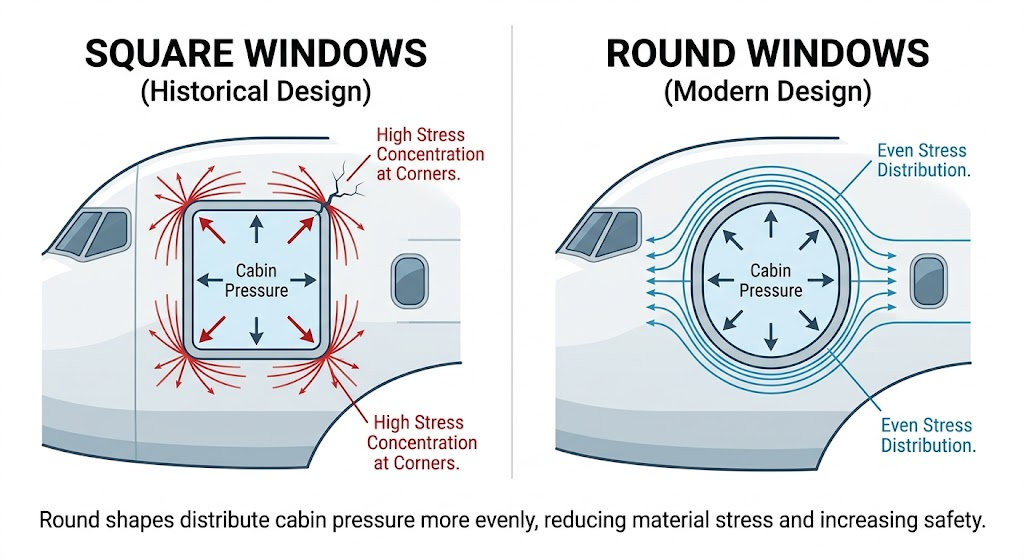
THE SCIENCE BEHIND IT: It started like this: 90 degree angles, sharp metal materials making up the edges and a square shape. The first commercial airplane took flight in 1914, and it didn’t take long for the design of these planes to change. Fatal accidents began to happen causing the plane to break apart, and scientists traced it back to the design of the window. One incident in particular killed all 43 people on the plane. Once the plane reached a certain altitude, the sharp edges on all four corners caused microcracks in the plane’s structure. The high pressure in the cabin was not distributed evenly around the rigid edges of the windows, concentrating pressure into just the corners, causing the plane to break apart and explode.
Now you may be wondering, why did it take so long to figure out what was the main cause? Back when commercial flights began to take off, they flew at lower altitudes (less pressure in the cabin) and slower speeds. But as years went by and aerodynamics began to progress, planes flew higher and faster, which was more than the square window design could take.
Then came the circle—a never ending shape. There are no edges, so when used in a plane, it cannot cause the microcracks that deform a plane. In the mid to late 1950s the BOAC (British Overseas Airways Corporation) was the first airline to redesign the airplane and install the new addition of circular windows.
THE CURRENT STATE: Now even though we have been using circular windows for over 75 years, scientists say that we could go back to square windows. This is because our materials are stronger and more durable then they were back in the 1950s, however we have kept the circular windows instead.
Today, it is easy to take these engineering tasks made for our safety for granted, but when looking at the bigger picture, or through a particular circular window, without these changes every flight would be at risk for these disastrous outcomes like the 1950s.