

The Ultimate College Application Guide
Photo from Pixabay via Pexels.
Emmy Schmidt and Claire Schumacher
College applications are likely the largest and most time consuming process you will go through in your high school career. Whether it’s deciding where to go, figuring out what major you may be interested in, or even how to fill out your applications, all of it is equally stressful and overwhelming. As seniors who have completed our applications, we wanted to share some tricks and tips so your college application process can be as easy and successful as possible! Below, we have a range of topics, all of which are commonly asked questions or misunderstood portions of the application process. We hope that this step-by-step guide will alleviate some of the stressors that we faced, and help you to rock your college applications! We also created a downloadable PDF College Apps Checklist that is embedded in this document, so feel free to create a copy and fill it out on your own!
-
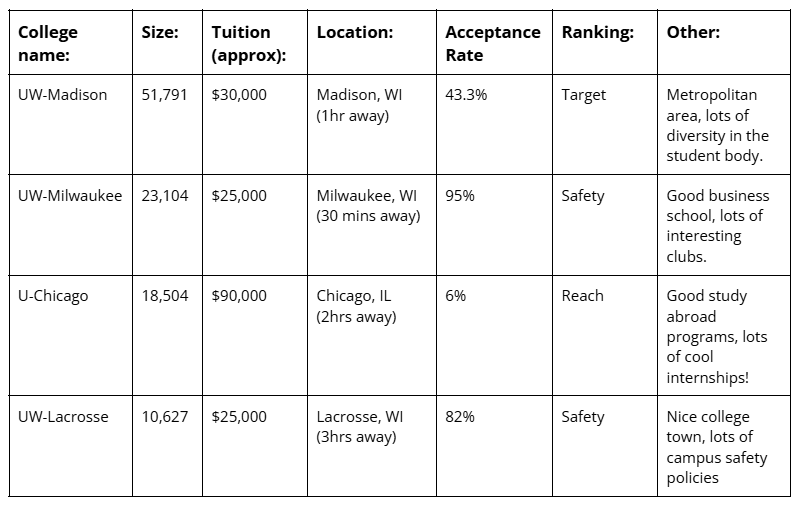
Choosing where you want to apply to college is the biggest decision you will make throughout the whole college process. The best way we’ve found to format a prospective college list is in a chart with columns, each column being one of your criteria. (An example chart is shown below.) Everyone's personal college criteria is different, like if you prefer a large school or a small one, but the categories you should consider remain the same from student to student. Things every student should consider are: student population, tuition costs (including room and board!), location, acceptance rate (likelihood you’ll get in), and another generalized section composed of other information you may want later. Make this list, and keep it accessible for later. (You will definitely need it!)
Example college chart:
-
The first thing you should do when considering what or how many colleges you should apply to is identify safety, target, and reach schools. Safety schools are schools that you are likely to get into with your GPA, test scores, and extracurriculars. To be a safety school, your credentials should align with the college's top 25% of students admitted. A target school is where your GPA and test scores closely match with the average of admitted students. These schools are both realistic for admittance, and provide competition. A reach school is where your credentials may fall slightly behind the average of students being admitted. Ideally, your test scores and GPA are in or around the bottom 25% of admitted students. If you have any colleges that interest you, this is where you would categorize them into safeties, targets, and reaches. On average you should apply to one or two safety schools, as you have a high likelihood of getting admitted, two to four target schools, as these are the schools that best fit your learning capabilities, and one to three reach schools, as these schools will be challenging but rewarding to be admitted to. Remember, this is just an average and if you apply to more or less schools than what we suggest, that is okay! Just remember that most colleges have a fee to apply to their colleges (around $70 on average), and those fees can rack up with each application. We do, however, strongly recommend you apply to at least one safety, target, and reach school. That way you can apply to those prestigious colleges but still have reassurance that you will get into other schools as well.
-
The Common Application website, more commonly known as CommonApp, is the forum students will use to apply to many, or all, of their colleges. While it looks intimidating at first, it actually is rather easy to navigate and use once you get the hang of it. To apply through CommonApp, there are two sections: the actual common application and the ‘‘My Colleges’’ tab, where you can add all of the colleges you want to apply to.
The first thing on the CommonApp is your “Profile,” where you will need to input personal information, demographics, and family information. This may require some parental help, so we recommend having a parent tackle this portion with you.
After that, there will be an “Education” tab, which is where you can submit your grades, current-year classes, and any honors you would like to share. It will also ask for your class rank. If you don’t know your rank, you can email your counselor in Student Services to ask for it! For the “Honors” section, you should put down anything you have received awards for—whether it’s academics, arts, or even sports. Don’t worry, you don’t need to have every section filled out, just put in any awards that are important to you or might relate to your designated major!
The next drop down task is the “Testing” information. Unfortunately, after the class of 2027, colleges will start to lean away from being test-optional. Madison, a common destination for many Hamilton graduates, will remain test-optional through spring of 2027, among most other Wisconsin colleges. When deciding whether or not to submit your ACT, SAT, or AP course scores, we would recommend doing research on the average range of scores for your desired school. If your score falls within (or above) the average range, that’s awesome! We suggest you submit it if this is the case. However, if your scores fall below average, that’s okay too—schools will look at more than just test scores when reviewing your application. It is totally fine to still report your scores if they are lower, especially if other parts of your application show your true academic profile. Another thing to consider, through spring of 2027, is to not submit your scores. Schools cannot penalize you for not submitting your test scores, so you will not be at a disadvantage. Overall, decide what works best for you and gives you the highest chance of getting accepted.
The next portion of the Common Application is the “Activities” tab. Here, we suggest you make a list of all of the activities, jobs, volunteering, internships, or other extracurricular activities you have been involved in, and rank them from most important to least. You only get ten spots to list your activities, so it is best to list your more impressive activities first. Also, don’t feel like you have to list every extra-curricular, especially if you didn’t have a leadership position or contribute much to the activity. When describing each activity, be precise and list any leadership positions in as few words as possible to fit within the 150 word limit.
One of the most important things on the Common Application is the personal statement. This 650 word essay allows college admissions officers to see your personality and voice, as well as your writing capabilities. Colleges already know your accolades and capabilities through other portions of your application, but here is a spot for you to stand out to your admissions officers. If you haven’t taken the AP Language course and written your college essay, we suggest you start brainstorming ideas for your personal statement sometime during your junior year. When writing your personal statement it is important to take into consideration what it should and shouldn’t do. A personal statement should use a more casual tone (than a formal essay), and it should demonstrate qualities, values, and skills you would contribute to a college campus. It can include “I” statements and it often incorporates some sort of vulnerability in your life. A personal statement shouldn’t be a typical English essay with a thesis, reasons, and evidence. It also shouldn’t be a trauma dump of difficult parts of your life. Admissions officers are looking for how you have overcome challenges, not just a list of them. Your personal statement should be written in your own voice and show how you have grown as a person through moments in your life.
Besides the personal statement, there is one other task to complete in the “Essays” portion of the application. There are two writing prompts, one of which is, “Would you like to share any details about challenges or other circumstances you’ve experienced?” This prompt is an excellent place to explain why there may be certain “holes” or lacking areas in your application. For example, a student may have experienced physical ailments that prevented them from doing any extracurriculars and caused them to miss many days of school. This spot is the perfect opportunity to share what you have gone through, how it may have negatively impacted your academic profile, and how you intend to overcome/get through your challenge in college. There is a very precarious line between stating challenges you have faced and how it impacted your education, and sounding like you are complaining about your life’s circumstances. In this section, it is important to keep to the facts, and if you don’t believe you have any challenges or holes to fill in your application, you don’t need to fill out this portion. This section is meant for notable challenges, not necessarily your B- in freshman year biology. The other question asked is, “Would you like to share any additional details or qualifications not reflected in the application?” This question is also used to fill any holes in your application. Maybe, you don’t have any circumstances that have prevented you from having a thorough application, but there wasn’t a spot to include a specific activity or honor you have received. For this prompt, list anything that you feel your application needs to be a complete encapsulation of you. Again, if you don’t have anything to write here, it is totally fine to leave the prompt blank.
The last section of the first part of the application is the “Course & Grades” tab. For this, you will need access to your transcript, which can be found in Infinite Campus. Grades will need to be imputed from ninth grade all the way to eleventh grade. This is a time consuming process, but you need to go slowly and make sure every section is accurate. Since you will be submitting applications during your senior year, you will not need to submit your senior grades.
After you are done with the first part of the CommonApp application, you will move on to the “My Colleges” section. Here you will search up all of the colleges you intend to apply to and add them to your tab. The colleges you add will all require different things from you, so it is important to look through each of them to determine which ones will take the most time, require the most supplementals, or need the most personal information. Below is a link to a table where you can find colleges you want to apply to and see what they require for the 2025-2026 school year, which is generally the same for each school year.
-
Parchment is another college-admissions forum that you may have utilized. During your senior year, all of the Student Services counselors will come into your home advisements and explain Parchment, but not everyone will need to use it. Parchment is a website used exclusively for ordering and sending copies of your transcripts to colleges. However, if you only use CommonApp for your applications, you DO NOT need to use Parchment. CommonApp automatically sends your transcripts to your colleges, so if you apply to colleges on their individual websites and not with CommonApp, you will need to send your transcripts manually. The University of Alabama, among other schools, offers a “Free Week” where applications are free on their website. So, I applied during Free Week on the U of A portal. Because it was their portal instead of Common App, I ended up having to order and send my transcripts separately. Had I paid the $55 and applied to Alabama on CommonApp, I wouldn’t have had to order transcripts. Another thing to note, Parchment charges $7.15 per transcript you order, so sticking to CommonApp is an easy way to avoid that unnecessary fee.
-
Recommendation letters come from your teachers and academic advisors, and are sent to colleges in addition to your application. Rec letters “humanize” your application and bring your personality and achievements to life in a way your application alone can’t. As some students already know, it is crucial to secure your recommendation letters early, as teachers can quickly get backlogged and overwhelmed by the influx of students requesting letters come September. We, as seniors, cannot stress this enough: ask for your recommendation letters at the end of your junior year. Knowing you have direct confirmation on who will be writing your letters is a weight off of your back as you apply, and makes life easier for your teachers by not overwhelming them closer to your deadlines. When considering who to ask for your letters, think of which teachers can reflect on you as the most authentic version of yourself. Choose teachers who you have a strong relationship with, and who know you on a more personal level. It is ideal to have your letters come from varying academic subjects, because having all of your letters come from science teachers shows less diversity in your application than having letters from two-three different subjects. Also, letters don’t necessarily have to come from teachers. Students often forget that club advisors, tutors, employers, and counselors can also write recommendation letters on your behalf! Sometimes, the most meaningful letters come from people who didn’t know you in an educational setting at all. The club advisor you have worked with for all of high school can probably reflect you better in a recommendation letter than a teacher you had for one semester.
Timeline
We have formatted a complete timeline detailing any and every step of the college admissions process in chronological order. We also created a downloadable PDF checklist that you can use online or print: an invaluable asset for staying organized throughout the college application process!
The timeline detailed below goes much more in depth than the PDF, so be sure to follow along with it as well. The timeline begins at the end of your sophomore year, when the college application process “begins,” and goes through fall of your senior year, after all your applications are submitted.
End of Sophomore Year/Summer Before Junior Year: Make Your Interest List and Extracurricular Log
-
Begin to think of what you want in a college and make a list of any and all colleges that fit your criteria! A longer list is better; you will narrow it down as you progress through the college process. Also, your college criteria may change as time goes on. Personally, I always thought I wanted to go to a big school in a college town; however, as I researched more and toured schools, I actually realized I wanted a small-medium school in a metropolitan, city centric area. The more you learn about different schools, the more you will actually learn about yourself as a student and what you want. My original college list had 16 schools on it, I ended up touring five, and applying to six of the schools from my original list. See our bigger section above regarding choosing where to apply for more information!
-
Something that will be extremely beneficial to your college application process is creating a log of everything you have done in high school that could be beneficial to you later on.
This list should include:
Volunteering
One time visits aren’t significant, but anything on a regular basis with the same organization are definitely notable.
Keep an accurate record of how many hours you volunteer: CommonApp will ask for exact hour counts so having a full log will be super helpful when it comes time to fill it out.
You don’t need to cure cancer, but your volunteering experience should be memorable and important to you and your development as a person.
Work Experience
Any and all jobs you have had are important to keep a record of.
Log how many hours you work per week, and what your role at your job is.
Having work experience adds good diversity to your application, it shows you can manage a schedule and have soft skills!
Extracurriculars
All clubs you are involved with inside and outside of school should be kept track of!
We recommend having two to three school-based clubs on your application, and one or two outside-of-school activities/clubs. (Example: HOSA, French Club, Best Buddies, and volunteering for Leukemia Lymphoma Society and Sussex Leos Club)
Your application looks best to admissions officers with MULTI-YEAR involvement. Joining six clubs during your Junior year looks far worse on your application than having 3-4 year involvement with three clubs. CommonApp makes you share how long you have been a member with each club, so join clubs early and commit to the ones you actually enjoy!
Leadership
CommonApp will also ask about leadership, so you should apply for executive roles in your clubs Sophomore and Junior year.
Having at least one leadership role on your application shows that you take initiative in your extracurriculars and that you have the type of qualities that college admissions advisors are looking for.
Some leadership positions weigh more heavily than others in the eyes of an admissions officer, positions like serving as president of a large club, being an NHS Officer, or being a manager at your job, all show more initiative and dedication to your work than being the secretary of a club with 15 members.
Sports
Being a multi-year athlete is another thing you should log, and it shows that you have teamworking capabilities and that you are also driven to personal growth and development.
A varsity sport is even better, as it demonstrates your competitive capacity.
Being a team captain is another example of leadership as well!
To reiterate: All of the bullet points listed above should be logged and kept track of to use later for your CommonApp! Additionally, when asking for your recommendation letters, some teachers may request that you send them a list of extracurricular activities, so having this log is beneficial for that as well! We have provided a template below on the second page of the checklist timeline if this is something you haven’t started yet! Feel free to make a copy of that document and fill it in with your own information!
June/July Before Junior Year: Make Your Tour List:
After doing your research and making your interest list, start to narrow down schools to the ones you are most interested in. Make a list of schools you’d be interested in touring—this is essential to have before the year starts. We recommend making your tour list in June/July before you start junior year. This way, once the throes of junior year begin, you don’t need to worry about researching schools while being bogged down with homework, a hard courseload, and standardized tests.
Early Junior Year (Mostly First Semester): Take College Tours! (Narrow Down Your List!)
Depending on the length of your list, the sooner you start to tour the better. Especially if you plan to tour colleges out of state, booking them early in your junior year or over the summer is ideal. Also, we recommend taking notes while you tour! You can just make a note on your phone and write down things you like, things you don’t like, and things you want to know more about! When I toured UChicago, I took notes as we walked and ended up using my notes in my “Why UChicago” supplemental essay! Also, if you tour early (as recommended!), there may be some significant time gaps between touring a school and applying to it. Taking detailed notes while you are there, taking pictures of campus, and even doing continued research on the school sets you up for success when considering if it is truly the school for you.
Mid Junior Year (First and Second Semester): Standardized Tests
The ACT is the main standardized test that Wisconsin students take. The school-mandated ACT is in March of your junior year, but if you plan to take additional ACTs you should plan them far ahead of time as seats fill up in testing centers quickly. When looking at colleges, you should find the average ACT score for your top schools.
The best course of action to get your highest possible score is:
Take a practice test (or two!).
Analyze your score, see where you need to improve. Students tend to have two weaker and two stronger sections, so take your two weakest sections, and study them.
Format a plan to raise your lowest scores. Some ways you could study to raise your scores include:
An ACT Tutor
Taking an ACT Prep course
Looking at free online resources for the sections you struggle with!
There are many ACT study resources online, so take advantage of them!
After working to raise your lowest scores, take the official ACT and see how your scores improved! Remember to schedule your actual ACTs at least one month in advance to ensure you have a seat reserved in the testing center.
Retake the ACT as many times as you need, but remember that each test costs $60 (or more!) and you aren't guaranteed to raise your scores. Also, most colleges don’t take your Superscore, so don’t bank on your Superscore getting you in anywhere.
End of Junior Year: Recommendation Letters
As previously explained above, the best time to ask for and confirm your recommendation letters is March-June of your junior year. This allows you to have a clear idea of who you want to write them and allows your teachers ample time to get them done. You will need to remind your teachers come fall of your senior year to upload your letters to CommonApp, but having them ready to go beforehand is best. We reccommend sending a reminder email early in September, and make sure to say a big thank you to any teachers who write you one! (Maybe even send them a Starbucks giftcard!)
June/July Before Senior Year: Finalizing College List
The summer before your senior year is instrumental in the college application process. By June-July you should have finalized your college list and have a clear plan of what schools you want to apply to. We recommend 4-7 schools, and you should have in-depth knowledge of each school you pick and why you want to go there. However, every student is different, and you shouldn’t let how many schools your peers apply to change your mind. As someone going through this currently, I have a friend who applied to 20+ colleges and a friend who applied to two. It is entirely up to you and what you think will be best for you. Also, you should take into consideration that most colleges charge an application fee, and some fees are pretty large. UChicago cost $95 to apply, while UW-Milwaukee was free: it really just depends on the school. On CommonApp, you are able to filter your “college search” tab to show schools that are free to apply to—if that is something that matters to you. Once you have a finalized list, you should start thinking about what each college will require from you in their application. Some schools may ask for a resume, most will ask for a supplemental, and some may need a portfolio of your work. Having a clear idea of what you’ll need done by the date CommonApp opens is great for alleviating stress during the admissions process.
August Before Senior Year: CommonApp Opens!
CommonApp opens on August 1st, a date that often is ignored because students are trying to soak up the last month of summer before senior year starts. However, if you have followed the timeline above so far, you should be well on your way to starting Common Application and have everything outlined for easy admissions. You also can make your CommonApp account ahead of time to start filling out the general application information. This was helpful for me personally with getting ahead of the deadlines—because August 1st came, I ignored it, and I proceeded to notrevist my CommonApp until mid-September. This was definitely illogical on my part; it put me in a time crunch to write my supplemental essays and finish my individual college applications. If you choose to fill out your general application early, it can only help you. Doing the majority of your CommonApp legwork before school starts is the BEST way to set yourself up for success in the college application process.
September of Senior Year: Work on Applications (SUPPLEMENTALS!)
By now, your colleges should be chosen and your general application should be filled out. Because you have this done, the bulk of your work is done and you can fully dedicate yourself to each college’s supplemental essay (if they have one). Everyone goes about their supplemental essays differently, and you will see that no one way works best. However, saving all of your supplementals for the weekend before your deadline is by far the quickest way to crash and burn. Supplementals can make or break your application and sometimes are the deciding factor for if you get into a school or not. Booking out ample time to write, revise, and get peer/teacher opinions on your essays is essential for crafting the best possible supplementals. Every supplemental has a different prompt and word limit, so looking into all of that ahead of time is pertinent. Throughout the months of August and September, make a concrete plan of when and how you want to break up your supplemental essays. Spread them out enough to have time to think in between essays, but not too far that you'll be pushing deadlines. I wrote two supplemental essays a week for the entire month of September, and 3-4 days was the perfect amount of time for me to plan, draft, and finalize every essay. By the end of the month, I had all of my essays done and felt confident about every single one.
October of Senior Year: Finalize and Submit Applications
Early October is ideal for submissions, as you will have everything off your plate and completed about a month in advance (deadline dependent), allowing you to really look over all aspects of your applications before turning them in. Also, if you turn in applications early, you tend to get more scholarship money. Colleges, whether private or public, only have allotted amounts to give in financial aid and scholarship every year. Turning in applications early means that colleges still have bigger portions of their endowments left for that year and are very likely to offer you more money compared to your peers who turned in applications near or on their due date. Also, early submissions show your prospective colleges that you are organized and on top of deadlines, making you a more appealing candidate overall. They also will go through your application sooner than others, meaning you have a higher probability of acceptance, compared to, again, the kids who applied last minute. Most schools cap how many students they take every year and the later you turn in your application, the closer you are to their “cap” limit.
November of Senior Year: First Mass Round of Deadlines
Early Action/Early Decision Deadline: October 15th or November 1st (School dependent)
Regular Decision Deadline: From mid-December to mid-February (School Dependent)
-
Applying Early Action means you submit your application by the “early” deadline, which is often November 1st. Submitting to the Early Action deadline puts your application into the first pool of applicants, meaning you have a better chance at being admitted in the first round. If you don’t get in Early Action, your application will automatically be deferred to the Regular Decision pool, meaning you, in all efficacy, get a second chance. Early Action is by far the most popular submission category for competitive schools because you have a far better chance at getting in. All timelines shared above are formatted to support Early Action submissions. Early Action is non-binding, meaning if you get in to a school, you aren’t legally-bound to go there. Early Action is the most common deadline, and the one we recommend most. It gives you a leg-up on other applicants, and it feels great to have applications off your plate by early November—you get to just enjoy the rest of your senior year!
Early Action Decision Days:
Some more competitive schools, however, have decision days. This means that every applicant to their school finds out if they got in on the exact same day at the exact same time. Decision days can often be nervewracking, as most decision days fall in late December to mid-January, meaning you may wait 3-4 months to hear back from a school. This is also entirely up to the college, some schools have the same decision day every year and some schools release their decisions all at once with no prior warning.
-
Conversely to Early Action, Early Decision, or ED, is binding. You can only apply ED to one school, and you sign a myriad of contracts legally binding you to that school if you are accepted. Not everyone uses their ED, but those who do typically save it for their “super reach” school. When going through my final applications, I chose to use my ED on UChicago, which is undoubtedly my dream school. I made this decision because UChicago is highly competitive, only accepting between 6-8% of applicants yearly. ED-ing to a college gives you a better chance of being accepted, as schools prioritize students who are entirely committed to their school over Early Action candidates. The major pitfall of applying ED is that ED applicants tend to receive less scholarship from the colleges they apply to, which is risky when looking at present-day tuition rates. Because ED is binding, you have to accept whatever tuition offer they send you, though you can argue it lower and win more scholarship money. If you don’t get into your ED school, no harm comes to you, your ED is effectively null and void. You still go to college, just obviously not at that school.
-
Regular Decision is the latest deadline and is non-binding. There is much more flexibility when it comes to Regular Decision deadlines, and they typically fall between mid-December and mid- February, but it varies by school. This is a catchall deadline, and it's meant for anyone who did not submit to an Early Action or ED deadline.
-
Some schools, typically ones that are big and public or small and private, have rolling admission. This means that as soon as you click submit on CommonApp, your application is sent to their admissions team and they start to go through it. Rolling admission schools can send their decision to you as soon, or late, as they want. However, the earlier you submit the sooner you hear back. I applied to UW-Milwaukee’s Lubar Business Honors College in the first week of October and was accepted three days after turning in my application. However, I applied to UMN-Twin Cities Carlsen Business College on the same day, and still haven’t heard back. Rolling admission is entirely up to the college.
-
Something many US students don’t consider is the possibility of applying to international schools. We won’t go in-depth about this, but if you find yourself considering an international university more seriously, try to do your own research. To summarize the process of international college applications briefly, instead of CommonApp, most countries have a similar forum for their university portals. The UK uses UCAS, which is the portal I utilized because I applied to five universities in the UK. UCAS requires a revised personal statement, which is very different from the personal statement that US students write. They also only accept one recommendation letter, so choose your recommender wisely! For any further questions or information, I found Google Gemini, ChatGPT, and emailing with international recruiters to be very beneficial.