"Patriotism: A Menace to Liberty" by Emma Goldman: A Review
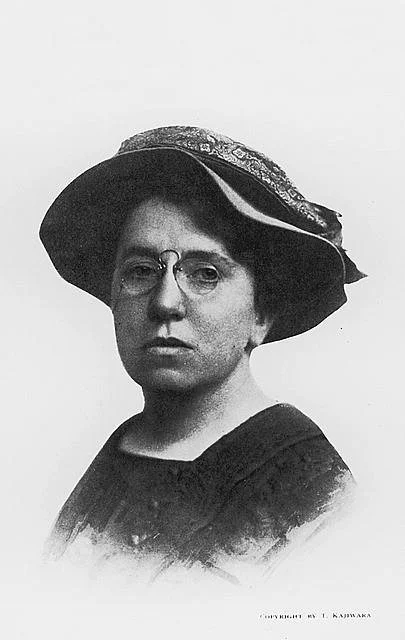
Photo from the Library of Congress.
Elias Callen
“We Americans claim to be peace-loving people. We hate bloodshed; we are opposed to violence. Yet we go into spasms of joy over the possibility of projecting dynamite bombs from flying machines upon helpless citizens. We are ready to hang, electrocute, or lynch anyone, who, from economic necessity, will risk his own life in the attempt upon that of some industrial magnate. Yet our hearts swell with pride at the thought that America is becoming the most powerful nation on earth, and that it will eventually plant her iron foot on the necks of all other nations. Such is the logic of patriotism.” —Emma Goldman
Emma Goldman wrote this essay in 1911, at the very beginning of the modern U.S. empire’s influence abroad and the horrid dawn of American exceptionalism. Goldman's analysis of the absurdity of patriotism still rings true today, and the situations of the late gilded age eerily resemble the conditions we find ourselves in coming into 2026.
Goldman begins by setting up the definition of patriotism she believes is most accurate, a superstition. One that “assumes that our globe is divided into little spots, each one surrounded by an iron gate.” She is here, attacking the notion that borders and the divide of countries is innate to the earth, and nothing more than a social contract between the ruling class, forced upon the working person. With this view of the earth's division of nations, the flaw in the idea that “those who have had the fortune of being born on some particular spot [are] better, nobler, grander, more intelligent than [others] in any other spot” becomes self-evident.
These facts hold a certain weight in today's political landscape, with its intense nationalistic rhetoric of “America first” or “America for Americans,” when it is recognized that the fervor to fight, die, and most importantly live for the idea of a country is nothing but foolish. From the time a child is able to comprehend and make friends with others, their mind is saturated with patriotic bile and an inflated sense of pride brought about by stories of the “horrid others” and only the worst news from other countries.
In Goldman’s time, these “others” were the violent Italians, drunk Irishmen immigrants, poor and dirty Russians, Catholics destroying American Protestantism, etc. This trend has not ceased, but evolved. We don’t fear Italians any longer, we have new targets of American fear: Mexicans and Latinos, Chinese, Muslims, Somalis, Palestinians. A child who grows up believing that their country is the center of enlightenment and all that is good will inevitably turn upon the innocent lives of others. Goldman's description of patriotism as the superstition in the superiority of one's own nation is currently on full display.
This superstition then pushes men to “clamor for a greater army and navy, more battleships and ammunition… Just think of it–four hundred million dollars taken from the produce of the people. For surely it is not the rich who contribute to patriotism." To Goldman, patriotism is a syphon on the average American—one that doesn’t and cannot possibly serve their interest, promoted by the rich and ruling to establish a cheap army of willing volunteers who will gladly be shipped off to foreign lands to fight a war for money that makes the corporations at home billions. Goldman notes that in the past five years, every major military power of her time increased spending on their respective war departments, a trend that continues today.
The US recently passed legislation to raise the national defence budget to over 900 billion dollars, and the UK and other NATO states, like Germany and Poland, have rapidly begun to increase their military capacity, all at the expense of the material conditions of their citizens. Those still patriotic through such calamity are the most glaring proof of Goldman’s message.
Goldman uses the example of the Spanish-American war, which was fought mainly on the island of Cuba (which for decades had its own independence movement, weakening the Spanish colonial forces). “Let us take our own Spanish-American war, supposedly a great and patriotic event in the history of the United States…But when the smoke was over, the dead buried, and the cost of the war came back to the people… that is, when we sobered up from our patriotic spree it suddenly dawned on us that the cause of the Spanish-American war was the consideration of the price of sugar; or, to be more explicit, that the lives, blood, and money of the American people were used to protect the interests of American capitalists…”
The wars in the wake of 9/11 bear a striking resemblance to the Spanish-American war. Years of propaganda and anger against the Arab nations, pushed over the edge by the catastrophe of 9/11 lead to a “patriotic spree,” fervor untamed and violent, that cost 20 years, over 4.5 million dead, and all in the name of American superiority and vengeance that fundamentally accomplished nothing. Patriotism is a tool of the wealthy designed to convince the working class that the enemy is the other poor, starving and languished person on the other side of an invisible border, ever shrinking and expanding. The prison warden, the tyrant, or the boss are not worthy of challenge to the patriot. It demands total allegiance: to sacrifice family in the name of the flag.
“Considering the evil results that patriotism is fraught with for the average man, it is as nothing compared with the insult and injury that patriotism heaps upon the soldier himself…” Goldman doesn’t forget the soldier, the armed wing of patriotism that dishes out the violence against whomever and whatever is deemed the enemy. On a lecture tour in San Francisco, Goldman was visited by soldiers as well as being able to observe the barracks from her lecture hall in Presidio. What she was confronted with was the ugly truth that the army had made men, even the ones skilled beforehand, unable to assimilate back into regular society. Having been conditioned for violence, “no peaceful pursuit could content them.” The criminals who were turned over to the military from the prisons to serve their penance in the military came out no less prone to criminal activities after being brutalized by the army.
The most prime example of this is a man Goldman refers to in her writing, Private William Buwalda. “Because he foolishly believed that one can be a soldier and exercise his rights as a man at the same time, the military authorities punished him severely. True, he had served his country fifteen years, during which time his record was unimpeachable. According to Gen. Funston, who reduced Buwalda’s sentence to three years, ‘The first duty of an officer or an enlisted man is unquestioned obedience and loyalty to the government, and it makes no difference whether he approves of that government or not.’” His crime? Meeting with fifteen hundred other soldiers in a park to hear Emma Goldman speak. The army sentenced a man for exercising his right to free association and speech. Goldman attributes this to patriotism. The army of any nation is a microcosm of what patriotism intends to be for the entire nation. It is the total suppression of will and of mind for the purpose of making man a willing servant of authority. “[Patriotism has turned] a thinking man into a loyal machine!”
Is this not parallel now with the ruthless persecution of Navy Captain Mark Kelly by the Secretary of Defence Pete Hegseth? The difference now is that Kelly is not a radical by any definition, but simply told the media that soldiers have the right to refuse illegal orders! The superstition of a great and pure America now has moved onto punishing even the moderate dissenters, those who still will die for country and order.
Goldman's essay clearly and directly outlines how patriotism undermines any chance that the working class has to gain any real kind of freedom, and how it’s implement in the fabric of all of our lives turns brother against brother. “When we have undermined the patriotic lie, we shall have cleared the path for that great structure wherein all nationalities shall be united into a universal brotherhood — a truly FREE SOCIETY.”
Read the full essay here: Patriotism: a menace to liberty | The Anarchist Library