Rotating Detonation Engines: The future of space travel?
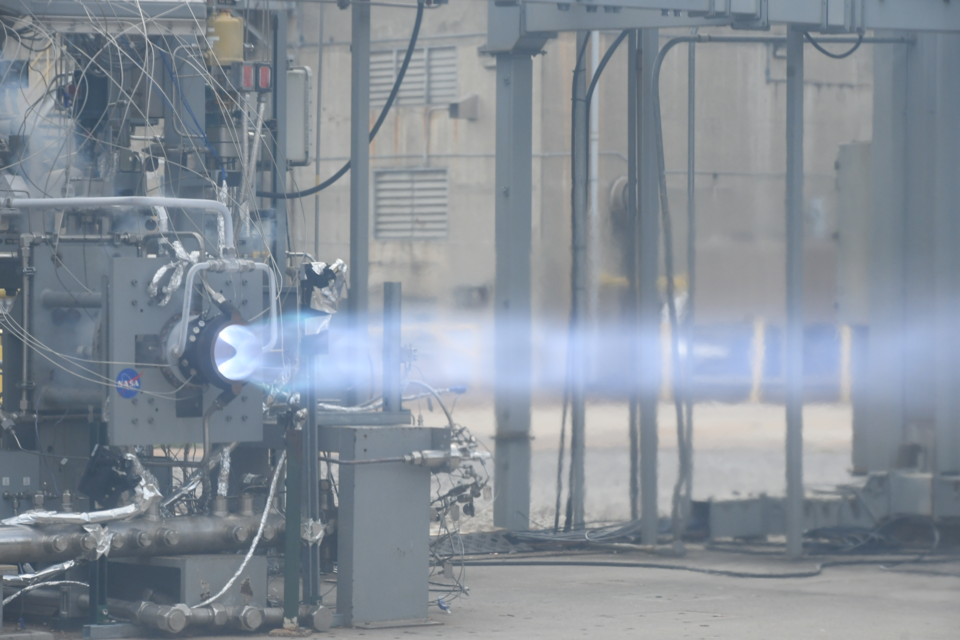
Cover image from NASA.
The first rockets ever used were the gunpowder-propelled arrows of the 13th century. These simple tubes of gunpowder with an open end were incredibly rudimentary, and while they were effective for their time, they still had a long way to go.
During the turn of the 20th century, Russian schoolteacher Konstantin Tsiolkovsky proposed some of the first ideas that resemble our modern space explorations. Among these was the accurate assessment that the faster the exhaust of a rocket, the better its performance. Robert Goddard, an American inventor, would follow this up by launching the first liquid-propelled rocket in 1926. While the flight was unimpressive, the use of liquid oxygen and gasoline represented a large leap in the exhaust velocity over solid rockets. This would all culminate in one of the most famous rockets of the 20th century, the German V2 (Benson, 2021).
By the 1940s, rocket engine design had progressed to appear very similar to our modern-day designs. Looking at the V2, it had a bipropellant system using a liquid oxygen oxidizer (LOX) and an alcohol-water fuel. During flight, fuel and oxidizer were injected into a combustion chamber using turbopumps, where they would then burn to create exhaust gases. These gases were finally accelerated through a conical, converging-diverging nozzle, pushing the gases to supersonic speeds. While several significant improvements had yet to come, such as advances replacing the conical nozzle with a more efficient bell nozzle, replacing the open cycle gas generator with a staged combustion cycle, improvements in fuel chemistry, or the use of 3D printing for custom geometries, almost all modern rocket engines still resemble this original architecture. Even the SpaceX Raptor engines, one of the most modern lines of rocket engines, are bipropellant engines that burn fuel in a combustion chamber and push it through a de Laval nozzle (Belluscio, 2016).
So what are rotating detonation engines, and what makes them different from what we have now?
Deflagration vs Detonation
Naturally, when people hear the word “detonation,” they immediately think of explosives. And, while many famous explosives like C4 or TNT are classified as “high explosives” that detonate, there are also many “low explosives” like gunpowder, which deflagrate instead of detonate.
Scientifically, detonation is actually a very specific term that doesn’t refer to whether or not something explodes, but to whether the explosion wave propagates through the materials at supersonic speeds. In other words, in detonations, the explosion is triggered by a supersonic wave that travels through the explosive material, compressing and igniting it through the sheer pressure and force of the shockwave.
Deflagrations, on the other hand, are actually a lot closer to what most people think of when they imagine an explosion. This is simply the process of part of a material combusting, the heat from that combusted region conducting further along, and then igniting the next portion of the material. Black powder, one of the earliest explosives invented, is an example of a material that deflagrates. Candles are another easy way to visualize deflagration. As the flame of the candle burns, it slowly moves its way down the wick to fresh material, propagating the reaction by having heat conduct from one section to another. The main difference between deflagration and detonation then, is that a detonation relies on a supersonic wave to ignite material, whereas a deflagration simply relies on the heat of the reaction to conduct to and ignite the next part of the material.
But rocket engines aren’t supposed to explode (Roulette et al., 2026)! So what’s the point of talking about detonations and deflagrations and how different materials explode? Well, both detonations and deflagrations are actually processes by which a fuel can combust and don’t necessarily just refer to explosives. In fact, almost all modern rocket engines rely on deflagration, the same process that can cause materials like black powder to explode.
Going back to our V2 rocket engine example, the liquid oxygen oxidizer and alcohol-water fuel are both injected into the combustion chamber via two separate turbopumps. Once in the combustion chamber, the fresh fuel and oxidizer mix, reacting almost instantly from the heat of the combustion chamber and generating superheated gas that shoots out the nozzle. Because this combustion process relies on the heat already in the combustion chamber transferring and igniting the fresh fuel, it is considered a deflagration. The main reason why these rockets don’t explode like other deflagration reactions is in large part thanks to the nozzle exhausting the high-pressure gases before they build up enough pressure to actually rip apart the combustion chamber (though the advanced engineering required to build combustion chambers is still absolutely incredible and just as vital).
On the other hand, a rotating detonation engine (RDE), as you might be able to guess, detonates. In a rotating detonation engine, the “combustion chamber” is more of a combustion ring. Fuel is injected into this ring, where a detonation wave (or multiple waves) spins around at supersonic speeds. The wave then combusts the freshly injected fuel and oxygen through a violent shockwave compression, adding energy to the wave and creating insanely high-pressure exhaust gas. The sheer violence of this reaction is actually enough to generate a back pressure that can temporarily block additional fuel from entering through the port the wave is at. This, along with just the insanity that is trying to contain and control a supersonic shockwave, is a major part of why RDEs are only a recent advancement.
So why bother?
What makes rocket science hard isn’t being able to send a rocket up. As is with any engineering field, if you threw enough money at the problem, it would probably go away. The real difficulty is making something go up efficiently. That’s where the main benefit of RDEs comes in.
Just for some context, rocket efficiency is usually measured using specific impulse. Specific impulse is a bit of a weird unit if you aren’t familiar with rockets and physics, but, in very rough terms, it tells you the ratio between a rocket’s thrust and the rate at which it burns fuel. It is measured in units of seconds, though that’s more just a consequence of how the math works out and doesn’t really mean much intuitively.
Going back to our V2 rocket, these rockets had a specific impulse of 239s (Wade, n.d.). The Raptor 3, one of SpaceX’s newest and most advanced engines, has a specific impulse of 350s (Wikipedia, 2026). That means that in the roughly 70 years since the V2 rocket, our propulsion systems have only increased in efficiency by roughly 46%. Of course, specific impulse isn’t the whole story, as it doesn’t capture anything like thrust-to-weight or reliability, but it serves as a good reference point when it comes to evaluating how efficiently a rocket engine can burn its fuel.
Now, the big question. How much better is a rotating detonation engine?
Research into these engines states that they can have a 10-25% higher specific impulse (Wang, 2025). That is mainly because RDEs are an isochoric process, whereas traditional deflagration-based engines are isobaric, though that is way beyond the scope of a high school news article that is already way out of its depth. And, while maybe not an earthshattering improvement, these efficiency improvements are still very impressive and have caused companies to focus significant efforts towards development of RDEs.
Current designs have yet to hit that ideal 25% improvement, though. In 2023, Japan Aerospace Exploration Agency (JAXA) successfully launched an RDE on a rocket, but it only hit a specific impulse of 290s and only ran for 6 seconds, well below the standard traditional engines can achieve (Sato et al., 2026). NASA, DARPA, L3Harris, and a whole host of other organizations have also tested concept RDEs, although data about their specific impulse is still limited, as the main hurdle is just getting these engines to run without exploding.
The other major benefit of RDEs is that they can be significantly shorter. In traditional engines, a converging section is normally required to get subsonic exhaust to sonic speeds. However, because the combustion in an RDE is powered by a supersonic wave, the exhaust gases are already being expelled at or above the speed of sound, allowing these engines to skip the converging section entirely and have a much shorter profile. Additionally, these engines usually use aerospike nozzles instead of traditional bell nozzles, further allowing them to shorten their profile.
Where RDEs are now
As it stands, despite there being several potential benefits, rotating detonation engines are not a mature enough technology to even be considered for use in an actual rocket. Almost every current firing of an RDE right now is happening on a thrust stand, in a controlled environment, in a propulsion lab.
However, that isn’t to say that progress is not being made. In 2023, NASA tested a full-scale, 3d printed RDE that ran for 251 seconds and generated 5,800 pounds of thrust (Osorio, 2023). This record flight was recently surpassed in 2026 by Astrobotic, which successfully tested a 300-second continuous burn that generated 4,000 pounds of thrust (Astrobotic, 2026). And as more and more companies continue to join in on the race to the first flight-ready RDE, the future looks pretty good.
References
Astrobotic. (2026, April 23). Astrobotic Breaks Records for Rotating Detonation Rocket Engine Hot Fire. Astrobotic. https://www.astrobotic.com/astrobotic-breaks-records-for-rotating-detonation-rocket-engine-hot-fire/
Belluscio, A. G. (2016, October 3). ITS Propulsion – The evolution of the SpaceX Raptor engine. nasaspaceflight. https://www.nasaspaceflight.com/2016/10/its-propulsion-evolution-raptor-engine/
Benson, T. (2021, May 13). Brief History of Rockets. NASA Glenn Research Center. Retrieved September 21, 2026, from https://www.grc.nasa.gov/www/k-12/TRC/Rockets/history_of_rockets.html
Osorio, R. J. (2023, December 20). NASA's 3D-printed Rotating Detonation Rocket Engine Test a Success. NASA. Retrieved September 21, 2026, from https://www.nasa.gov/centers-and-facilities/marshall/nasas-3d-printed-rotating-detonation-rocket-engine-test-a-success/
Roulette, J., Porter, M., Zieminski, N., & Freed, J. (2026, August 5). Blue Origin zeroes in on rocket engine issue as source of New Glenn explosion. Reuters. Retrieved September 21, 2026, from https://www.reuters.com/science/blue-origin-zeroes-rocket-engine-issue-source-new-glenn-explosion-2026-08-05/
Sato, T., & Matsuoka, K. (2026). Space Flight of Liquid Rotating Detonation Engine Using Sounding Rocket S-520-34. Journal of Spacecraft and Rockets, 63(2), 579-596. aiaa. 10.2514/1.A36447
Wade, M. (n.d.). V-2. astronautix. http://www.astronautix.com/v/v-2.html
Wang, B. (2025, July 31). Air Force Research Lab, DARPA and NASA Rotating Detonating Engine Research. nextbigfuture. Retrieved September 21, 2026, from https://www.nextbigfuture.com/2025/07/air-force-research-lab-and-nasa-rotating-detonating-engine-research.html
Wikipedia. (2026, September 8). SpaceX Raptor. Wikipedia. Retrieved September 21, 2026, from https://en.wikipedia.org/wiki/SpaceX_Raptor