
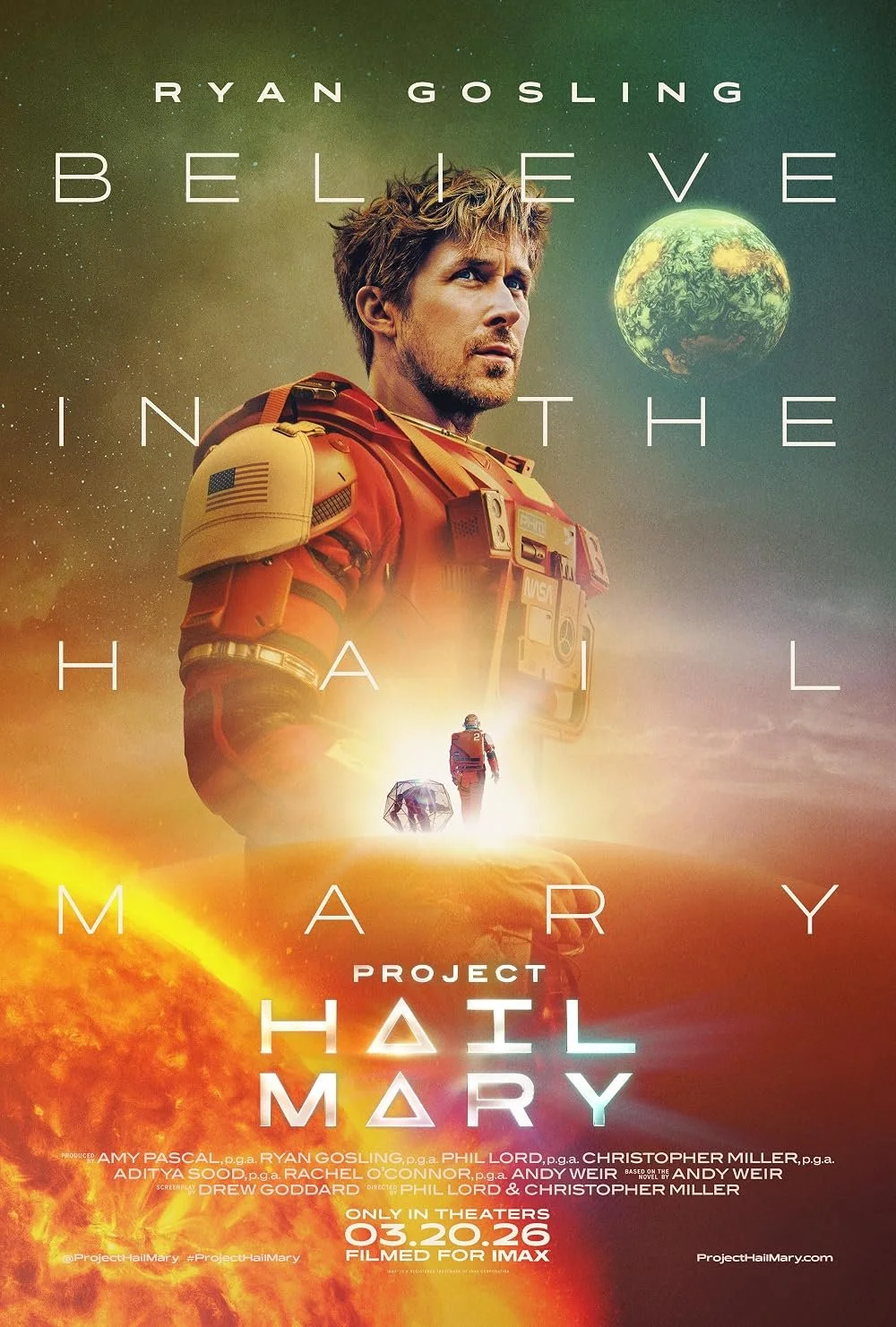
Project Hail Mary: The Value of Optimism
Photo from IMDb.
Preface
May 4, 2021, marked the publication of a new sci fi novel titled Project Hail Mary, written by former software engineer and current author Andy Weir. Subsequently, a film adaptation of the aforementioned novel, produced and directed by Phil Lord and Christopher Miller and starring actor Ryan Gosling, was released on March 9, 2026. As of now, the film has a score of 95% on Rotten Tomatoes and an 8.3 out of 10 on IMDb. More notably, its latter score pertains to an impressive achievement in Ryan Gosling’s acting career, specifically that it was among one of the highest-rated of any of his films.
Between the literature and film versions of this particular narrative, what stood out the most to me was how the messaging retained its value throughout the original and the adaptation. The degree to which viewers may have interpreted it varied, though when I approached many different individuals about what they thought of the messaging, there was a consistency. From dedicated fans of Project Hail Mary to people who simply viewed it once and moved on, most seemed to agree that the story offered an optimistic perspective on an otherwise doom-and-gloom plotline.
An Initial Overview of the Plot
Project Hail Mary opens fundamentally the same way in both the book and the movie. Ryland Grace—portrayed by Ryan Gosling in the film—awakens from a comatose state, confused and unable to remember where he is or even who he is. Over the course of the narrative, Grace steadily recalls memories, both those important to the success of the mission and of his life beforehand. On the ship, both of the crew members that were anticipated to support Grace in the mission had passed away from unknown circumstances, also previously in a comatose state.
It’s revealed through Grace’s flashbacks that, after a scientist on earth detected an unknown streak of light spanning from the Sun to Venus, known as the Petrova Line, samples were gathered of its contents. It was quickly discovered that the line was seemingly taking energy from the sun, diminishing its luminosity and leading Earth on a collision course for a rapid global cooling. With the habitability of the earth in jeopardy, former molecular biologist and middle school science teacher, Ryland Grace, was unexpectedly approached by United Nations representative Eva Stratt. Such an occasion pertained to a need for specialized scientists to research the sample; to which they were found out to be microorganisms, consequently named Astrophage.
Months of research and testing passed, with Ryland Grace leading many of the scientific sides of the mission, deservingly titled Project Hail Mary due to the last-resort nature of it. A crew of three individuals were to be sent to the only star unaffected by an existing Petrova Line, Tau Ceti, with the goal to have a solution sent back in probes due to the one-way nature of the trip. Grace was not one of the original crew members intended for this mission; however, the sheer amount of energy emitted by tested Astrophage led to the death of the original science specialist of the crew, which pushed Ryland Grace into that empty position. Bluntly, he was sent on the one-way trip unconsentually.
After waking up from hypersleep on the Hail Mary mission and finding himself as the only surviving crew member, Grace had minimal guidance up until he encountered another unexpected ship-like object also within Tau Ceti’s orbit. He found himself meeting the organisms (rather, one organism) living on the ship, who Grace soon establishes communication with and subsequently names “Rocky.” Rocky eventually moves onto Graces’ ship, and relative months in the narrative pass by while they continue their journey to uncover the nuances of Tau Ceti’s Astrophage population and eventually find a solution that they send back to Earth. Over this time, the two individuals grow a strong and wholesome bond through their shared experiences that eventually leads to a fundamentally happy and complete ending by the end of the narrative.
An Analysis and Conclusion
In a 2026 interview by former actor and news writer Aaron Pruner with Andy Weir, Pruner shared a question regarding why such a terrifying plotline was carried out in such a “feel-good” manner. Such a question had also frequently crossed my mind multitudes of times whilst reading the book and watching the movie. Wasn’t the plot of Project Hail Mary apocalyptic in nature? Easily, Weir could have strayed to a version of the story where all things went to doom-and-gloom, possibly showing a more negative side of science and innovation. However, Weir responded quickly, “‘It’s just an outcrop, an outgrowth of my worldview, I suppose’” (1). And, upon further investigation, the aforementioned worldview directly surrounded one primary idea—optimism.
Andy Weir was accurate in his declaration, as there were truly many, many ways this was seen in his original work.
Among these modes of communication, one of the first that stood out was an exploration of a complex, nuanced problem causing anguish towards a wide demographic, specifically the Astrophage infestation within Earth’s solar system, among other neighboring solar systems. The narrative challenged this road-block by showcasing persistence in the wake of the unknown despite the fact that this problem was beyond the scope of anything people had seen. The leveraging against an intricate issue was something that presented itself with significance regarding the narrative.
For example, in the beginning of the book, when Ryland Grace woke from his comatose state, he soon came to realize that the gravity where he was felt uncomfortably stranger than usual. With quick-thinking, he quickly measured the length of time passed for an object to hit the floor, allowing him and the reader to realize he wasn’t on Earth. Although this was a smaller fundamental problem, it provided an introduction to the consistency of the effectiveness of leveraging with optimism instead of wallowing in pessimism or despair against a situation unknown at the moment. Even if he didn’t know what to expect of his data, Grace consistently believed that finding an answer in the first place would suffice as a good outcome. Expanding upon this, even if road-blocks and complicated unknowns continuously placed themselves in the mission’s way, Grace continued his work, and believed he must input strong effort to achieve a good outcome.
Pivoting in a different direction, I feel as if it’s most deserving to also bring up the fan-favorite character, Rocky, iconically depicted in the film by actor and puppeteer, James Ortiz. But why was he a fan-favorite? On one hand, he carried himself with a comical demeanor and an abundance of wholesome sincerity, which tends to appeal to consumers as an enjoyable character to view. But on the other hand, he also represented an optimistic hypothetical to first contact with an alien species.
To some degree, the idea of meeting an alien species for the first time sounds horribly daunting, especially because most well-known depictions of extraterrestrial beings hold a negative connotation: Ever seen Alien (1979)? But when Grace and Rocky held the same goal of saving their planets from a mass extinction due to their shared Petrova Line issue, they were quickly able to find a common ground during their first interactions. Rocky became a close friend to Grace, and through their complementary abilities, they found a solution to the overarching issue. Despite the circumstances of their overarching missions, despite how negative first-contact could have been, a positive light was shown on this aspect of the narrative.
I mentioned before that I noticed many ways Andy Weir’s world views are reflected in his work. To relay the definition of optimism, it is defined as a mindset where the individual believes that, consistently, negativity falls to the wayside under good or positive outcomes. But why is this optimism important? Optimism isn’t a buzzword thrown around for the sake of award-winning essay competitions or a club name; as concluded in a National Institute of Health article, “...it is apparent that optimism is a mental attitude that heavily influences physical and mental health, as well as coping with everyday social and working life” (2). Optimism in an applicable mindset, not something one is born with, or something inaccessible to people.
Project Hail Mary stands out in its genre because of its optimism. So many pieces of science fiction work show how science and innovation can be the downfall of progress and humanity, or that unknown or nuanced problems are too complex to be understood without fantastical means. In a genre so littered with pessimism, Project Hail Mary stands out, especially as a popular and highly regarded work of science fiction. That popularity reaches masses of people: Its message of standing true to an optimistic mindset in dark situations reaches masses of people, whether they’re individuals who consume science fiction media on a consistent basis or people like me who never enjoyed science fiction until Project Hail Mary.
So I turned off my TV and walked out of my living room, returned my online copy of the book, and felt a new intrigue towards seeking positivity. And as stated by Andy Weir, “I believe humanity is pretty frickin’ awesome, and I think we do great things, especially when we’re pushed. So, I think we’re an amazing species, and we do amazing things” (1).
Sources
Optimism and Its Impact on Mental and Physical Well-Being. (2010, May 14). NIH. https://pmc.ncbi.nlm.nih.gov/articles/PMC2894461/#sec7
Pruner, A. (2026, March 20). ‘Project Hail Mary’ Creator Andy Weir Just Taught Me a Surprising Thing About Sci-Fi. CNET. https://www.cnet.com/culture/entertainment/project-hail-mary-andy-weir-interview/