Corey Ruiz Deserved to Live: The Myth of The Perfect Victim
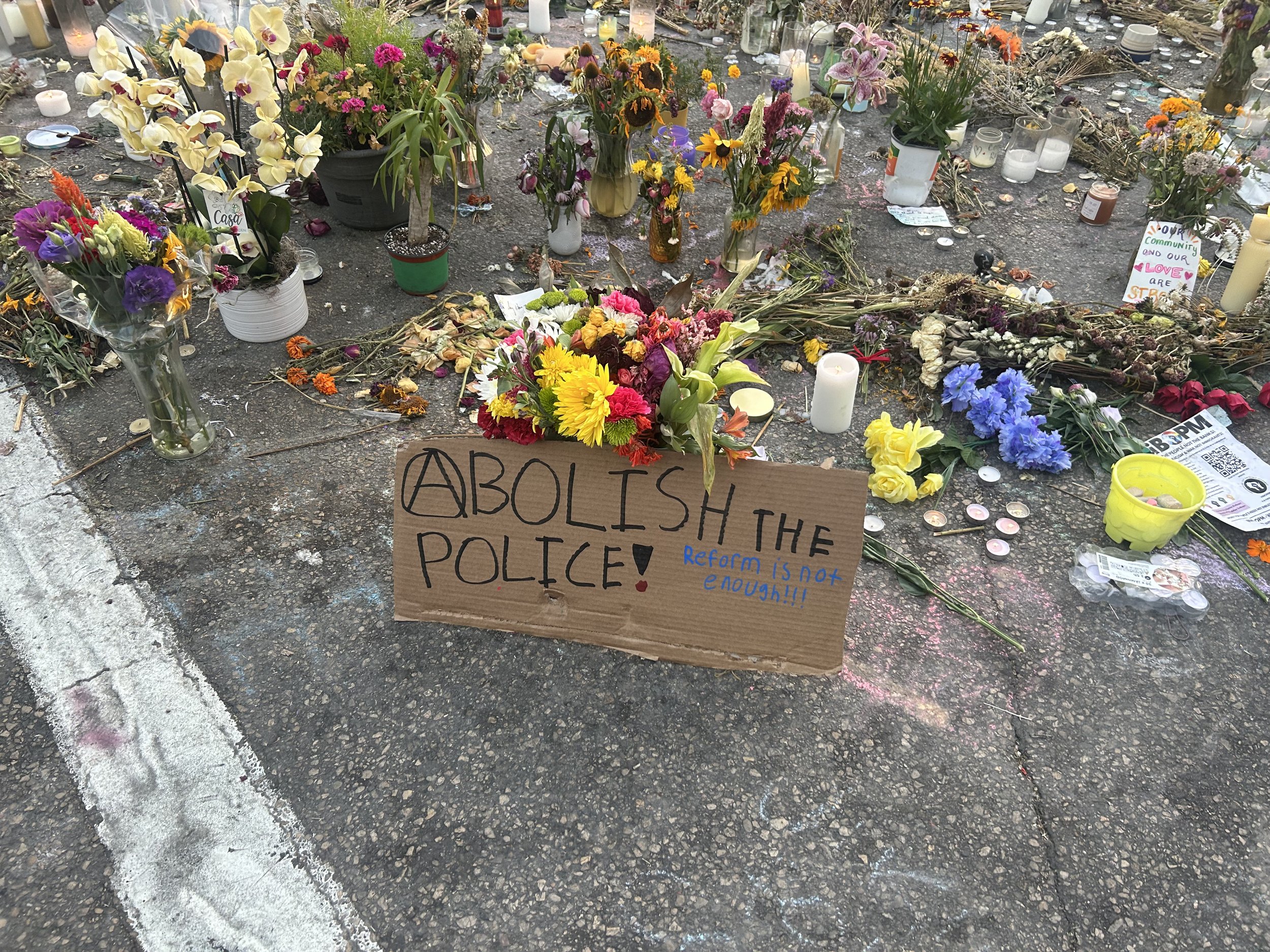
Photo submitted by Elias Callen.
In July of this year, Madison police shot and killed a man at the intersection of Williamson and Baldwin street, in broad daylight, not unlike the muder of George Flyod in 2020, or Tony Robinson in 2015. What has been significantly different however, was the response of the general public in the wake of the incident because of the fact that Corey Ruiz was armed. He had a knife, and he was going to use it to defend himself. This fact deterred a large portion of liberals who otherwise would have been sympathetic to abolitionist calls for the control of police, as they have been in the past, from showing any kind of support for the man they watched get shot by the police. Ruiz was not the victim that congressional Democrats can get behind: he had a criminal record, he struggled with drug addiction, and he was armed.
Politicians in Congress, and the ones we are supposed to be excited to vote for this coming November, have danced around a condemnation of the incident in any serious capacity, at most floating the idea of reforms or spending on training and body cameras. Democratic candidate for governor David Crowley stated, “We got to figure out ways that we put policies, procedures, and standard operating procedures in place that, you know, stops these things from happening in the future.” 1 But how many reform bills will have to be passed before murders of the homeless by police actually stop? These reform packages that attempt to make the police a more friendly force of wanton violence have consistently shown to have little or no effect on diminishing violent encounters.
Since the 2020 murder of George Floyd, over 3,000 bills focused on police reform have passed across all 50 states. 2 Yet, even after these reforms passed, police killings still increased by 10.44% when compared to the six year period between 2014 and 2020. 3 Reforms are not targeted at creating equitable or less dangerous police force, because they refuse to address the fact that those killed by police are regularly victims that the establishment deems unworthy of sympathy. They are often the homeless and drug addicts, who might have criminal records or are not mentally stable. The police simply cannot address these issues in their current (or future) form, and attempting to bend and break a system that was not designed to serve the people cannot go any further towards a just society. It should not be a surprise to people that Ruiz carried a knife with him, as homeless populations are far more vulnerable than those who have permanent residentancy. On average homeless people have a life expectancy of only 48, and experience violent crime at a rate 25 times higher than the general public. 4 Yet still the unhoused face further dehumanization when they choose to arm themselves against these circumstances; something that any other American has the right to do, and even is encouraged to do by the same politicians who denounced Ruiz as a senseless criminal.
The system of policing intentionally targets and violates the most vulnerable communities in the U.S., not through a series of practices nor becasue of “bad apple” cops, as reformists suggest, but innately as a part of the system of policing. Before direct violence can even be done onto a community, the victims of police violence are already determined to be not worth defending; such is the reason that the police exist there in the first place instead of affordable homes, free healthcare, and schools. As a collective, we seem to be holding our breath, waiting for someone to be slaughtered by the police who is of the highest moral quality, completely untouched by the painful reality of generational poverty and what it takes to survive as the undercast in the U.S. We want them to be innocent and unarmed, and also free from drugs, and to never have had a conviction, but these qualities should not undermine our ability to sympathize and support victims of structural state violence. In fact, outrage should be all the more expected when someone who is precisely so imperfect and flawed is murdered, because the chances for redemption and growth that this country claims to uphold were stripped away from them. That is the cognitive dissonance of the criminal-legal system, and why no victim of police brutality will ever be a good enough example for mainstream politicians to get behind abolition.
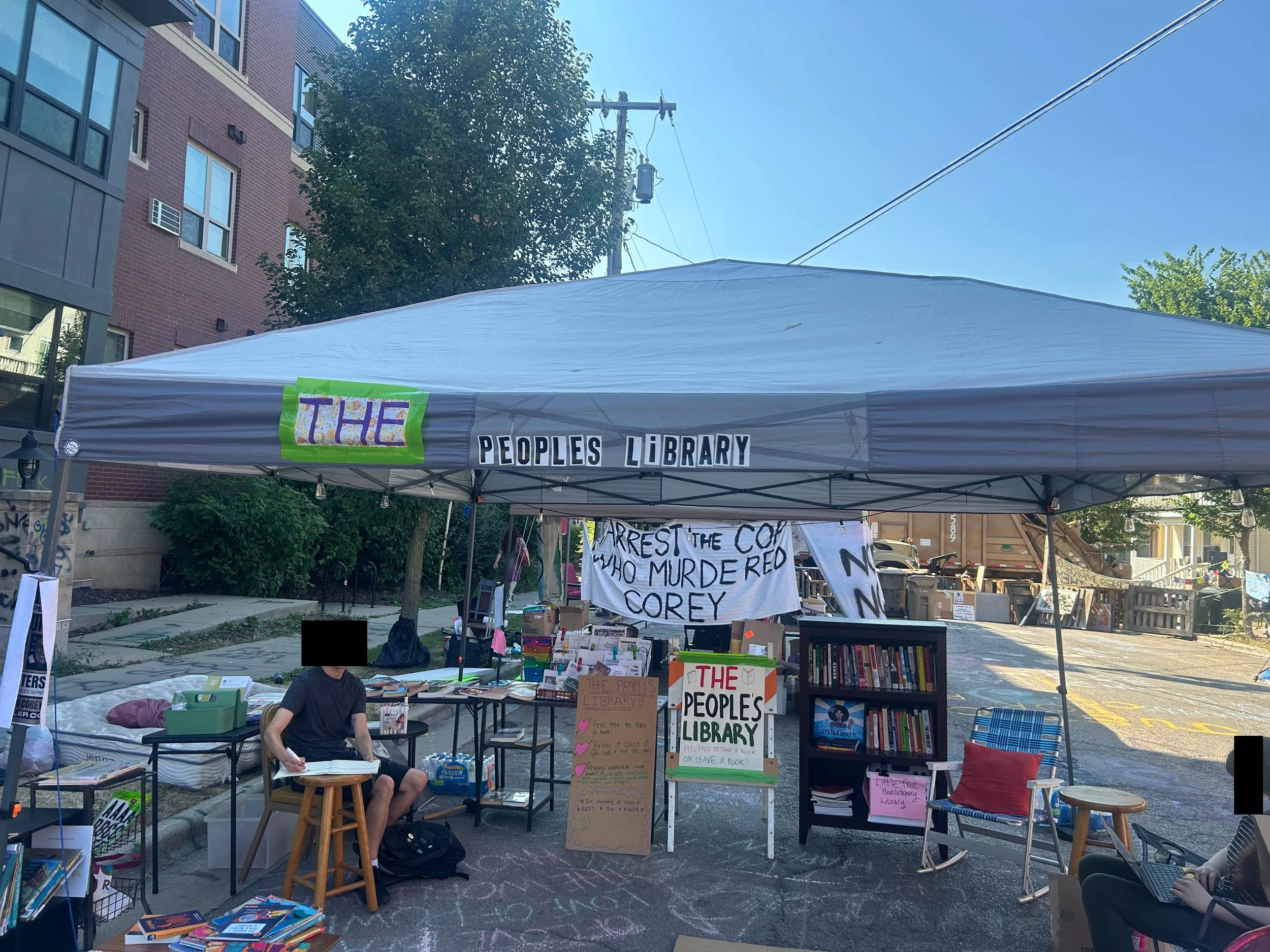
“The People’s Library” at the encampment in Madison, WI. Photo submitted by Elias Callen
With the killing of Corey Ruiz, this kind of rhetoric that qualifies only the most divine and perfect individuals for sympathy has been almost cruelly blatant. Following the incident, a barricaded zone was created at the intersection, which guarded the vigil and gave the community a space to grieve and share a connection with each other. After only two weeks following the killing, Democratic mayor Satya Rhodes-Conway dispatched the police to open the intersection and displace the activists and community members gathered there, citing that “[It] did transition quickly from what I would describe as a protest or a vigil to an encampment,” and that “It was clear that the situation was increasingly dangerous for everybody…” 5 During my time spent there, which amounted in total to about 12 hours unevenly spread over the course of three days, the most violent act that I witnessed was a white counterprotester storming through the barricades, punching a man in the head, and stomping on the vigil before the crowd could chase him out. 6 Otherwise the community and people there were both welcoming and providing. There was free food for all, a small library set up to distribute literature and political theory for free, and many tents to keep people cool from the blazing July sun. But for the state, that does not matter. The way the community was coming together to collectively resist and mourn the loss of someone, despite the fact that he was an imperfect victim, threatened the state's control through policing.
To play the moral grim reaper, deciding whose death is worthy of outrage and whose death we can pass on as less deserving fundamentally undermines any calls for liberation and justice. The system will not defend us from the police, and to wait for the perfect victim to rally behind actively slows down the movement. Perfection is a luxury that the working class, and all oppressed peoples, cannot afford.
Sources
Candidates for Wisconsin governor react to Madison shooting - WPR
Mortality among the homeless: Causes and meteorological relationships - PMC
*This number comes from the Σ police murders 2020-2026 -Σ police murders 2014-2020Σ police murders 2014-2020100=~10.44%